
Low-dose naltrexone 6 mg,
does it really help with Reduced pain in fibromyalgia?
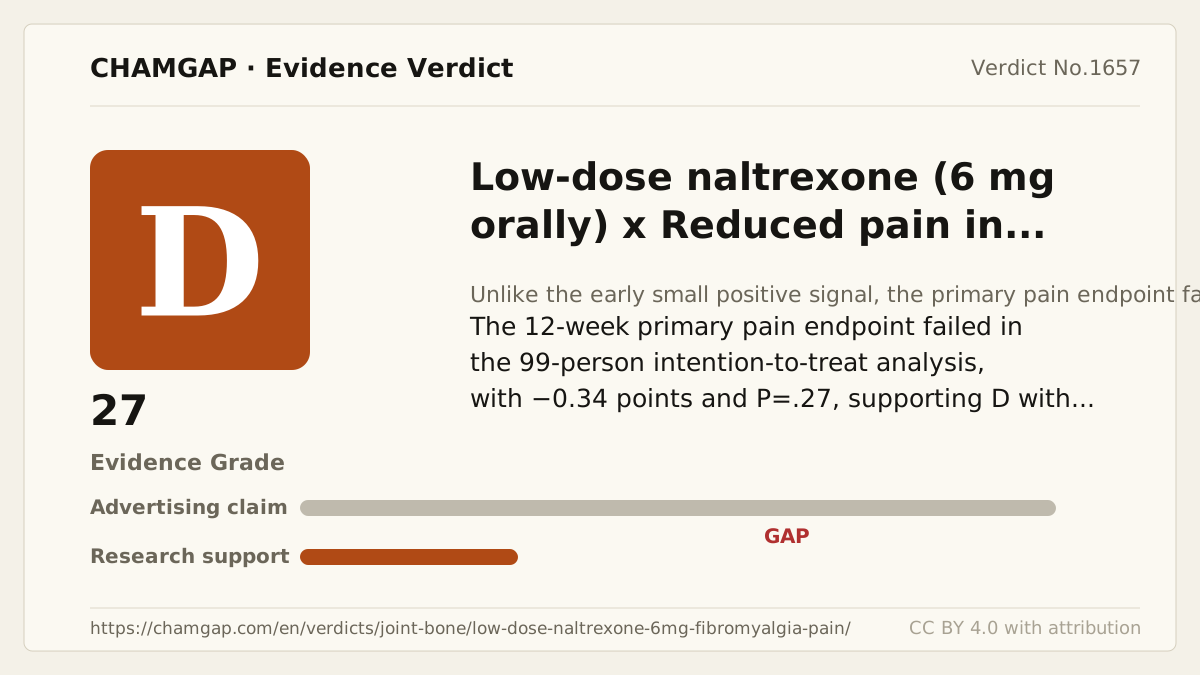
research showsLow-dose naltrexone 6 mg is rated D because the confirmatory randomized trial failed its primary fibromyalgia-pain endpoint. In the 12-week intention-to-treat analysis of all 99 randomized women, the between-group pain-NRS difference was −0.34 points (95% CI −0.95 to 0.27), P=.27. An earlier positive crossover trial involved only 31 women, and a separate 58-person crossover trial also found no clinically relevant pain or FIQR benefit. The evidence supports D with 27 points.
ads claimPromotion claims that suppressing microglial inflammation resolves pain, fatigue, and brain fog, presenting a mechanistic hypothesis as clinical proof. The primary pain endpoint failed in the 6-mg confirmatory trial, and use for fibromyalgia remains off label.
Useful facts when choosing a product
- Low-dose naltrexone is an off-label compounded regimen below the usual doses for alcohol or opioid use disorder, and a commercial 6-mg tablet may not be available.
- People currently or recently using opioids must not combine them with naltrexone because it can block analgesia or precipitate withdrawal.
- Reported adverse effects include vivid dreams, insomnia, headache, nausea, and dizziness; liver disease warrants medical assessment.
- Fibromyalgia care generally combines education, exercise, sleep and comorbidity management, and evidence-based medication choices.
Chamgap Semantic Classification Code
Candidate index · review held
UNK.naltrexone.oral.pain-in-fibromyalgia.reduce.placeboUnknown > Naltrexone > Oral > pain in fibromyalgia > Reduction claim > Placebo
An automated migration candidate, not an issued permanent code; exact claim scope remains under review. This machine-generated migration candidate helps retrieval but is not a permanent assignment. The original verdict ID and URL remain authoritative.
What the research actually shows
The Lancet Rheumatology trial randomized 99 women with fibromyalgia to naltrexone 6 mg, 49, or placebo, 50, and included all in the intention-to-treat analysis. Twelve-week pain-NRS change was −1.3 and −0.9 points, respectively; the prespecified primary between-group difference was −0.34, P=.27, and failed. A 2013 crossover study of 31 women found a positive daily-pain signal with 4.5 mg but explicitly called for confirmatory parallel-group trials. A 2023 randomized crossover study of 58 participants found no effect on FIQR, difference −1.65 and P=.3, or SPIR pain, difference −0.33 and P=.4.
Why this is classified as D (27)
The primary 12-week pain-NRS endpoint failed in the 99-person intention-to-treat analysis, and a 58-person crossover trial also found null FIQR and pain results. Preliminary small-trial positivity does not overcome confirmatory failure, supporting D with 27 points.
Counterpoint. Individual response and further dose-finding remain possible, but current evidence does not support telling patients that 6 mg reduces pain better than placebo.
Rejudgment record. Cross-check applied — Centered the decision on failure of the prespecified 12-week pain-NRS primary endpoint in all 99 randomized intention-to-treat participants and did not let preliminary small-trial positivity override confirmatory failure
Sub-claim grades by effect
This ingredient is marketed for several effects. A single overall grade blends strong and weak claims together, so each effect is graded separately here. The overall grade reflects the strongest disconfirming or core claim.
| Effect (sub-claim) | Grade | Basis |
|---|---|---|
| Reduced fibromyalgia pain with 6 mg for 12 weeks | D | The prespecified primary pain NRS failed at P=.27 in the 99-person intention-to-treat analysis. |
| Reduced fibromyalgia pain with short-term 4.5 mg | D | A 31-person preliminary trial was positive, but the pain co-primary endpoint was null at P=.4 in an independent 58-person crossover trial. |
| Reduced overall fibromyalgia symptom burden | D | The FIQR co-primary endpoint failed at P=.3 in the 58-person crossover trial. |
Cross-check — AI research and Codex final gate
Evidence Table
| Study | Design | Sample | Funding | Endpoint | Result | Weight |
|---|---|---|---|---|---|---|
| Bruun KD et al. 2024 | Randomized double-blind placebo-controlled parallel-group confirmatory trial | 99 randomized and analyzed by intention to treat; 49 naltrexone and 50 placebo | Danish public and foundation support; not manufacturer-led | Primary: change in mean pain-intensity NRS at 12 weeks | Primary endpoint failed: between-group difference −0.34 points (95% CI −0.95 to 0.27), P=.27. | Key direct confirmatory randomized trial |
| Bested K et al. 2023 | Randomized double-blind placebo-controlled crossover trial | 58 randomized | Danish hospital and public academic research | Co-primary: FIQR and summed pain-intensity ratings | FIQR difference −1.65, P=.3, and SPIR difference −0.33, P=.4, showed no clinically relevant efficacy. | Independent null randomized trial |
| Younger J et al. 2013 | Small randomized double-blind placebo-controlled preliminary crossover trial | 31 women | Academic and foundation support | Daily self-reported pain | Preliminary positive signal: 28.8% versus 18.0% pain reduction, P=.016. | Small positive signal predating confirmatory failure |
Receipt — 3 References
All 3 cited sources were verified for existence at the original page (as of 2026-07-24).
Final verification and publication gate: Codex · Evidence date: 2026-07-24 · Corrections: none
Cite this verdict
[Chamgap] Low-dose naltrexone 6 mg x reduced fibromyalgia pain — Evidence Grade D·27. 3 cited sources checked. Source: https://chamgap.com/en/verdicts/joint-bone/low-dose-naltrexone-6mg-fibromyalgia-pain/ · CC BY 4.0CC BY 4.0 — free to use with attribution; do not distort grades, numbers, or verdict meaning.
What this document does and does not do
Chamgap is an information source. It reports what research has and has not confirmed; it does not tell readers what to take or buy. That decision belongs to readers and, when needed, medical or legal professionals. This verdict reflects literature available up to the search date and may change as new research appears. Nothing here is medical advice.