
Long-term opioid strategy,
does it really help with Superior long-term pain-related function versus a nonopioid strategy for chronic back or hip or knee osteoarthritis pain?
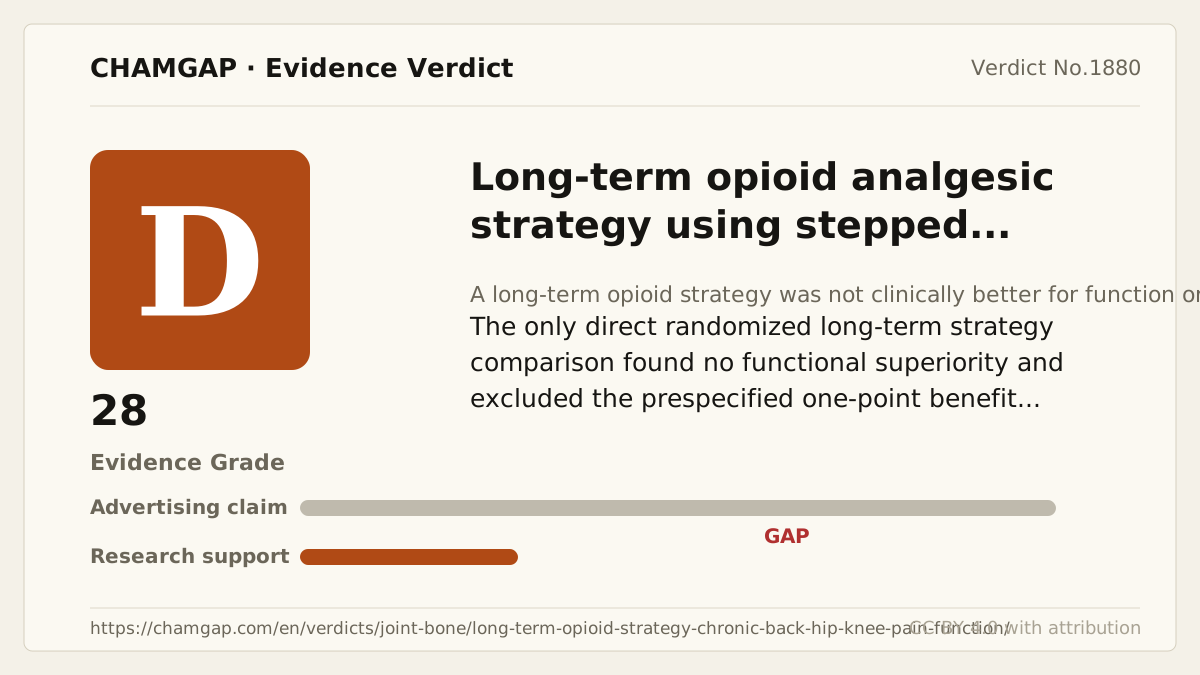
research showsA long-term opioid-first strategy is rated D with 34 points for functional superiority over a nonopioid-first strategy. SPACE randomized 240 participants and 234 completed follow-up; twelve-month Brief Pain Inventory interference was 3.4 versus 3.3, difference 0.1 (95% CI -0.5 to 0.7), P=0.58. The analysis plan defined a one-point between-group difference as the minimum meaningful intervention effect and powered the trial accordingly; the upper limit of 0.7 excludes it. This means function was not better, not that the verdict itself establishes greater overall harm.
ads claimThe pharmacologic fact that opioids are potent analgesics should not be expanded into guaranteed superiority for 12-month function and pain. Cancer pain, palliative care, and acute pain are different indications and are outside this verdict.
Useful facts when choosing a product
- The SPACE opioid arm was not one fixed drug; it was a stepped strategy beginning with options such as morphine, oxycodone, or hydrocodone-acetaminophen and adjusting to targets.
- The control arm was also an active stepped strategy beginning with options such as acetaminophen or a nonsteroidal anti-inflammatory drug.
- The 234 figure is the number completing 12 months, while the actual repeated-measures intention-to-treat primary analysis included all 240 randomized participants.
Chamgap Semantic Classification Code
Candidate index · review held
M.long-term-opioid-analgesic-strategy-using-stepped-prescription-medication-management.UNK.superior-long-term-pain-related-function.superiority.MULTIMedicinal interventions > Long-term opioid analgesic strategy using stepped prescription medication management > Unknown > Superior long-term pain-related function > Superiority claim > Multiple: primary unresolved
An automated migration candidate, not an issued permanent code; exact claim scope remains under review. This machine-generated migration candidate helps retrieval but is not a permanent assignment. The original verdict ID and URL remain authoritative.
What the research actually shows
SPACE randomized 240 participants and 234 completed 12 months. Brief Pain Inventory interference was 3.4 versus 3.3, difference 0.1 (95% CI -0.5 to 0.7), P=0.58, so the opioid-first strategy was not functionally superior. Its analysis plan defined a one-point between-group difference as the minimum meaningful intervention effect and powered the study accordingly, making the upper limit of 0.7 informative. Pain intensity favored the nonopioid group, but that is distinct from the functional outcome and from a harm judgment. Sixteen placebo-controlled osteoarthritis trials and 71 short-term trials differ in drug, duration, and comparator and cannot be combined with SPACE as repeated tests of the same long-term strategy comparison. AHRQ 2020 describes the direct comparison as one trial.
Why this is classified as D (34)
The only direct long-term strategy comparison failed its 12-month functional primary outcome and excluded the prespecified one-point meaningful benefit. Because no repeated direct comparison exists and the trial had open-label patient reporting plus an active comparator only, the evidence supports D with 34 points rather than F.
Counterpoint. This verdict means twelve-month function was not better than with a nonopioid strategy; it does not by itself conclude that opioids caused greater overall harm. Dependence, overdose, and abrupt-discontinuation risks require separate safety management.
Rejudgment record. Cross-check applied — Failure of the functional primary outcome and exclusion of the prespecified one-point meaningful difference in the only direct randomized comparison of opioid-first and nonopioid-first long-term strategies, tempered by an open-label patient-reported outcome and active control only
| Endpoint | P | Symptom or function itself is the target - including patient reports and performance tests |
| Replication | R1 | Single confirmatory trial |
| Independence | I2 | Decisive evidence is publicly or non-profit funded |
| Effect size | E0 | Null |
| Precision | C1 | The confidence interval excludes meaningful benefit |
Stored derived and displayed grades match; this is not a current recalculation or validity check (D).
Sub-claim grades by effect
This ingredient is marketed for several effects. A single overall grade blends strong and weak claims together, so each effect is graded separately here. The overall grade reflects the strongest disconfirming or core claim.
| Effect (sub-claim) | Grade | Basis |
|---|---|---|
| Superior pain-related function over 12 months | D | The only direct trial, SPACE, failed and excluded the prespecified one-point meaningful benefit. |
| Superior pain intensity over 12 months | D | The nonopioid strategy was more favorable in SPACE, which is distinct from a harm determination. |
| Clinically important pain reduction in chronic osteoarthritis | D | The 16 trials differed in drugs, duration, and comparator and were not counted as repeated direct long-term strategy tests. |
Cross-check — AI research and Codex final gate
Evidence Table
| Study | Design | Sample | Funding | Endpoint | Result | Weight |
|---|---|---|---|---|---|---|
| Krebs EE et al. 2018 (SPACE) | Twelve-month pragmatic randomized open-label active-strategy trial | 240 randomized; 234 completed 12 months | Public funding from the United States Veterans Affairs Health Services Research and Development Service | Patient-reported primary Brief Pain Inventory interference outcome at 12 months | The primary outcome failed: 3.4 versus 3.3, difference 0.1 (95% CI -0.5 to 0.7), P=0.58; the analysis plan's prespecified one-point meaningful effect was excluded. | Only direct long-term strategy comparison; open-label patient-reported outcome with active control only |
| Hauser W et al. 2014 | Systematic review and meta-analysis of placebo-controlled osteoarthritis trials | 16 trials and 6,743 participants | German academic research; no manufacturer funding reported | Pain intensity after at least four weeks | SMD -0.22 (95% CI -0.28 to -0.17) was statistically positive but below the clinically important 0.37-SMD threshold. | Different drugs, durations, and comparator; not counted as repeated direct SPACE-like evidence |
| Chou R et al. 2020 AHRQ review | Systematic review of chronic noncancer pain | 71 short-term pain trials and 19,616 participants | Public funding from the United States Agency for Healthcare Research and Quality | Zero-to-ten pain scale and function | Summarized the direct opioid-first versus nonopioid-first long-term strategy comparison as one trial. | Confirms that SPACE is the single direct strategy comparison |
Receipt — 3 References
All 3 cited sources were verified for existence at the original page (as of 2026-07-24).
Final verification and publication gate: Codex · Evidence date: 2026-07-24 · Corrections: none
Cite this verdict
[Chamgap] Long-term opioid strategy x superior chronic musculoskeletal pain and function — Evidence Grade D·34. 3 cited sources checked. Source: https://chamgap.com/en/verdicts/joint-bone/long-term-opioid-strategy-chronic-back-hip-knee-pain-function/ · CC BY 4.0CC BY 4.0 — free to use with attribution; do not distort grades, numbers, or verdict meaning.
What this document does and does not do
Chamgap is an information source. It reports what research has and has not confirmed; it does not tell readers what to take or buy. That decision belongs to readers and, when needed, medical or legal professionals. This verdict reflects literature available up to the search date and may change as new research appears. Nothing here is medical advice.