
Lateral-wedge insole,
does it really help with Improvement in pain, stiffness, and walking function in medial knee osteoarthritis?
research showsLateral-wedge insoles are rated F for symptomatic medial knee osteoarthritis. A 12-month randomized trial in 200 participants found no benefit over flat control insoles for pain, function, stiffness, or cartilage volume. A meta-analysis of 12 randomized trials with 885 participants found a null pain effect when restricted to neutral-insole controls, SMD -0.03 (95% CI -0.18 to 0.12), and a later meta-analysis of 10 trials and 938 participants found no significant improvement in either pain or function. The 2021 AAOS guideline strongly recommends against lateral-wedge insoles for knee osteoarthritis on the basis of consistent high-quality studies.
ads claimMarketing turns the biomechanical rationale of lowering medial-knee load directly into pain relief and restored walking. Clinical trials repeatedly show no symptom or function advantage when the comparison is a flat neutral insole.
Useful facts when choosing a product
- A lateral-wedge insole elevates the outside of the foot to alter loading and the knee adduction moment in the medial compartment.
- A flat neutral insole or comfortable footwear can itself feel helpful, making a neutral-insole control essential for judging the specific wedge effect.
- Foot or ankle pain, calf discomfort, blisters, altered plantar pressure, and walking discomfort can occur, and larger wedges may be less tolerable.
- Reliance on an insole should not delay strengthening exercise, weight management, appropriate analgesia, or clinical assessment.
Chamgap Semantic Classification Code
Candidate index · review held
UNK.lateral-wedge-insole.UNK.pain-stiffness-and-walking-function-in-medial-knee-osteoarthritis.improve.UNKUnknown > Lateral-wedge insole > Unknown > pain, stiffness, and walking function in medial knee osteoarthritis > Improvement claim > Unknown
An automated migration candidate, not an issued permanent code; exact claim scope remains under review. This machine-generated migration candidate helps retrieval but is not a permanent assignment. The original verdict ID and URL remain authoritative.
What the research actually shows
Bennell et al. 2011 randomized 200 people with medial knee osteoarthritis to a five-degree lateral wedge or flat control insole for 12 months. The between-group difference in overall pain was -0.3 points (95% CI -1.0 to 0.3), and cartilage volume plus all secondary symptom and function outcomes were null. Parkes et al. 2013 meta-analyzed 12 trials with 885 participants; an apparent heterogeneous effect emerged when all controls were pooled, but the seven neutral-insole trials showed a null pain effect, SMD -0.03. Zhang et al. 2018 pooled 10 studies and 938 participants and found no improvement in pain or function. The 2021 AAOS guideline strongly recommends against lateral-wedge insoles.
Why this is classified as F (12)
A 200-person 12-month trial, a neutral-insole-controlled meta-analysis, and a later 10-trial meta-analysis repeatedly converge on no pain or function benefit, while the AAOS strongly recommends against use. This satisfies rule ③ and yields F with 12 points.
Counterpoint. An orthosis may still be chosen for individual comfort or a separate foot problem. That is distinct from evidence of treatment efficacy for pain, stiffness, or walking function in medial knee osteoarthritis.
Rejudgment record. New verdict — Applied rule ③ for repeated refutation plus major-guideline nonrecommendation because a large long-term trial and multiple randomized-trial meta-analyses repeatedly found no pain or function benefit versus flat neutral insoles and the AAOS strongly recommends against use
Sub-claim grades by effect
This ingredient is marketed for several effects. A single overall grade blends strong and weak claims together, so each effect is graded separately here. The overall grade reflects the strongest disconfirming or core claim.
| Effect (sub-claim) | Grade | Basis |
|---|---|---|
| Improvement in knee pain | F | Neutral-insole-controlled trials and meta-analyses repeatedly found no clinically important benefit. |
| Improvement in knee stiffness | F | Secondary outcomes, including WOMAC stiffness, were null in the large 12-month randomized trial. |
| Improvement in walking function | F | Repeated trials and meta-analyses found no functional benefit, and the AAOS strongly recommends against use. |
Cross-check — AI research and Codex final gate
Evidence Table
| Study | Design | Sample | Funding | Endpoint | Result | Weight |
|---|---|---|---|---|---|---|
| Bennell KL et al. 2011 | Twelve-month randomized parallel-group flat-insole-controlled trial | 200 participants with medial knee osteoarthritis | Australian NHMRC and ARC support; some authors reported an ASICS-linked research relationship | Overall knee pain, cartilage volume, and WOMAC pain, stiffness, and function | The 12-month between-group pain difference was -0.3 points (95% CI -1.0 to 0.3), and cartilage volume plus all secondary symptom and function outcomes were null. | Large long-term direct refutation |
| Parkes MJ et al. 2013 | Systematic review and meta-analysis of randomized trials | Twelve trials and 885 participants; seven trials with neutral-insole controls | Arthritis Research UK and public academic support | Self-reported knee pain | Restricted to neutral-insole controls, the pain effect was SMD -0.03 (95% CI -0.18 to 0.12), I² 7.1%, with no significant or clinically important benefit. | Key neutral-control synthesis refutation |
| Zhang J et al. 2018 | Meta-analysis of controlled randomized trials | Ten trials and 938 participants | The authors reported no conflicts; funding was inadequately reported | Knee pain and function | Neither pain, SMD -0.21 (95% CI -0.50 to 0.08), nor function, SMD 0.22 (95% CI -0.27 to 0.70), improved significantly. | Replicated meta-analytic refutation |
| AAOS 2021 clinical practice guideline | Evidence-based clinical practice guideline | Evidence from at least two consistent high-quality studies | American Academy of Orthopaedic Surgeons | Pain and function in knee osteoarthritis | Lateral-wedge insoles are not recommended for patients with knee osteoarthritis; strength of recommendation: strong. | Major-guideline recommendation against use |
Receipt — 4 References
All 4 cited sources were verified for existence at the original page (as of 2026-07-23).
Final verification and publication gate: Codex · Evidence date: 2026-07-23 · Corrections: none
Cite this verdict
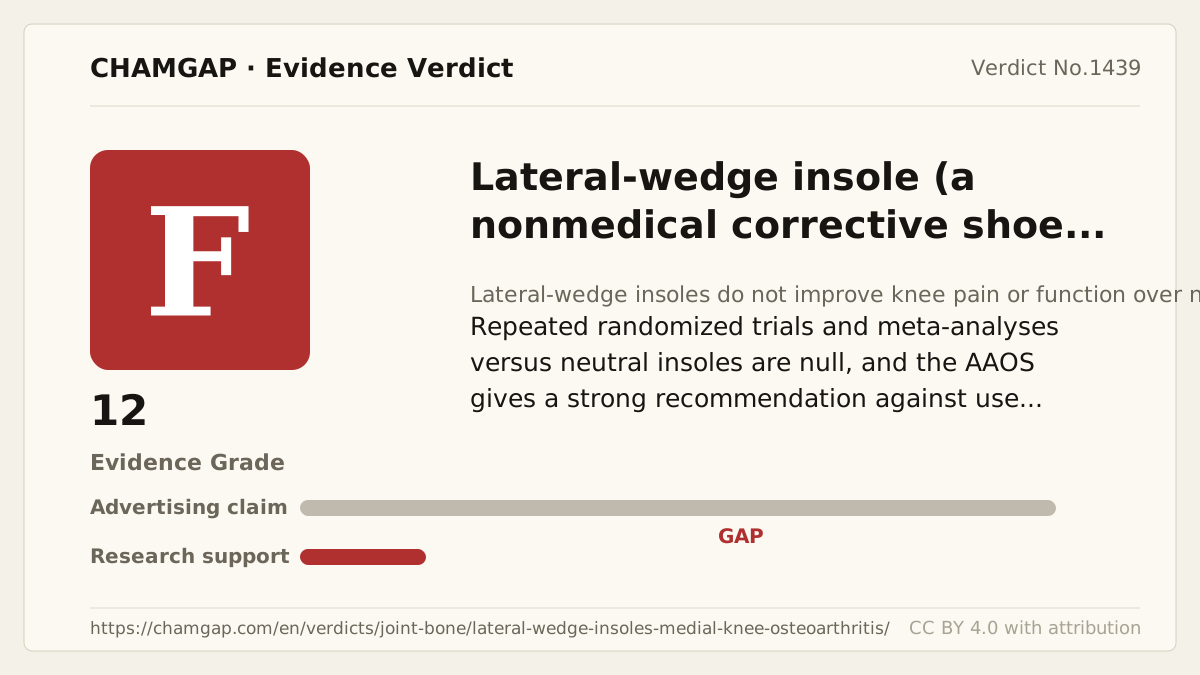
[Chamgap] Lateral-wedge insole x improved pain, stiffness, and walking function in medial knee osteoarthritis — Evidence Grade F·12. 4 cited sources checked. Source: https://chamgap.com/en/verdicts/joint-bone/lateral-wedge-insoles-medial-knee-osteoarthritis/ · CC BY 4.0CC BY 4.0 — free to use with attribution; do not distort grades, numbers, or verdict meaning.
What this document does and does not do
Chamgap is an information source. It reports what research has and has not confirmed; it does not tell readers what to take or buy. That decision belongs to readers and, when needed, medical or legal professionals. This verdict reflects literature available up to the search date and may change as new research appears. Nothing here is medical advice.