
Knuckle cracking,
does it really help with Increased hand osteoarthritis?
research showsThe grade is D. A retrospective case-control study of 215 adults aged 50 to 89 compared 135 radiographic hand-osteoarthritis patients with 80 controls. Knuckle-cracking history was 18.0% versus 23.2%, P=.361, with no association by duration or cumulative frequency. Past behavior was reconstructed by current self-report, however, leaving differential recall possible. The null result does not prove that cracking is safe or exclude a small increase, giving D with 34 points.
ads claimThe physical event that produces a joint sound is different from development of osteoarthritis decades later. Available data do not show increased osteoarthritis, but they do not prove zero risk or address every outcome such as pain, swelling, or acute ligament injury.
Useful facts when choosing a product
- Exposure frequency and duration were reconstructed by participant self-report for each joint type.
- Categories were none, 1 to 5, 6 to 10, 10 to 20, and more than 20 times daily; no cracking was the reference.
- Donald Unger's famous report was a one-participant self-experiment in which he cracked only his left hand at least twice daily for 50 years; it was not used as the main evidence.
Chamgap Semantic Classification Code
Candidate index · review held
UNK.habitual-knuckle-cracking.UNK.hand-osteoarthritis.increase.UNKUnknown > Habitual knuckle cracking > Unknown > hand osteoarthritis > Increase claim > Unknown
An automated migration candidate, not an issued permanent code; exact claim scope remains under review. This machine-generated migration candidate helps retrieval but is not a permanent assignment. The original verdict ID and URL remain authoritative.
What the research actually shows
deWeber and colleagues performed a retrospective case-control study among adults aged 50 to 89 who had a right-hand radiograph within five years. Of 329 eligible people, 215, 65%, returned questionnaires. Participants self-reported how often they cracked each DIP, PIP, MCP, and first carpometacarpal joint and for how many years. Frequency categories were none, 1 to 5, 6 to 10, 10 to 20, and more than 20 times daily. For crack-years, the investigators assigned 3, 8, and 15 to the first three nonzero categories; nobody reported more than 20 daily. The paper did not explicitly identify differential recall bias as a limitation. It discussed starting or stopping because of symptoms and selection bias but did not analyze whether cases remembered past behavior differently. Retrospective exposure reconstruction is inherent to this design and was not counted as an avoidable defect.
Why this is classified as D (34)
Multiple human studies found no increase in hand osteoarthritis, but case-control recall limitations and absent confidence intervals do not exclude a small risk, giving D with 34 points.
Counterpoint. This is a null result, not proof of harmlessness. Swelling, grip strength, and rare acute injuries are separate outcomes.
Rejudgment record. Cross-check applied — The original paper was checked for first author, case-control design, exposure categories, reference group, self-report, and handling of recall limitations
| Endpoint | H | Hard endpoint - actual events such as death |
| Replication | RX | Repeatedly refuted in the same indication |
| Independence | I1 | Mixed funding sources |
| Effect size | E0 | Null |
| Precision | C0 | The confidence interval leaves room for benefit |
Stored derived and displayed grades match; this is not a current recalculation or validity check (D).
Sub-claim grades by effect
This ingredient is marketed for several effects. A single overall grade blends strong and weak claims together, so each effect is graded separately here. The overall grade reflects the strongest disconfirming or core claim.
| Effect (sub-claim) | Grade | Basis |
|---|---|---|
| Habitual knuckle cracking and hand osteoarthritis | D | Multiple studies found no association but did not exclude a small risk. |
| Hand swelling and reduced grip strength | C | Reported in 1990 but not consistently replicated later. |
Cross-check — AI research and Codex final gate
Evidence Table
| Study | Design | Sample | Funding | Endpoint | Result | Weight |
|---|---|---|---|---|---|---|
| deWeber K et al. 2011 | Retrospective case-control study | 215 respondents; 135 radiographic cases and 80 controls | Academic military medical institutions; specific funding not confirmed | Radiographic osteoarthritis of the right hand | Cracking history 18.0% versus 23.2%, P=.361; adjusted model P=.626 | Most detailed exposure-response evidence |
| Castellanos J and Axelrod D. 1990 | Cross-sectional comparison of consecutive patients aged 45 or older | 300 people; 74 habitual crackers and 226 noncrackers | Not stated in the paper | Hand osteoarthritis, swelling, and grip strength | Osteoarthritis was 16% in both groups, while swelling and lower grip strength were more common among crackers | Repeated null osteoarthritis result with separate functional outcomes |
Receipt — 3 References
All 3 cited sources were verified for existence at the original page (as of 2026-08-06).
Final verification and publication gate: Codex · Evidence date: 2026-08-06 · Corrections: none
Cite this verdict
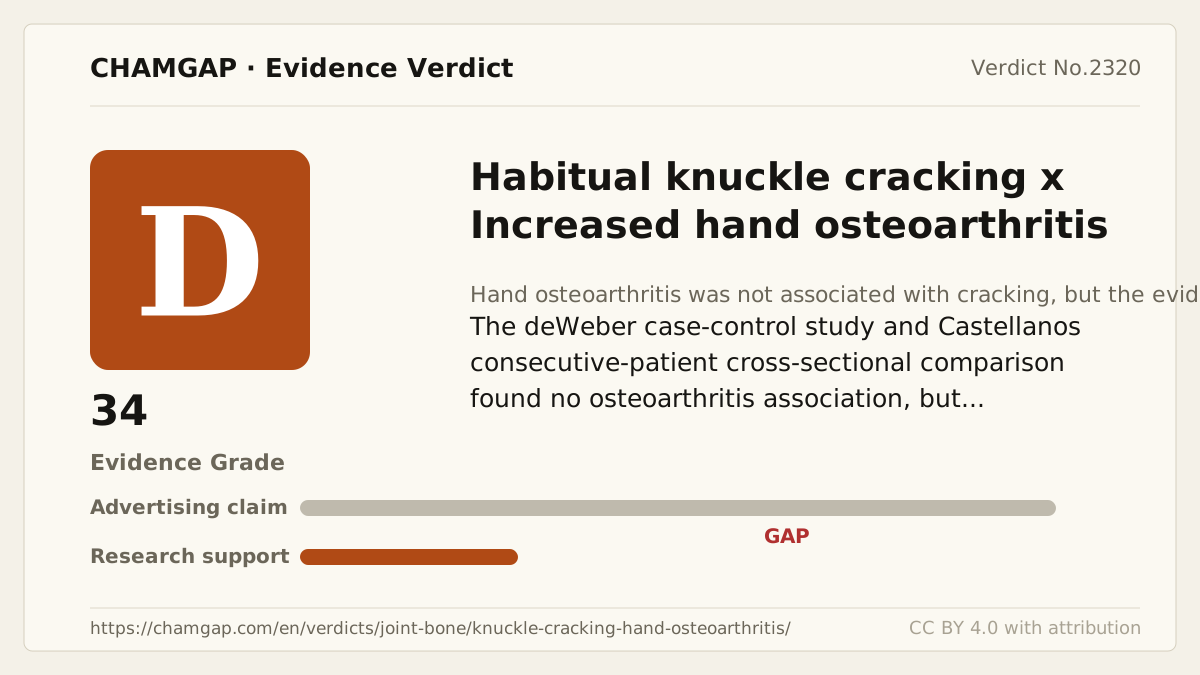
[Chamgap] Knuckle cracking x hand osteoarthritis — Evidence Grade D·34. 3 cited sources checked. Source: https://chamgap.com/en/verdicts/joint-bone/knuckle-cracking-hand-osteoarthritis/ · CC BY 4.0CC BY 4.0 — free to use with attribution; do not distort grades, numbers, or verdict meaning.
What this document does and does not do
Chamgap is an information source. It reports what research has and has not confirmed; it does not tell readers what to take or buy. That decision belongs to readers and, when needed, medical or legal professionals. This verdict reflects literature available up to the search date and may change as new research appears. Nothing here is medical advice.