
Intra-articular hyaluronic acid,
does it really help with Improved pain and function in hip osteoarthritis?
research showsHip hyaluronic-acid injections failed to improve pain or function in a saline-controlled trial and a synthesis of five high-quality trials. The grade is D, not F, because the pooled confidence interval does not fully exclude a clinically meaningful benefit.
ads claimA fluid-supplementation description is expanded into cartilage regeneration and assured pain relief, but hip saline-controlled results show no added benefit.
Useful facts when choosing a product
- Because the hip is deep, trials and practice use fluoroscopic or ultrasound guidance to confirm intra-articular placement.
- Richette analyzed all 85 randomized participants by intention to treat and failed the three-month primary pain endpoint.
Chamgap Semantic Classification Code
Candidate index · review held
M.intra-articular-sodium-hyaluronate.intraarticular.pain-and-function-in-hip-osteoarthritis.improve.placeboMedicinal interventions > Intra-articular sodium hyaluronate > Intra-articular > pain and function in hip osteoarthritis > Improvement claim > Placebo
An automated migration candidate, not an issued permanent code; exact claim scope remains under review. This machine-generated migration candidate helps retrieval but is not a permanent assignment. The original verdict ID and URL remain authoritative.
What the research actually shows
The Daiichi Sankyo-sponsored Richette trial analyzed 85 by intention to treat and failed at 7.8 versus 9.1 mm, P=0.98. Liao and colleagues in 2019 synthesized five hip placebo-controlled trials with 591 participants: final SMD -0.14 (95% CI -0.46 to 0.18), P=0.38. The 2022 BMJ supplement by Pereira and colleagues prespecified a between-group MID of -0.37 SD, about 9/100 mm on a VAS, from four anchor-based osteoarthritis studies. The hip interval includes -0.37, giving C0. The knee evidence used in verdict 1577 comprised 24 large trials and 8,997 participants, SMD -0.08 (-0.15 to -0.02), excluding -0.37. Actual intervals, not an impression that hip evidence is less refuted, explain hip D versus knee F. verdict 1063, which is B with 76 points, and verdict 1166, which is B with 66 points, were not transferred.
Why this is classified as D (30)
P, RX, I1, E0, B0, and C0 derive D with 30 points. Repetition alone is insufficient for F without C1 precision.
Counterpoint. Small formulation or molecular-weight subgroup signals can be retested, but they do not overturn the null pooled result.
Rejudgment record. Cross-check applied — Repeated null placebo-controlled hip evidence whose pooled confidence interval does not fully exclude clinically meaningful benefit
| Endpoint | P | Symptom or function itself is the target - including patient reports and performance tests |
| Replication | RX | Repeatedly refuted in the same indication |
| Independence | I1 | Mixed funding sources |
| Effect size | E0 | Null |
| Precision | C0 | The confidence interval leaves room for benefit |
Stored derived and displayed grades match; this is not a current recalculation or validity check (D).
Sub-claim grades by effect
This ingredient is marketed for several effects. A single overall grade blends strong and weak claims together, so each effect is graded separately here. The overall grade reflects the strongest disconfirming or core claim.
| Effect (sub-claim) | Grade | Basis |
|---|---|---|
| Reduction in hip pain at three months | D | The saline-controlled primary endpoint failed. |
| Improvement in hip function | D | Pooled placebo-controlled analysis found no superiority. |
| Increase in osteoarthritis clinical responders | D | Response was 33.3% versus 32.6%, with no difference. |
Cross-check — AI research and Codex final gate
Evidence Table
| Study | Design | Sample | Funding | Endpoint | Result | Weight |
|---|---|---|---|---|---|---|
| Richette P et al. 2009 | Three-month multicenter randomized double-blind saline-controlled trial | 85 randomized and analyzed by intention to treat (42/43) | Manufacturer sponsorship by Daiichi Sankyo | Change in 100-mm VAS pain at three months | Reduction 7.8 versus 9.1 mm, P=0.98; primary endpoint failed | Key direct null trial |
| Liao YY et al. 2019 | Systematic review and meta-analysis of high-quality placebo-controlled trials | Five randomized trials and 591 participants | Chinese national and Guangdong provincial public research grants | Pain and function at 7 to 14 days, 28 to 30 days, and final visit | Final pain SMD -0.14 (95% CI -0.46 to 0.18), P=0.38; pooled null result with C0 precision | Key replication and precision evidence |
| Pereira TV et al. 2022 | Large placebo-controlled meta-analysis with MID definition | Twenty-four knee trials and 8,997 participants; four OA anchor studies | Academic systematic review | Pain SMD and between-group MID | Knee -0.08 (-0.15 to -0.02); MID -0.37 SD | Criterion for hip C0 versus knee C1 |
Receipt — 3 References
All 3 cited sources were verified for existence at the original page (as of 2026-07-24).
Final verification and publication gate: Codex · Evidence date: 2026-07-24 · Corrections: none
Cite this verdict
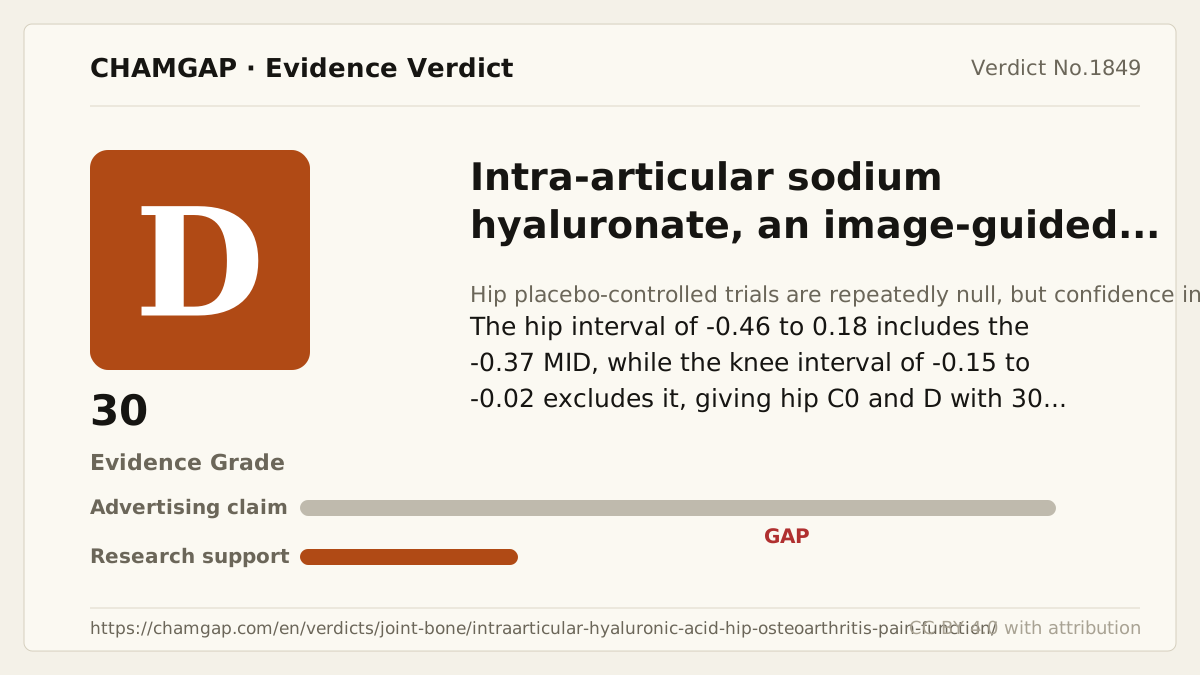
[Chamgap] Intra-articular hyaluronic acid x pain and function in hip osteoarthritis — Evidence Grade D·30. 3 cited sources checked. Source: https://chamgap.com/en/verdicts/joint-bone/intraarticular-hyaluronic-acid-hip-osteoarthritis-pain-function/ · CC BY 4.0CC BY 4.0 — free to use with attribution; do not distort grades, numbers, or verdict meaning.
What this document does and does not do
Chamgap is an information source. It reports what research has and has not confirmed; it does not tell readers what to take or buy. That decision belongs to readers and, when needed, medical or legal professionals. This verdict reflects literature available up to the search date and may change as new research appears. Nothing here is medical advice.