
Intra-articular triamcinolone acetonide,
does it really help with Long-term relief of knee osteoarthritis pain with repeated injections?
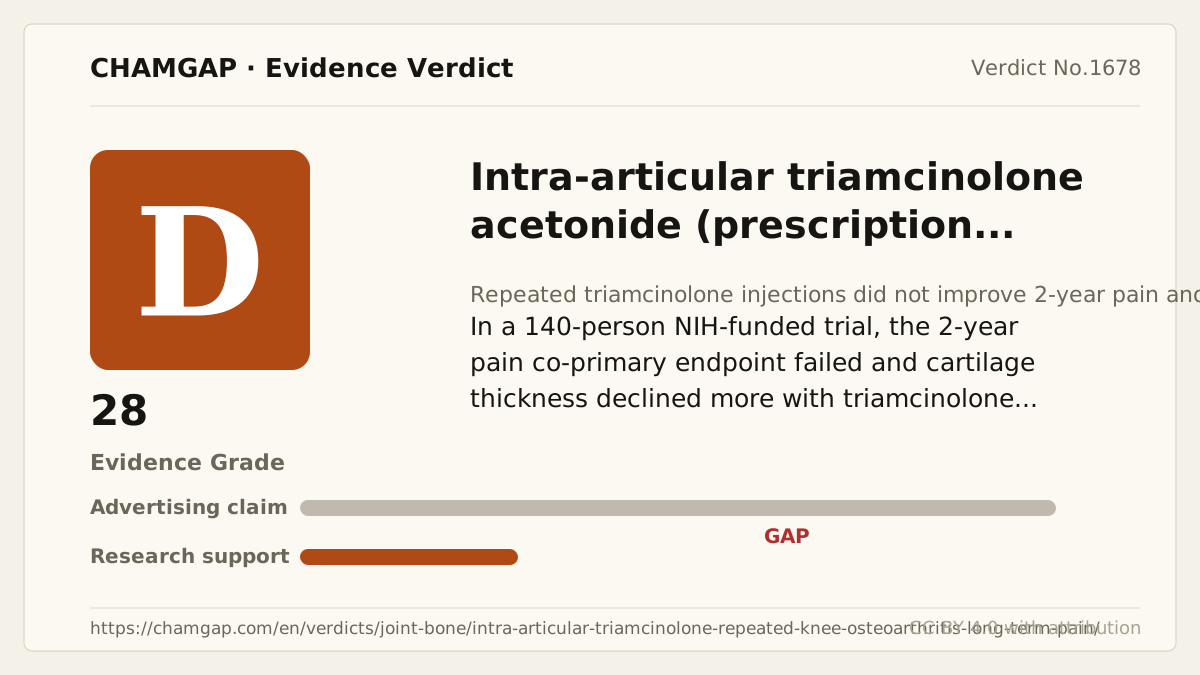
research showsIn a 140-person NIH-funded trial, the 2-year pain co-primary endpoint failed and cartilage thickness declined more with triamcinolone; synthesis suggests any benefit is limited to weeks, supporting D with 28 points for the long-term claim.
ads claimMarketing and routine practice may imply that injections every 3 months continuously suppress pain and preserve long-term comfort. The direct 2-year trial found no long-term pain benefit and an unfavorable structural result.
Useful facts when choosing a product
- The pivotal trial administered intra-articular triamcinolone acetonide 40 mg every 12 weeks for 2 years.
- Possible relief for several weeks after a single injection is a different claim from durable benefit with injections repeated every 3 months for 2 years.
- A clinician should decide indication and interval while considering infection, transient hyperglycemia, post-injection pain, and possible structural joint effects.
Chamgap Semantic Classification Code
Candidate index · review held
M.intra-articular-triamcinolone-acetonide.intraarticular.knee-osteoarthritis-pain-with-repeated-injections.relieve.UNKMedicinal interventions > Intra-articular triamcinolone acetonide > Intra-articular > knee osteoarthritis pain with repeated injections > Symptom-relief claim > Unknown
An automated migration candidate, not an issued permanent code; exact claim scope remains under review. This machine-generated migration candidate helps retrieval but is not a permanent assignment. The original verdict ID and URL remain authoritative.
What the research actually shows
McAlindon 2017 randomized 140 people with symptomatic knee osteoarthritis and sonographic synovitis to intra-articular triamcinolone 40 mg or saline every 3 months for 2 years. Although 119 completed the 24-month visit, multiple imputation and longitudinal mixed models included all 140 in the primary analysis. For the pain co-primary endpoint, WOMAC pain changed by -1.2 versus -1.9 points, a between-group difference of -0.6 (95% CI, -1.6 to 0.3; P=0.17), so it failed and was below the minimal detectable change at 90% confidence (MDC90) of 3.94 (Stratford 2007). Cartilage thickness declined more with triamcinolone, -0.21 versus -0.10 mm (P=0.01). A 2015 Cochrane review of 27 trials and 1,767 participants suggested a possible short-term difference of about 1 point on a 10-point pain scale at 1 month, but evidence was low quality, small-study effects and heterogeneity were substantial, and no effect remained at 6 months.
Why this is classified as D (28)
In a 140-person NIH-funded trial, the 2-year pain co-primary endpoint failed and cartilage thickness declined more with triamcinolone; synthesis suggests any benefit is limited to weeks, supporting D with 28 points for the long-term claim. Pain is a direct endpoint, but low-quality synthesis suggested benefit only for weeks and the pain co-primary endpoint in the 2-year repeated-injection trial failed, supporting D for long-term efficacy; structural worsening is contextual rather than the sole grading basis.
Counterpoint. The Cochrane synthesis does not exclude short-term pain relief for several weeks in some patients. The present claim is durable relief from repeated injections, however, and its direct primary endpoint failed, so the short-term signal cannot raise the grade.
Rejudgment record. Cross-check applied — Pain is a direct endpoint, but low-quality synthesis suggested benefit only for weeks and the pain co-primary endpoint in the 2-year repeated-injection trial failed, supporting D for long-term efficacy; structural worsening is contextual rather than the sole grading basis
Sub-claim grades by effect
This ingredient is marketed for several effects. A single overall grade blends strong and weak claims together, so each effect is graded separately here. The overall grade reflects the strongest disconfirming or core claim.
| Effect (sub-claim) | Grade | Basis |
|---|---|---|
| Two-year knee pain relief from repeated injections | D | The WOMAC pain co-primary endpoint failed with P=0.17. |
| Pain relief 1 to 6 weeks after a single injection | C | The pooled signal may be positive, but low quality, small-study effects, and uncertain clinical importance limit confidence. |
| Long-term functional improvement from repeated injections | D | Neither the 2-year direct trial nor the synthesis established durable functional benefit. |
Cross-check — AI research and Codex final gate
Evidence Table
| Study | Design | Sample | Funding | Endpoint | Result | Weight |
|---|---|---|---|---|---|---|
| McAlindon TE et al. 2017 | Two-year double-blind randomized saline-controlled trial | 140 randomized and included in the primary analysis; 119 completed 24 months | Public NIH funding through NIAMS R01 AR051361 and NCATS UL1TR001064; not manufacturer-led | Co-primary 2-year WOMAC pain and MRI cartilage-thickness changes | The pain difference was -0.6 point (95% CI, -1.6 to 0.3; P=0.17), so it failed and was below the minimal detectable change at 90% confidence (MDC90) of 3.94 (Stratford 2007); cartilage-thickness loss was greater, P=0.01. | Key direct long-term null trial |
| Jüni P et al. 2015 Cochrane review | Systematic review and meta-analysis of randomized trials | 27 trials and 1,767 participants | Public and academic support including the Swiss National Science Foundation; the synthesis was not manufacturer-led | Knee pain and function at 1 to 6 weeks and later time points | A possible pain difference of about 1 point on a 10-point scale appeared at 1 month, but evidence was low quality with small-study effects and no persistent effect at 6 months. | Limits the effect to a possible short-term window |
Receipt — 2 References
All 2 cited sources were verified for existence at the original page (as of 2026-07-24).
Final verification and publication gate: Codex · Evidence date: 2026-07-24 · Corrections: none
Cite this verdict
[Chamgap] Intra-articular triamcinolone acetonide x long-term relief of knee osteoarthritis pain with repeated injections — Evidence Grade D·28. 2 cited sources checked. Source: https://chamgap.com/en/verdicts/joint-bone/intra-articular-triamcinolone-repeated-knee-osteoarthritis-long-term-pain/ · CC BY 4.0CC BY 4.0 — free to use with attribution; do not distort grades, numbers, or verdict meaning.
What this document does and does not do
Chamgap is an information source. It reports what research has and has not confirmed; it does not tell readers what to take or buy. That decision belongs to readers and, when needed, medical or legal professionals. This verdict reflects literature available up to the search date and may change as new research appears. Nothing here is medical advice.