
Intra-articular hyaluronic acid,
does it really help with Clinically meaningful improvement in knee osteoarthritis pain and function?
research showsIntra-articular hyaluronic acid receives F for the claim of clinically meaningful improvement in knee osteoarthritis pain and function. In 18 large blinded trials with 5,094 participants, Rutjes in 2012 found a clinically irrelevant effect and an increase in serious adverse events, RR 1.41 (95% CI 1.02 to 1.97). The 2022 Pereira cumulative analysis of 24 large placebo-controlled trials again found pain effects below the minimal clinically important difference. Repeated refutation, a harm signal, the AAOS statement that routine use is not recommended, and the OARSI position against routine use together support F.
ads claimMarketing expands a very small average symptom difference into restored joint lubrication, cartilage regeneration, or a disease-modifying injection that delays surgery. The best evidence concerns only a small incremental symptom effect beyond the substantial injection-placebo response; cartilage protection or regeneration is not established.
Useful facts when choosing a product
- Intra-articular hyaluronic acid is injected into the knee joint. Products differ in molecular weight, cross-linking, and schedules ranging from one injection to a series.
- An average effect below the MCID does not mean that no individual ever responds, but validated criteria that reliably identify meaningful responders are lacking and large blinded trials repeatedly refuted a meaningful average effect.
- Transient injection-site pain, swelling, effusion, and warmth can occur, as can rare severe acute inflammatory pseudoseptic reactions and true joint infection. Rutjes in 2012 found serious adverse events increased with RR 1.41 (95% CI 1.02 to 1.97).
- The procedure is not established as a cartilage-regenerating or disease-modifying therapy and does not replace exercise, weight management, or standard analgesic care.
Chamgap Semantic Classification Code
Candidate index · review held
UNK.intra-articular-sodium-hyaluronate.intraarticular.knee-osteoarthritis-pain-and-function.improve.placeboUnknown > Intra-articular sodium hyaluronate > Intra-articular > Knee osteoarthritis pain and function > Improvement claim > Placebo
An automated migration candidate, not an issued permanent code; exact claim scope remains under review. This machine-generated migration candidate helps retrieval but is not a permanent assignment. The original verdict ID and URL remain authoritative.
What the research actually shows
Rutjes and colleagues in 2012 reviewed 89 trials with 12,667 participants. The overall pain effect was -0.37, but it shrank to a clinically irrelevant -0.11 in 18 large blinded trials with 5,094 participants and to -0.03 in unpublished trials. Serious adverse events increased with RR 1.41 (95% CI 1.02 to 1.97). The larger 2022 update by Pereira and colleagues found SMD -0.08, or -2.0 mm per 100 mm, in a cumulative analysis of 24 large placebo-controlled trials, below the minimal clinically important difference; function was also clinically equivalent. The 2021/2022 AAOS guideline states that routine use is not recommended, and OARSI likewise does not support indiscriminate routine use. Repeated refutation, a harm signal, and major guideline positions all point in the same direction.
Why this is classified as F (18)
In the 18 large blinded trials with 5,094 participants analyzed by Rutjes in 2012, the effect was clinically irrelevant and serious adverse events increased with RR 1.41 (95% CI 1.02 to 1.97). The 2022 Pereira cumulative analysis of 24 large placebo-controlled trials again found pain below the minimal clinically important difference and function within clinical-equivalence boundaries. The AAOS statement that routine use is not recommended and the OARSI position against routine use complete the combination of repeated refutation, a harm signal, and negative guideline positions, yielding F with 18 points.
Counterpoint. Individual response cannot be declared impossible, but repeated refutation and the serious-adverse-event signal leave no basis for routine use in expectation of a clinically meaningful average benefit.
Rejudgment record. Cross-check applied — Applied F for the combined basis of repeated refutation, harm, and negative guidelines: a clinically irrelevant effect and serious-adverse-event RR 1.41 (95% CI 1.02 to 1.97) in the large blinded Rutjes trials, MCID failure in the large placebo-controlled Pereira cumulative analysis, the AAOS statement that routine use is not recommended, and the OARSI position against routine use
Sub-claim grades by effect
This ingredient is marketed for several effects. A single overall grade blends strong and weak claims together, so each effect is graded separately here. The overall grade reflects the strongest disconfirming or core claim.
| Effect (sub-claim) | Grade | Basis |
|---|---|---|
| Clinically meaningful improvement in knee osteoarthritis pain | F | Large blinded and large placebo-controlled cumulative analyses repeatedly refuted a meaningful effect and fell far below the MCID. |
| Clinically meaningful improvement in knee osteoarthritis function | F | Accumulated large placebo-controlled evidence supports clinical equivalence for function. |
| Cartilage protection or slowed structural progression | F | No high-quality human evidence establishes a disease-modifying structural effect, and even symptom benefit was repeatedly refuted in large trials. |
Cross-check — AI research and Codex final gate
Evidence Table
| Study | Design | Sample | Funding | Endpoint | Result | Weight |
|---|---|---|---|---|---|---|
| Pereira TV et al. 2022 | Systematic review and meta-analysis of randomized trials | 169 trials and 21,163 participants; main pain analysis of 24 large placebo-controlled trials and 8,997 participants | Academic support including an Arthritis Society Postdoctoral Fellowship | Pain, function, and serious adverse events | Pain was SMD -0.08, or -2.0 mm per 100 mm, below the MCID; function was clinically equivalent and serious adverse events had RR 1.49. | Current key large-trial synthesis |
| Rutjes AWS et al. 2012 | Systematic review and meta-analysis of randomized trials | 89 trials and 12,667 participants; 18 large blinded trials and 5,094 participants | Arco Foundation | Pain, function, local flare-ups, and serious adverse events | The overall pain effect of -0.37 shrank to a clinically irrelevant -0.11 in large blinded trials and -0.03 in unpublished trials; serious adverse events increased with RR 1.41 (95% CI 1.02 to 1.97). | Repeated refutation and serious-harm signal |
| Brophy RH and Fillingham YA. AAOS guideline summary. 2022 | Evidence-based clinical practice guideline | Guideline review including 28 hyaluronic acid comparative studies | American Academy of Orthopaedic Surgeons | Pain, function, and clinical importance in symptomatic knee osteoarthritis | Stated that intra-articular hyaluronic acid is not recommended for routine use, with moderate strength. | Major guideline against routine use |
| Bannuru RR et al. OARSI guideline. 2019 | International guideline for nonsurgical management | High-quality meta-analytic evidence and expert consensus | Osteoarthritis Research Society International | Symptom management in knee, hip, and polyarticular osteoarthritis | Did not endorse indiscriminate routine use across knee osteoarthritis and limited consideration to conditional settings for selected comorbidity profiles. | Guideline against routine use |
Receipt — 4 References
All 4 cited sources were verified for existence at the original page (as of 2026-07-24).
Final verification and publication gate: Codex · Evidence date: 2026-07-24 · Corrections: none
Cite this verdict
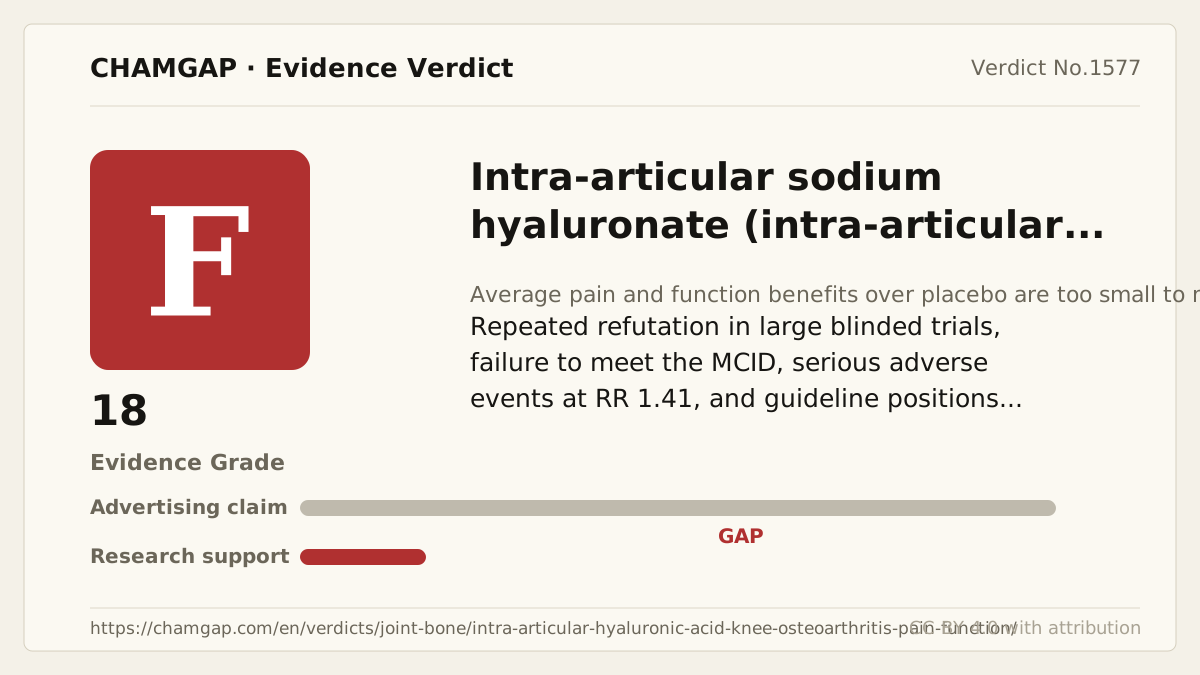
[Chamgap] Intra-articular hyaluronic acid x clinically meaningful improvement in knee osteoarthritis pain and function — Evidence Grade F·18. 4 cited sources checked. Source: https://chamgap.com/en/verdicts/joint-bone/intra-articular-hyaluronic-acid-knee-osteoarthritis-pain-function/ · CC BY 4.0CC BY 4.0 — free to use with attribution; do not distort grades, numbers, or verdict meaning.
What this document does and does not do
Chamgap is an information source. It reports what research has and has not confirmed; it does not tell readers what to take or buy. That decision belongs to readers and, when needed, medical or legal professionals. This verdict reflects literature available up to the search date and may change as new research appears. Nothing here is medical advice.