
Intra-articular corticosteroid,
does it really help with Short-term improvement in pain and shoulder function in adhesive capsulitis?
research showsIntra-articular corticosteroid is rated C despite improving early pain and function in adhesive capsulitis. Carette randomized 93 and analyzed all 93 by intention to treat with last observation carried forward; the six-week SPADI primary endpoint succeeded at P=.0004. An approximately 27.6-point contrast exceeded the 8-to-13-point SPADI MCID range summarized by Roy 2009, but a sample below 200 and a six-week primary assessment create a B2 ceiling.
ads claimOne-shot cure or durable prevention claims overstate short-term symptom evidence.
Useful facts when choosing a product
- Carette used one fluoroscopically guided intra-articular 40-mg triamcinolone hexacetonide injection.
- Groups converged by twelve months.
Chamgap Semantic Classification Code
Candidate index · review held
M.intra-articular-corticosteroid-injection.intraarticular.short-term-improvement-in-pain-and-shoulder-function-in-adhesive-capsulitis.improve.placeboMedicinal interventions > Intra-articular corticosteroid injection > Intra-articular > Short-term improvement in pain and shoulder function in adhesive capsulitis > Improvement claim > Placebo
An automated migration candidate, not an issued permanent code; exact claim scope remains under review. This machine-generated migration candidate helps retrieval but is not a permanent assignment. The original verdict ID and URL remain authoritative.
What the research actually shows
Carette randomized 93 participants across four groups and included all 93 in intention-to-treat analysis using last observation carried forward. The six-week SPADI primary assessment succeeded at P=.0004. Funding came from the nonindustry Arthritis Society of Canada. A 2017 meta-analysis of five studies and 225 participants found pain reduction at zero to eight weeks but no difference at nine to twenty-four weeks. Roy 2009 summarized a SPADI MCID range of 8 to 13 points. Verdict 1678, which is D with 28 points, concerns repeated knee injections, while verdict 1577, which is F with 18 points, concerns knee hyaluronic acid; both differ in joint or intervention.
Why this is classified as C (56)
P, R2, I2, and E+ are capped by B2 for small size and a six-week primary assessment, giving C with 56 points.
Counterpoint. It may create a short window for rehabilitation when early pain limits exercise.
Rejudgment record. Cross-check applied — Clinically important short-term symptom benefit capped by small size and short duration
| Endpoint | P | Symptom or function itself is the target - including patient reports and performance tests |
| Replication | R2 | Independently replicated across trials |
| Independence | I2 | Decisive evidence is publicly or non-profit funded |
| Effect size | E+ | Meets the clinically important threshold |
Stored derived and displayed grades match; this is not a current recalculation or validity check (C).
Sub-claim grades by effect
This ingredient is marketed for several effects. A single overall grade blends strong and weak claims together, so each effect is graded separately here. The overall grade reflects the strongest disconfirming or core claim.
| Effect (sub-claim) | Grade | Basis |
|---|---|---|
| Pain reduction through eight weeks | C | Pooled benefit is positive but short term. |
| Short-term shoulder function improvement | C | The six-week SPADI effect exceeded MCID. |
| Durable long-term pain and function improvement | D | Pain was null at nine to twenty-four weeks and groups converged at twelve months. |
Cross-check — AI research and Codex final gate
Evidence Table
| Study | Design | Sample | Funding | Endpoint | Result | Weight |
|---|---|---|---|---|---|---|
| Carette S et al. 2003 | Four-arm randomized placebo-controlled trial | 93 randomized and 93 analyzed by LOCF intention to treat | Nonindustry Arthritis Society of Canada funding | SPADI at six weeks | Overall P=.0004; primary endpoint met | Key short-term trial |
| Wang W et al. 2017 | Systematic review and meta-analysis | Five studies and 225 participants | Academic Zhejiang University research; no manufacturer funding reported | Pain and range of motion | Pain benefit at zero to eight weeks, null at nine to twenty-four weeks | Duration boundary |
Receipt — 3 References
All 3 cited sources were verified for existence at the original page (as of 2026-07-24).
Final verification and publication gate: Codex · Evidence date: 2026-07-24 · Corrections: none
Cite this verdict
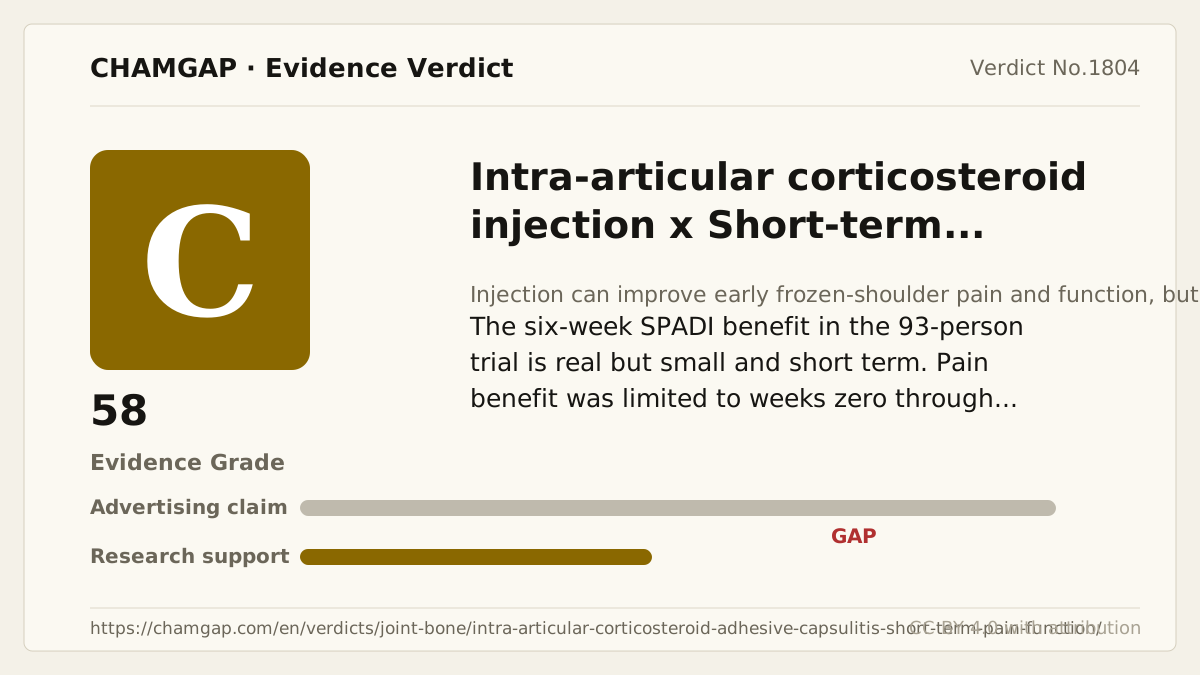
[Chamgap] Intra-articular corticosteroid x short-term pain and function improvement in adhesive capsulitis — Evidence Grade C·56. 3 cited sources checked. Source: https://chamgap.com/en/verdicts/joint-bone/intra-articular-corticosteroid-adhesive-capsulitis-short-term-pain-function/ · CC BY 4.0CC BY 4.0 — free to use with attribution; do not distort grades, numbers, or verdict meaning.
What this document does and does not do
Chamgap is an information source. It reports what research has and has not confirmed; it does not tell readers what to take or buy. That decision belongs to readers and, when needed, medical or legal professionals. This verdict reflects literature available up to the search date and may change as new research appears. Nothing here is medical advice.