
Ice added to usual care for acute ankle sprain,
does it really help with Pain relief and faster recovery?
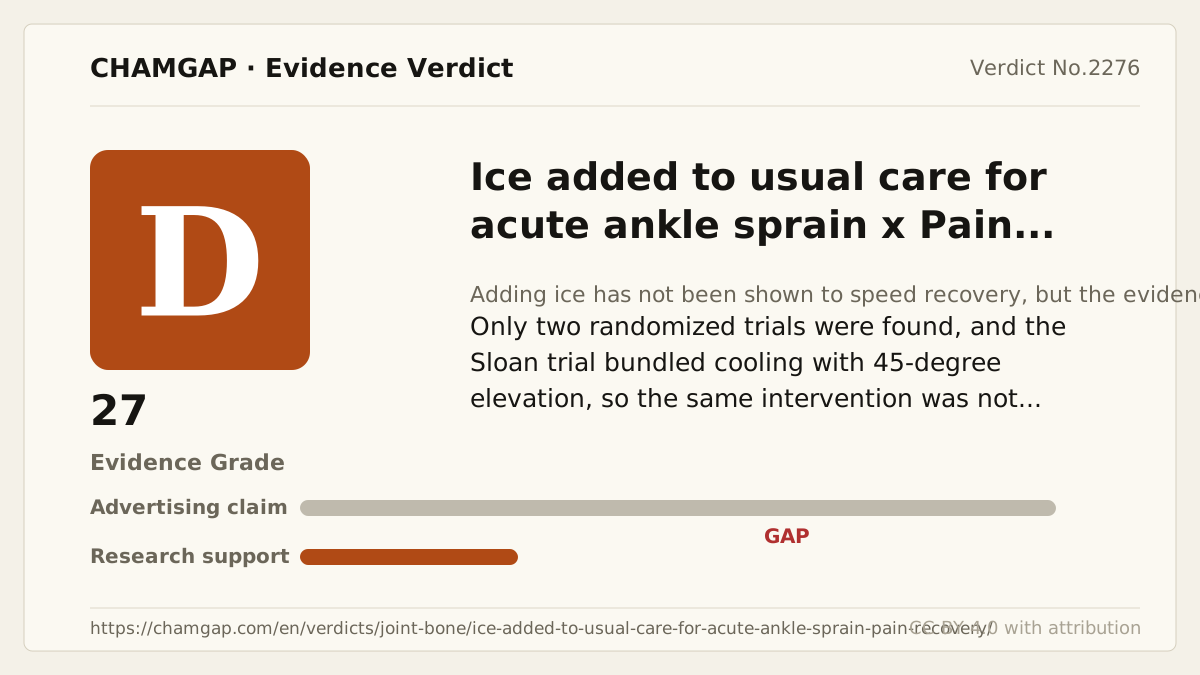
research showsGrade D, 27 points. Only two small randomized trials tested the added value of cooling. Neither showed a clear improvement in pain, swelling, motion, or function around day 7 to 10. The controls were not no treatment or heat: both groups received standard physiotherapy in one trial and high-dose anti-inflammatory medication plus elastic support in the other.
ads claimFirst-aid descriptions often bundle ice into RICE and imply faster healing. The trials tested an added cooling component, not RICE as a package and not cooling versus heat or no care.
Useful facts when choosing a product
- Cooling was added to background treatment rather than used as stand-alone care.
- Only two randomized trials were found: one randomized 30 participants and the other randomized 143 but reported seven-day outcomes for 116.
- The Laba trial reported a five-point pain mean difference of −0.03 points; original group means could not be confirmed.
Chamgap Semantic Classification Code
Candidate index · review held
UNK.ice-added-to-usual-care.UNK.pain-relief-and-faster-recovery.relieve.MULTIUnknown > Ice added to usual care > Unknown > Pain relief and faster recovery > Symptom-relief claim > Multiple: primary unresolved
An automated migration candidate, not an issued permanent code; exact claim scope remains under review. This machine-generated migration candidate helps retrieval but is not a permanent assignment. The original verdict ID and URL remain authoritative.
What the research actually shows
Laba and Roestenburg randomized 30 patients, 14 to ice plus standard physiotherapy and 16 to standard physiotherapy alone. The five-point pain mean difference of −0.03 points (95% CI −0.34 to 0.28) came from this single trial; original group means could not be confirmed from the public paper or abstract. Sloan and colleagues randomized 143 patients to a cooling anklet with 45-degree elevation or a non-cooling dummy anklet; both groups received high-dose anti-inflammatory medication and elastic support. Seven-day results were available for 116 patients and showed no clear pain, swelling, motion, or weight-bearing benefit. With only two trials and elevation bundled into the Sloan intervention, the same intervention was not independently replicated.
Why this is classified as D (28)
Repeated null results came from small, short trials, and one confounded cooling with elevation. The pain interval did not exclude worthwhile benefit, supporting D with 28 points.
Counterpoint. The usefulness of compression, exercise, analgesia, or the whole early-care package is a separate question.
Rejudgment record. Cross-check applied — The exact comparators, seven-to-ten-day follow-up, five-point pain scale, standardized between-group effect, and confidence interval were cross-checked to separate repeated null findings from adequate exclusion of benefit.
| Endpoint | P | Symptom or function itself is the target - including patient reports and performance tests |
| Replication | R1 | Single confirmatory trial |
| Independence | I1 | Mixed funding sources |
| Effect size | E0 | Null |
| Precision | C0 | The confidence interval leaves room for benefit |
Stored derived and displayed grades match; this is not a current recalculation or validity check (D).
Sub-claim grades by effect
This ingredient is marketed for several effects. A single overall grade blends strong and weak claims together, so each effect is graded separately here. The overall grade reflects the strongest disconfirming or core claim.
| Effect (sub-claim) | Grade | Basis |
|---|---|---|
| Adding ice to usual care improves pain and recovery after acute ankle sprain | D | Two small randomized trials found no added benefit but did not exclude worthwhile benefit. |
Cross-check — AI research and Codex final gate
Evidence Table
| Study | Design | Sample | Funding | Endpoint | Result | Weight |
|---|---|---|---|---|---|---|
| Miranda et al., 2021 systematic review | Systematic review of two randomized trials of added cryotherapy for acute ankle sprain | Two trials; 30 and 143 randomized, with outcomes reported for 116 in the latter | The review had non-profit support; funding of the included trials was not reported | Five-point pain scale, swelling, range of motion, function and recovery | Pain mean difference −0.03 points (95% CI −0.34 to 0.28) from the single 30-person Laba trial; original group means could not be confirmed | Central evidence, but only two small trials with high risk of bias |
| Sloan et al., 1989 randomized trial | Cooling anklet plus elevation versus non-cooling dummy anklet; both groups received anti-inflammatory medication and elastic support | 143 enrolled and randomized; 116 had seven-day outcomes | Not reported | Pain, swelling, range of motion and weight bearing at seven days | No significant cooling benefit on measured outcomes | Comparator care was clear, but elevation was bundled with cooling and outcome data were incomplete |
Receipt — 2 References
All 2 cited sources were verified for existence at the original page (as of 2026-08-05).
Final verification and publication gate: Codex · Evidence date: 2026-08-05 · Corrections: none
Cite this verdict
[Chamgap] Adding ice for acute ankle sprain × pain and recovery — Evidence Grade D·28. 2 cited sources checked. Source: https://chamgap.com/en/verdicts/joint-bone/ice-added-to-usual-care-for-acute-ankle-sprain-pain-recovery/ · CC BY 4.0CC BY 4.0 — free to use with attribution; do not distort grades, numbers, or verdict meaning.
What this document does and does not do
Chamgap is an information source. It reports what research has and has not confirmed; it does not tell readers what to take or buy. That decision belongs to readers and, when needed, medical or legal professionals. This verdict reflects literature available up to the search date and may change as new research appears. Nothing here is medical advice.