
Hydroxychloroquine,
does it really help with Improvement of pain, swelling, physical function, and disease activity in DMARD-naive low-activity early rheumatoid arthritis?
research showsHydroxychloroquine is rated B because it produces moderate improvements in pain, joint scores, grip strength, and global assessments versus placebo in rheumatoid arthritis. In a six-month double-blind trial of 126 participants with early rheumatoid arthritis, mean improvement over placebo was 20% for joint score, 40% for pain, and 22% for grip strength. A Cochrane review of four placebo-controlled trials and 592 participants also found significant standardized effects of about -0.33 to -0.52 across core outcomes while characterizing the overall effect as moderate. The 2021 ACR guideline conditionally recommends hydroxychloroquine over other conventional DMARDs in DMARD-naive low disease activity, but certainty was very low and methotrexate is preferred for moderate-to-high activity. F grades for hand osteoarthritis in verdict 1049 and COVID-19 in verdict 640 concern different diseases and are not transferred to rheumatoid arthritis.
ads claimPromotion can turn a comparatively well-tolerated medicine into a gentle joint treatment that is sufficient monotherapy at every rheumatoid arthritis severity. Its best-fitting role is an initial option in low activity and low prognostic risk, with treatment adjustment required if the disease-activity target is not reached.
Useful facts when choosing a product
- Hydroxychloroquine is a prescription conventional synthetic DMARD for inflammatory rheumatoid arthritis rather than an immediate analgesic. Benefit may take several weeks, requiring rheumatology follow-up.
- Dose is selected with actual body weight and kidney function in mind. Because irreversible retinal toxicity rises with dose and cumulative exposure, baseline eye assessment and periodic optical coherence tomography and visual-field screening are required.
- QT prolongation and ventricular arrhythmia, rare cardiomyopathy, myopathy or neuropathy, and severe hypoglycemia can occur, so cardiac disease, kidney impairment, and other QT-prolonging medicines require review.
- Moderate-to-high disease activity, rapid-damage risk, or failure to reach target may require methotrexate or another DMARD strategy rather than hydroxychloroquine alone. Dose changes and discontinuation should not be self-directed.
Chamgap Semantic Classification Code
Candidate index · review held
M.hydroxychloroquine-sulfate.UNK.pain-swelling-physical-function-and-disease-activity-in-dmard-naive-low-activity-early-rheumatoid-arthritis.improve.placeboMedicinal interventions > Hydroxychloroquine sulfate > Unknown > pain, swelling, physical function, and disease activity in DMARD-naive low-activity early rheumatoid arthritis > Improvement claim > Placebo
An automated migration candidate, not an issued permanent code; exact claim scope remains under review. This machine-generated migration candidate helps retrieval but is not a permanent assignment. The original verdict ID and URL remain authoritative.
What the research actually shows
Clark and colleagues randomized 126 participants with early rheumatoid arthritis to hydroxychloroquine 400 mg/day or placebo for six months; 121 completed the study. Mean improvement over placebo was 20% for joint score, 40% for pain, and 22% for grip strength, with favorable patient and physician global assessments. The Cochrane review by Suarez-Almazor and colleagues pooled four placebo-controlled hydroxychloroquine trials with 300 active and 292 placebo participants and found moderate improvements across core outcomes and erythrocyte sedimentation rate. A 2020 review of clinical and structural efficacy found hydroxychloroquine monotherapy similar to or less effective than methotrexate or sulfasalazine. The 2021 ACR guideline conditionally preferred it over other conventional DMARDs for DMARD-naive low disease activity because of tolerability and risk profile, while strongly preferring methotrexate for moderate-to-high activity.
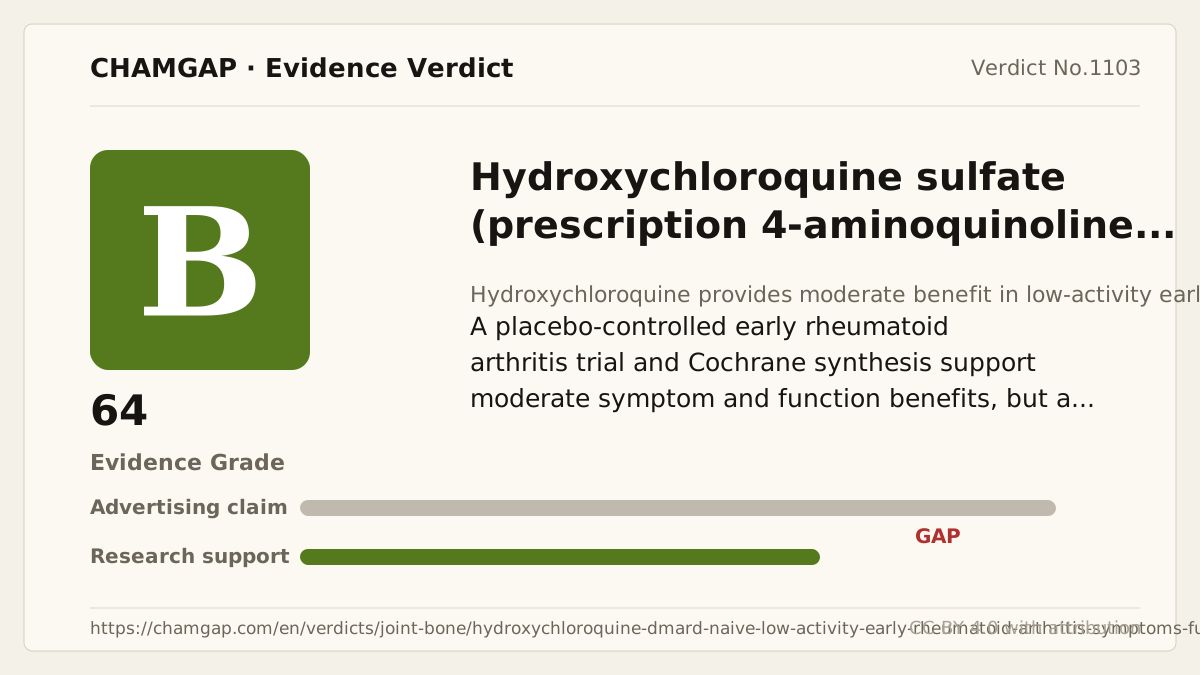
Why this is classified as B (64)
A placebo-controlled trial of 126 participants with early rheumatoid arthritis improved pain, joint scores, grip strength, and global assessments, while a four-trial, 592-participant Cochrane synthesis supported moderate efficacy. Structural disease-modification evidence and magnitude are weaker than for methotrexate, and the ACR recommendation in DMARD-naive low activity is conditional with very-low-certainty evidence. Restriction to low-activity early rheumatoid arthritis yields B with 64 points. Retinal toxicity, QT effects, myopathy, and hypoglycemia remain separate safety issues.
Counterpoint. Methotrexate is generally preferred from the outset for moderate-to-high activity or poor prognostic features. Even when activity starts low, failure to reach target calls for escalation, switching, or combination under a treat-to-target strategy. Eye screening is mandatory safety management independent of efficacy.
Rejudgment record. New verdict — Accepted moderate symptom and function improvement in a 126-participant early rheumatoid arthritis placebo trial and a four-trial Cochrane synthesis, while accounting for weaker structural disease modification, the very-low-certainty conditional 2021 ACR recommendation limited to low disease activity, and separation from F-rated hand osteoarthritis and COVID-19 disease axes
Sub-claim grades by effect
This ingredient is marketed for several effects. A single overall grade blends strong and weak claims together, so each effect is graded separately here. The overall grade reflects the strongest disconfirming or core claim.
| Effect (sub-claim) | Grade | Basis |
|---|---|---|
| Improvement in disease activity in low-activity early rheumatoid arthritis | B | A placebo-controlled trial and four-trial synthesis showed moderate efficacy, but use is conditional in low activity and structural disease-modification evidence is weaker. |
| Reduction of pain and joint swelling in rheumatoid arthritis | B | Pain and joint scores improved significantly over placebo in the 126-participant randomized trial. |
| Improvement in physical function and grip strength in rheumatoid arthritis | B | Grip strength and function-related outcomes were positive, but the effect was moderate and modern functional-scale evidence is limited. |
Cross-check — AI research and Codex final gate
Evidence Table
| Study | Design | Sample | Funding | Endpoint | Result | Weight |
|---|---|---|---|---|---|---|
| Clark P et al. 1993 | Six-month randomized double-blind placebo-controlled trial | 126 participants with early rheumatoid arthritis; 121 completed | Non-United States government research support; no manufacturer sponsorship reported | Joint score, pain, grip strength, and patient and physician global assessments | Hydroxychloroquine produced 20% greater mean improvement in joint score, 40% greater improvement in pain, and 22% greater improvement in grip strength than placebo, with favorable global assessments. | Pivotal direct efficacy evidence in early rheumatoid arthritis |
| Suarez-Almazor ME et al. Cochrane review 2000 | Systematic review and meta-analysis of randomized placebo-controlled trials | Four trials; 300 hydroxychloroquine and 292 placebo participants | Academic Cochrane review | Core rheumatoid arthritis disease-activity outcomes, erythrocyte sedimentation rate, and withdrawals | Standardized mean differences across outcomes ranged from -0.33 to -0.52 and significantly favored hydroxychloroquine, with the overall effect characterized as moderate. | Consistency evidence across multiple randomized trials |
| Fraenkel L et al. ACR guideline 2021 | GRADE-based American College of Rheumatology clinical practice guideline | 133 manuscripts mapped to at least one PICO question | American College of Rheumatology | Initial medicine selection by disease activity in DMARD-naive rheumatoid arthritis | Hydroxychloroquine was conditionally preferred over other conventional DMARDs in low disease activity with very-low-certainty evidence, while methotrexate was strongly preferred in moderate-to-high activity. | Evidence for scope and current clinical positioning |
Receipt — 4 References
All 4 cited sources were verified for existence at the original page (as of 2026-07-22).
Final verification and publication gate: Codex · Evidence date: 2026-07-22 · Corrections: none
Cite this verdict
[Chamgap] Hydroxychloroquine x symptoms, function, and disease activity in DMARD-naive low-activity early rheumatoid arthritis — Evidence Grade B·64. 4 cited sources checked. Source: https://chamgap.com/en/verdicts/joint-bone/hydroxychloroquine-dmard-naive-low-activity-early-rheumatoid-arthritis-symptoms-function-disease-activity/ · CC BY 4.0CC BY 4.0 — free to use with attribution; do not distort grades, numbers, or verdict meaning.
What this document does and does not do
Chamgap is an information source. It reports what research has and has not confirmed; it does not tell readers what to take or buy. That decision belongs to readers and, when needed, medical or legal professionals. This verdict reflects literature available up to the search date and may change as new research appears. Nothing here is medical advice.