
Hip arthroscopy,
does it really help with Improved hip-related quality of life and function at 12 months in femoroacetabular impingement syndrome?
research showsThe grade is C. UK FASHIoN randomized 348 participants to arthroscopy or personalized conservative care. The adjusted 12-month iHOT-33 difference favored surgery by 6.8 points (95% CI 1.7 to 12.0, P=.0093). The 6.8-point estimate exceeded the article's 6.1-point minimum important difference. However, the lower 95% confidence bound of 1.7 was below that threshold, so this trial alone did not exclude a smaller subthreshold effect. Patients knew whether they had surgery and reported the primary outcome themselves, and evidence came from a single trial.
ads claimSaying only that the result exceeded the minimum important difference omits uncertainty. The point estimate was 6.8, but the lower confidence bound was 1.7, so not every plausible effect exceeded the threshold.
Useful facts when choosing a product
- The comparator was active personalized care with assessment, education, pain management, and progressive exercise, not no treatment.
- Of 348 randomized participants, 319 completed 12-month questionnaires; the analysis used intention-to-treat multiple imputation.
- The 6.8-point estimate exceeded 6.1, but the 95% CI of 1.7 to 12.0 retained effects below the threshold.
Chamgap Semantic Classification Code
Candidate index · review held
P.hip-arthroscopy.procedural.hip-related-quality-of-life-and-function-at-in-femoroacetabular-impingement-syndrome.improve.UNKProcedures, devices and tests > Hip arthroscopy > Procedural > hip-related quality of life and function at in femoroacetabular impingement syndrome > Improvement claim > Unknown
An automated migration candidate, not an issued permanent code; exact claim scope remains under review. This machine-generated migration candidate helps retrieval but is not a permanent assignment. The original verdict ID and URL remain authoritative.
What the research actually shows
At 23 UK NHS hospitals, 348 participants were centrally assigned by telephone to arthroscopy, 171, or personalized physiotherapist-led conservative care, 177. Twelve-month questionnaires were completed by 319 (92%); the primary intention-to-treat analysis used multiple imputation for missing iHOT-33 values. The adjusted difference was 6.8 points (95% CI 1.7 to 12.0, P=.0093). The cited 6.1-point threshold came from anchor- and distribution-based work in 27 young active hip patients. The NIHR Health Technology Assessment Programme funded the trial. Participants and therapists knew allocation, and a masked assessor could not remove this risk from a patient-reported primary endpoint.
Why this is classified as B (70)
The 6.8-point estimate exceeded the article's 6.1-point minimum important difference, giving E+, and a publicly funded randomised trial measured a patient-centred outcome. An unblinded patient-reported primary endpoint (B1) and single-trial evidence keep it below the top band, giving B with 70 points.
Counterpoint. B does not mean the operation works for everyone. It means the mean advantage did not reach high certainty for magnitude or separation from treatment expectations.
Rejudgment record. Single-trial evidence — The publicly funded single 348-participant trial's point estimate exceeded the minimum important difference and qualified as E+, with the unblinded patient-reported primary endpoint (B1) and single-trial structure limiting the grade
| Endpoint | P | Symptom or function itself is the target - including patient reports and performance tests |
| Replication | R1 | Single confirmatory trial |
| Independence | I2 | Decisive evidence is publicly or non-profit funded |
| Effect size | E+ | Meets the clinically important threshold |
Stored derived and displayed grades match; this is not a current recalculation or validity check (B).
Sub-claim grades by effect
This ingredient is marketed for several effects. A single overall grade blends strong and weak claims together, so each effect is graded separately here. The overall grade reflects the strongest disconfirming or core claim.
| Effect (sub-claim) | Grade | Basis |
|---|---|---|
| Mean iHOT-33 advantage at 12 months | C | The 6.8-point advantage was statistically significant, but its interval extended down to 1.7 points. |
| An effect definitively exceeding the minimum important difference | D | The 95% CI did not exclude effects below 6.1 points. |
Cross-check — AI research and Codex final gate
Evidence Table
| Study | Design | Sample | Funding | Endpoint | Result | Weight |
|---|---|---|---|---|---|---|
| Griffin DR et al. 2018 UK FASHIoN | Twenty-three-center pragmatic randomized trial with open treatment and masked assessors | 348 randomized: 171 arthroscopy and 177 personalized conservative care; 319 completed 12-month questionnaires | National Institute for Health Research Health Technology Assessment Programme | Patient-reported iHOT-33 at 12 months | Adjusted difference 6.8 points (95% CI 1.7 to 12.0, P=.0093); the estimate exceeded 6.1 but the lower bound did not | Publicly funded superiority evidence retaining subthreshold effects and unblinded patient-report risk |
Receipt — 1 References
All 1 cited sources were verified for existence at the original page (as of 2026-08-18).
Final verification and publication gate: Codex · Evidence date: 2026-08-18 · Corrections: none
Cite this verdict
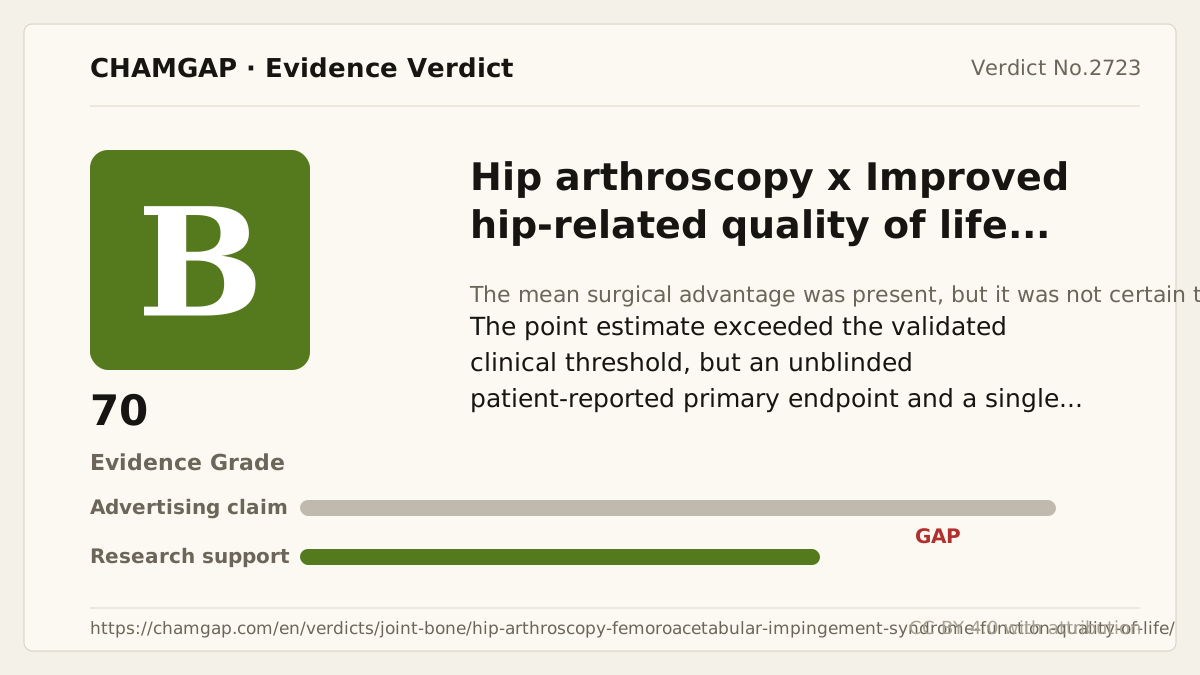
[Chamgap] Hip arthroscopy x femoroacetabular impingement syndrome — Evidence Grade B·70. 1 cited sources checked. Source: https://chamgap.com/en/verdicts/joint-bone/hip-arthroscopy-femoroacetabular-impingement-syndrome-function-quality-of-life/ · CC BY 4.0CC BY 4.0 — free to use with attribution; do not distort grades, numbers, or verdict meaning.
What this document does and does not do
Chamgap is an information source. It reports what research has and has not confirmed; it does not tell readers what to take or buy. That decision belongs to readers and, when needed, medical or legal professionals. This verdict reflects literature available up to the search date and may change as new research appears. Nothing here is medical advice.