
Group cognitive behavioral therapy,
does it really help with Reduced disability related to chronic low-back pain?
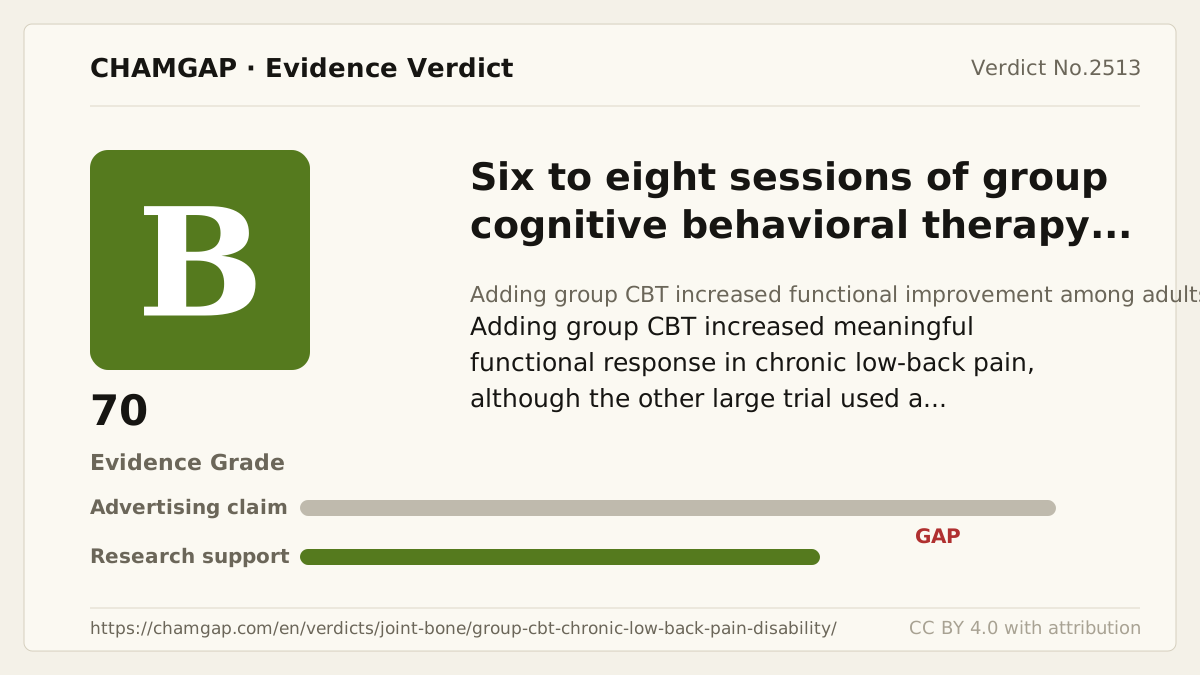
research showsThe grade is B. In a 701-person UK trial, 12-month RMDQ improvement was 2.4 versus 1.1 points, a 1.3-point between-group difference. In a US trial, 26-week improvement of at least 30% on RMDQ occurred in 57.7% with CBT versus 44.1% with usual care, RR 1.31 (95% CI 1.01-1.69). Because continuous change and responder rate are different estimands, they were not counted as strict independent replication. One publicly funded confirmatory trial established a prespecified clinical response, giving B with 70 points.
ads claimCBT here was not merely positive thinking. It was structured training in coping, pacing, goal setting, graded activity, and reducing avoidance.
Useful facts when choosing a product
- RMDQ is a patient-reported measure of daily functional limitation from low-back pain.
- UK-BeST used up to six hours of group treatment; Cherkin used weekly two-hour sessions for eight weeks.
- No duplicate of group CBT by chronic-low-back-pain disability was found in the existing verdict list.
Chamgap Semantic Classification Code
Candidate index · review held
X.six-to-eight-sessions-of-group-cognitive-behavioral-therapy-addressing-pain-related-thoughts-and-behaviors.behavioral.disability-related-to-chronic-low-back-pain.reduce.UNKBehaviors, exposures and policies > Six to eight sessions of group cognitive behavioral therapy addressing pain-related thoughts and behaviors > Behavioral delivery > disability related to chronic low-back pain > Reduction claim > Unknown
An automated migration candidate, not an issued permanent code; exact claim scope remains under review. This machine-generated migration candidate helps retrieval but is not a permanent assignment. The original verdict ID and URL remain authoritative.
What the research actually shows
Lamb used computer-generated block randomization, blinded outcome assessment, and the registered 12-month RMDQ, but analyzed only follow-up responders and lost 15% per group. Cherkin used blinded interviewers and intention-to-treat analysis with 86% follow-up at 26 weeks. Participants in both trials knew their assignment while reporting their own function.
Why this is classified as B (70)
A publicly funded confirmatory trial demonstrated a prespecified 30% RMDQ response. Another public trial supported continuous RMDQ improvement but used a different estimand, so it was not counted as strict replication. Public independence and clinically defined response give B with 70 points.
Counterpoint. B does not mean CBT corrects a structural cause of pain; it grades improvement in activity and daily function.
Rejudgment record. Cross-check applied — We cross-checked primary reports and registry entries for primary outcomes, analyzed samples, estimands, funding, and response rates, correcting the CBT-arm value.
| Endpoint | P | Symptom or function itself is the target - including patient reports and performance tests |
| Replication | R1 | Single confirmatory trial |
| Independence | I2 | Decisive evidence is publicly or non-profit funded |
| Effect size | E+ | Meets the clinically important threshold |
Stored derived and displayed grades match; this is not a current recalculation or validity check (B).
Sub-claim grades by effect
This ingredient is marketed for several effects. A single overall grade blends strong and weak claims together, so each effect is graded separately here. The overall grade reflects the strongest disconfirming or core claim.
| Effect (sub-claim) | Grade | Basis |
|---|---|---|
| Group CBT increases RMDQ functional response in chronic low-back pain. | B | At 26 weeks, response of at least 30% was 57.7% versus 44.1%. |
| Group CBT is superior to mindfulness-based stress reduction. | D | Cherkin found no significant difference between the two active treatments. |
Cross-check — AI research and Codex final gate
Evidence Table
| Study | Design | Sample | Funding | Endpoint | Result | Weight |
|---|---|---|---|---|---|---|
| Lamb et al., Lancet 2010 UK-BeST | Multicenter pragmatic individual randomized trial | 701 randomized (468/233); 598 analyzed at 12 months (399/199) | NIHR Health Technology Assessment Programme | Change from baseline in RMDQ at 12 months | 2.4 versus 1.1 points; between-group difference 1.3 (95% CI 0.56-2.06), P=.0008 | Publicly funded supportive trial using a different estimand |
| Cherkin et al., JAMA 2016 | Interviewer-blind three-arm individual randomized trial | 342 participants: 113 CBT, 113 usual care, 116 MBSR; 294 followed at 26 weeks | National Center for Complementary and Integrative Health grant R01AT006226 | Coprimary outcomes: at least 30% improvement in RMDQ and pain bothersomeness at 26 weeks | CBT RMDQ response 57.7% versus 44.1%, RR 1.31 (95% CI 1.01-1.69); pain-bothersomeness response 44.9% versus 26.6%, RR 1.69 (1.22-2.33) | Pivotal confirmatory trial establishing prespecified clinical response |
Receipt — 2 References
All 2 cited sources were verified for existence at the original page (as of 2026-08-14).
Final verification and publication gate: Codex · Evidence date: 2026-08-14 · Corrections: none
Cite this verdict
[Chamgap] Group cognitive behavioral therapy x chronic low-back-pain disability — Evidence Grade B·70. 2 cited sources checked. Source: https://chamgap.com/en/verdicts/joint-bone/group-cbt-chronic-low-back-pain-disability/ · CC BY 4.0CC BY 4.0 — free to use with attribution; do not distort grades, numbers, or verdict meaning.
What this document does and does not do
Chamgap is an information source. It reports what research has and has not confirmed; it does not tell readers what to take or buy. That decision belongs to readers and, when needed, medical or legal professionals. This verdict reflects literature available up to the search date and may change as new research appears. Nothing here is medical advice.