
Glucosamine,
does it really help with Improvement of chronic low-back pain and disability in degenerative lumbar osteoarthritis?
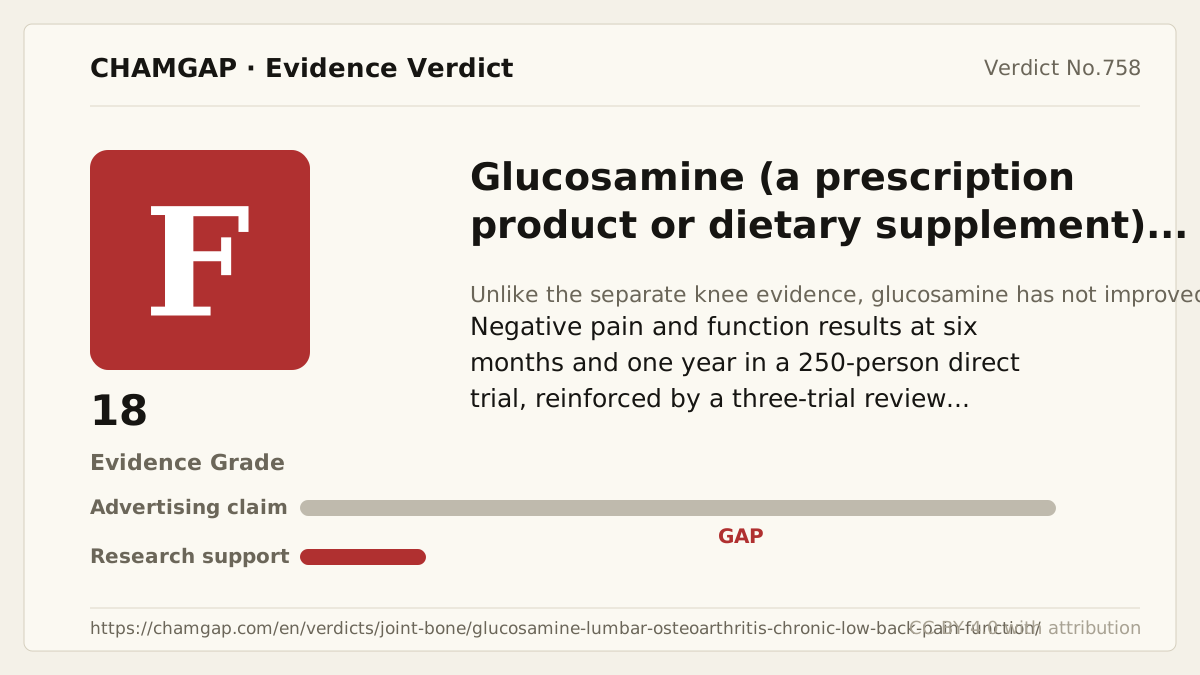
research showsF. Glucosamine does not improve pain or disability in people with chronic low-back pain and degenerative lumbar osteoarthritis. In the independent 250-participant Wilkens trial, the six-month RMDQ mean was 5.0 in both groups, pain and quality of life were negative, and one-year follow-up remained negative. A systematic review of three trials and 309 participants also found no functional benefit and mostly negative pain results. Direct and synthesized evidence repeatedly refutes the claim, giving F with 18 points; knee osteoarthritis is a separate disease axis.
ads claimMarketing expands cartilage replacement language or knee-joint studies into spinal disc or facet regeneration, less back pain, and restored function. Radiographic degeneration does not necessarily identify the pain source, and the direct lumbar trial showed no symptomatic benefit.
Useful facts when choosing a product
- Depending on jurisdiction and formulation, glucosamine is sold as prescription crystalline glucosamine sulfate or as a supplement, and salt form, content, and quality are not interchangeable.
- The direct negative lumbar trial used oral glucosamine sulfate 1,500 mg daily for six months, so other combination products cannot be assumed to have the same composition or effect.
- Glucosamine is generally tolerated similarly to placebo but can cause gastrointestinal symptoms, and people taking warfarin should seek advice because increased INR and bleeding have been reported.
- Shellfish-derived products warrant label review, although a small challenge study found a specific tablet tolerated by shrimp-allergic participants; human glucose findings are mixed, making monitoring reasonable in diabetes or high-risk patients.
Chamgap Semantic Classification Code
Candidate index · review held
UNK.glucosamine.UNK.chronic-low-back-pain-and-disability-in-degenerative-lumbar-osteoarthritis.improve.placeboUnknown > Glucosamine > Unknown > chronic low-back pain and disability in degenerative lumbar osteoarthritis > Improvement claim > Placebo
An automated migration candidate, not an issued permanent code; exact claim scope remains under review. This machine-generated migration candidate helps retrieval but is not a permanent assignment. The original verdict ID and URL remain authoritative.
What the research actually shows
Wilkens and colleagues randomized 250 adults older than 25 years with more than six months of low-back pain and degenerative lumbar osteoarthritis. At six months, mean RMDQ was 5.0 in both groups, with no differences in low-back pain, leg pain, or EQ-5D. Sodha and colleagues in 2013 reviewed three eligible trials with 309 participants and found no functional benefit, conflicting pain results, sparse data, and low quality. A 1999 crossover trial of a three-ingredient product in 34 men showed a knee signal but neither demonstrated nor excluded benefit for lumbar disease. LEGS studied knee osteoarthritis and is not direct evidence for this lumbar claim.
Why this is classified as F (18)
F. In the 250-participant direct independent trial, six-month RMDQ was 5.0 in both groups, pain and quality of life were negative, and one-year follow-up remained negative. The systematic review of three trials and 309 participants likewise found no functional benefit and mostly negative pain results, constituting repeated refutation. Knee osteoarthritis verdict 014 is separate, giving F with 18 points for the lumbar claim. Safety and formulation variability remain separate.
Counterpoint. Low-back pain care should assess exercise, education, sleep, weight, psychosocial factors, and neurologic red flags. Evidence-based non-drug care can be prioritized according to the cause and the patient's preferences.
Rejudgment record. Reassessment (cross-check reflected) — Applied F because the independent 250-person Wilkens trial found identical six-month RMDQ means of 5.0, negative pain and quality-of-life outcomes, and negative one-year follow-up, while a review of three trials and 309 participants also found no functional benefit and mostly negative pain results; knee osteoarthritis verdict 014 is separate
Sub-claim grades by effect
This ingredient is marketed for several effects. A single overall grade blends strong and weak claims together, so each effect is graded separately here. The overall grade reflects the strongest disconfirming or core claim.
| Effect (sub-claim) | Grade | Basis |
|---|---|---|
| Improvement of chronic lumbar pain and function | F | Negative six-month and one-year results in a 250-person direct trial were reinforced by repeated refutation in a three-trial review. |
| Knee osteoarthritis as a separate evidence axis | ? | Conflicting evidence in knee osteoarthritis verdict 014 is not transferred to lumbar efficacy. |
| Extension to cartilage or structural improvement | ? | No valid human evidence directly tests lumbar structural change. |
| Extension of lumbar efficacy to other formulations or combinations | ? | Lumbar efficacy has not been directly established for products with different salt forms or combination ingredients. |
Cross-check — AI research and Codex final gate
Evidence Table
| Study | Design | Sample | Funding | Endpoint | Result | Weight |
|---|---|---|---|---|---|---|
| Wilkens P et al. 2010 | Independent randomized double-blind placebo-controlled trial | 250 participants with chronic low-back pain and degenerative lumbar osteoarthritis | Norwegian public and nonprofit research support | Six-month RMDQ disability, pain, EQ-5D, and one-year follow-up | Six-month RMDQ was 5.0 in both groups, with no significant pain, quality-of-life, or one-year differences. | Strongest direct negative evidence |
| Sodha R et al. 2013 | Systematic review of glucosamine randomized trials in chronic low-back pain | Three randomized trials and 309 participants | Reported no external funding | Function and pain | No study improved RMDQ function; two were negative for pain and one high-risk-of-bias study was positive. | Direct synthesis limited by quantity and quality |
| Villacis J et al. 2006 | Double-blind placebo-controlled challenge in shrimp-allergic participants | 15 participants | Small product-specific safety study | Immediate and 24-hour delayed allergic reactions | All participants tolerated 1,500 mg of the tested shrimp-derived and synthetic tablets without reaction. | Product-specific safety evidence unrelated to efficacy |
Receipt — 4 References
All 4 cited sources were verified for existence at the original page (as of 2026-07-20).
Final verification and publication gate: Codex · Evidence date: 2026-07-20 · Corrections: none
Cite this verdict
[Chamgap] Glucosamine x improvement of chronic low-back pain and disability in degenerative lumbar osteoarthritis — Evidence Grade F·18. 4 cited sources checked. Source: https://chamgap.com/en/verdicts/joint-bone/glucosamine-lumbar-osteoarthritis-chronic-low-back-pain-function/ · CC BY 4.0CC BY 4.0 — free to use with attribution; do not distort grades, numbers, or verdict meaning.
What this document does and does not do
Chamgap is an information source. It reports what research has and has not confirmed; it does not tell readers what to take or buy. That decision belongs to readers and, when needed, medical or legal professionals. This verdict reflects literature available up to the search date and may change as new research appears. Nothing here is medical advice.