
Genicular nerve radiofrequency ablation,
does it really help with Short-term improvement in pain and function for knee osteoarthritis that has not responded to conservative treatment.?
research showsSome patients may improve through about 12 weeks, but heterogeneity is extreme and benefit at 24 to 48 weeks is inconsistent. The verdict is C with 52 points: a possible short-term symptomatic benefit should not be expanded into a claim of durable or structural benefit.
ads claimMarketing often describes a nonsurgical, long-lasting pain block, whereas randomized evidence mainly addresses average symptom changes over several weeks to about 12 weeks. Interrupting nerve signals does not imply cartilage regeneration or structural disease modification.
Useful facts when choosing a product
- This outpatient procedure places an electrode near sensory genicular nerve branches under imaging guidance and creates a thermal lesion.
- Conventional, cooled, and pulsed techniques, target nerves, and diagnostic-block criteria vary across studies.
- The goal is to reduce pain signaling, not to regenerate cartilage or reverse osteoarthritis progression.
- Post-procedure soreness or sensory change may occur, and nerve or vascular injury and infection are uncommon but possible.
Chamgap Semantic Classification Code
Candidate index · review held
P.genicular-nerve-radiofrequency-ablation.procedural.short-term-improvement-in-pain-and-function-for-knee-osteoarthritis-that-has-not-responded-to-conservative-treatment.improve.shamProcedures, devices and tests > Genicular nerve radiofrequency ablation > Procedural > Short-term improvement in pain and function for knee osteoarthritis that has not responded to conservative treatment. > Improvement claim > Sham procedure or device
An automated migration candidate, not an issued permanent code; exact claim scope remains under review. This machine-generated migration candidate helps retrieval but is not a permanent assignment. The original verdict ID and URL remain authoritative.
What the research actually shows
The intervention judged here is genicular nerve radiofrequency ablation. The 2026 sham-controlled meta-analysis pooled cooled, monopolar, and bipolar radiofrequency ablation with cryoneurolysis across eight randomized trials and 627 participants; it reported a 12-week pain mean difference of -1.65 out of 10 (95% CI -2.57 to -0.74; I²=83%) and a WOMAC function mean difference of -11.37 (95% CI -18.83 to -3.91; I²=91%), so these are not radiofrequency-only estimates. The 2025 meta-analysis of 25 trials and 2,049 participants combined radiofrequency ablation, genicular nerve block, cryoneurolysis, and alcoholic neurolysis. It found pain benefit versus sham at four and 12 weeks only, no benefit at 24 or 48 weeks, no functional improvement at any time, and low or very low certainty; those pooled values likewise must not be assigned to radiofrequency ablation alone.
Why this is classified as C (52)
There is a short-term positive signal in direct patient-reported pain and function from syntheses that include radiofrequency ablation, but the pooled values also include cryoneurolysis, genicular nerve blocks, or other neurolysis and are not radiofrequency-only effects. Extreme heterogeneity, low certainty, and inconsistent longer-term findings support grade C for radiofrequency ablation.
Counterpoint. Better responses may occur with careful patient selection and standardized technique, but that possibility does not establish durable average efficacy.
Rejudgment record. Cross-check applied — Small, short, heterogeneous, and conflicting studies cap the evidence at grade C.
Sub-claim grades by effect
This ingredient is marketed for several effects. A single overall grade blends strong and weak claims together, so each effect is graded separately here. The overall grade reflects the strongest disconfirming or core claim.
| Effect (sub-claim) | Grade | Basis |
|---|---|---|
| Short-term pain improvement in knee osteoarthritis unresponsive to conservative care | C | The 12-week sham-controlled estimate including radiofrequency ablation was positive, but it mixed in cryoneurolysis and had extreme heterogeneity; the mixed-intervention benefit did not persist at 24 to 48 weeks. |
| Short-term functional improvement in knee osteoarthritis unresponsive to conservative care | C | WOMAC function was positive in a sham meta-analysis combining radiofrequency ablation and cryoneurolysis, but I² was 91%; the broader synthesis combining radiofrequency, blocks, cryoneurolysis, and other neurolysis was null at every time point. |
| Structural improvement of knee osteoarthritis | ? | No human efficacy trial establishing cartilage regeneration or structural disease modification was identified. |
Cross-check — AI research and Codex final gate
Evidence Table
| Study | Design | Sample | Funding | Endpoint | Result | Weight |
|---|---|---|---|---|---|---|
| Barreto RB et al. 2026 | Systematic review and meta-analysis of sham-controlled randomized trials of cooled, monopolar, or bipolar radiofrequency ablation and cryoneurolysis | Eight randomized trials and 627 participants | Funding information was not stated in the PubMed abstract | Pain and WOMAC function at 12 weeks and adverse events | Pain improved by a mean difference of -1.65 out of 10 (95% CI -2.57 to -0.74; I²=83%) and WOMAC function by -11.37 (95% CI -18.83 to -3.91; I²=91%), with extreme heterogeneity; the pooled values combine radiofrequency ablation and cryoneurolysis and are not radiofrequency-only estimates. | Key short-term sham-controlled synthesis including radiofrequency ablation but mixing procedures |
| Almeida M et al. 2025 | Systematic review and meta-analysis of randomized trials of radiofrequency ablation, genicular nerve block, cryoneurolysis, and alcoholic neurolysis | Twenty-five trials and 2,049 participants | Funding information was not stated in the PubMed abstract | Pain and function at 4, 12, 24, and 48 weeks | Across mixed genicular nerve interventions, pain favored intervention over sham at four and 12 weeks only, not at 24 or 48 weeks; function did not improve at any time, certainty was low or very low, and the results cannot be interpreted as radiofrequency-only estimates. | Mixed-procedure synthesis demonstrating conflict in durability and function |
Receipt — 2 References
All 2 cited sources were verified for existence at the original page (as of 2026-07-24).
Final verification and publication gate: Codex · Evidence date: 2026-07-24 · Corrections: none
Cite this verdict
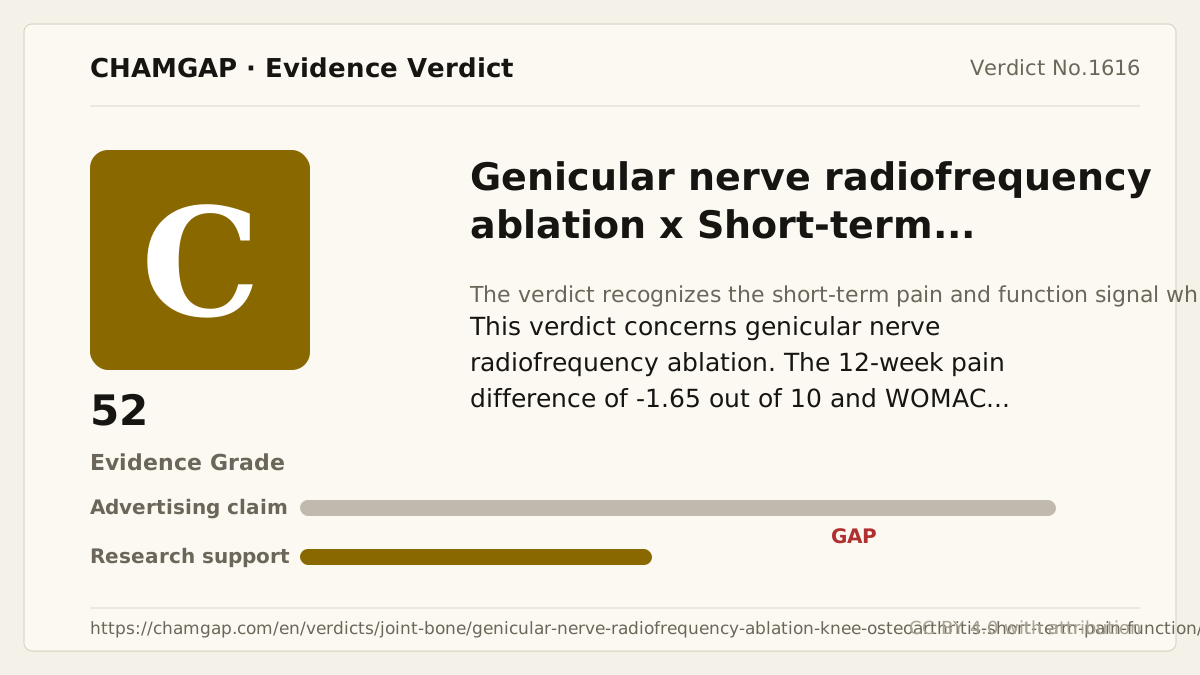
[Chamgap] Does genicular nerve radiofrequency ablation improve short-term pain and function in knee osteoarthritis? — Evidence Grade C·52. 2 cited sources checked. Source: https://chamgap.com/en/verdicts/joint-bone/genicular-nerve-radiofrequency-ablation-knee-osteoarthritis-short-term-pain-function/ · CC BY 4.0CC BY 4.0 — free to use with attribution; do not distort grades, numbers, or verdict meaning.
What this document does and does not do
Chamgap is an information source. It reports what research has and has not confirmed; it does not tell readers what to take or buy. That decision belongs to readers and, when needed, medical or legal professionals. This verdict reflects literature available up to the search date and may change as new research appears. Nothing here is medical advice.