
Febuxostat,
does it really help with Long-term reduction of gout flares and tophi by maintaining serum urate below 6 mg/dL in recurrent gout?
research showsFebuxostat is rated B because large randomized trials repeatedly show that it lowers and maintains serum urate below 6 mg/dL in recurrent gout, while evidence for long-term flare and tophus benefits relies mainly on open-label extensions and treat-to-target strategy data. In FACT, target achievement was 53% and 62% with febuxostat 80 and 120 mg versus 21% with fixed-dose allopurinol; in CONFIRMS it was 67% with 80 mg, 45% with 40 mg, and 42% with allopurinol. By contrast, the near-elimination of flares and 69% tophus resolution in the five-year FOCUS extension came from a single-arm cohort in which half of 116 participants discontinued. In the independent STOP Gout trial, 43.5% of febuxostat recipients still had at least one flare during the final 24 weeks after treat-to-target dosing. Strong urate lowering and a credible clinical direction are accepted, but direct evidence for the composite clinical claim is weaker than the surrogate evidence, yielding B with 74 points.
ads claimSimplified messaging can turn lowering urate into an immediate end to flares and disappearance of tophi. Flares may increase at initiation, anti-inflammatory prophylaxis is often needed for months, and people with a large crystal burden need prolonged target maintenance before clinical benefits emerge.
Useful facts when choosing a product
- Febuxostat is a prescription drug for long-term serum-urate lowering, not a drug that immediately treats the pain of an acute gout flare. The prescriber individualizes dosing according to serum urate, kidney and liver function, comorbidity, and the specific label.
- Gout flares can increase during initiation or dose escalation as tissue urate is mobilized, so colchicine, a nonsteroidal anti-inflammatory drug, or another anti-inflammatory prophylaxis is commonly used for three to six months. A flare is not a reason to stop febuxostat without medical advice.
- Elevated liver enzymes, rash, and severe hypersensitivity have been reported, and liver-function monitoring may be needed. Concomitant azathioprine or 6-mercaptopurine can cause marked toxicity and should be avoided.
- In people with gout and established cardiovascular disease, CARES found a signal for higher cardiovascular and all-cause mortality versus allopurinol, whereas FAST did not reproduce it. This unresolved safety issue should be discussed with the prescriber in light of cardiovascular history and alternatives.
Chamgap Semantic Classification Code
Candidate index · review held
M.febuxostat.UNK.gout-flares-and-tophi-by-maintaining-serum-urate-below-dl-in-recurrent-gout.reduce.MULTIMedicinal interventions > Febuxostat > Unknown > gout flares and tophi by maintaining serum urate below /dL in recurrent gout > Reduction claim > Multiple: primary unresolved
An automated migration candidate, not an issued permanent code; exact claim scope remains under review. This machine-generated migration candidate helps retrieval but is not a permanent assignment. The original verdict ID and URL remain authoritative.
What the research actually shows
FACT randomized 762 patients (760 treated) with gout to febuxostat 80 or 120 mg or allopurinol 300 mg and followed them for 52 weeks; serum urate below 6 mg/dL at each of the final three monthly measurements occurred in 53%, 62%, and 21%, respectively. CONFIRMS randomized 2,269 participants for six months to febuxostat 40 or 80 mg or allopurinol 200 or 300 mg according to renal function and confirmed 67% target achievement with 80 mg, but the principal efficacy outcome was serum urate. FOCUS was a five-year open extension of 116 people: 93% of the 58 remaining participants were below target, and 18 of 26 baseline tophi had resolved by the last visit on study drug, but half discontinued. The independent, publicly funded 940-person STOP Gout trial titrated both treatments to target; about 80% achieved the one-year target, while at least one flare during the final 24 weeks occurred in 43.5% with febuxostat and 36.5% with allopurinol. The ACR treat-to-target recommendation supports the strategy but regulatory or guideline endorsement was not counted as efficacy proof by itself.
Why this is classified as B (74)
Multiple large randomized trials strongly and consistently support achievement of serum urate below 6 mg/dL. Near-elimination of long-term flares and tophus resolution, however, are based mainly on open extensions with substantial attrition, and independent STOP Gout did not show superior flare control with febuxostat. The combination of strong surrogate evidence and limited direct long-term outcomes gives B with 74 points. Initiation flares, liver toxicity, and cardiovascular uncertainty remain separate safety issues.
Counterpoint. For recurrent flares or tophi when allopurinol does not achieve target or is not tolerated, febuxostat is an effective long-term urate-lowering option. This is distinct from claims of renal protection in asymptomatic hyperuricemia.
Rejudgment record. New verdict — Gave substantial weight to repeated target-urate success in the large FACT, APEX, and CONFIRMS randomized trials, but rated the composite claim B because long-term flare and tophus reductions rely mainly on high-attrition open extensions and treat-to-target strategy data, while independent STOP Gout showed no flare superiority
Sub-claim grades by effect
This ingredient is marketed for several effects. A single overall grade blends strong and weak claims together, so each effect is graded separately here. The overall grade reflects the strongest disconfirming or core claim.
| Effect (sub-claim) | Grade | Basis |
|---|---|---|
| Achievement and maintenance of serum urate below 6 mg/dL | B | Repeatedly established in large randomized trials, but serum urate is a surrogate and results depend on dose and comparator titration. |
| Reduction of long-term gout flares | B | Sustained target urate is linked to fewer flares, but near-elimination comes mainly from open extensions and independent testing showed no comparative superiority. |
| Reduction or resolution of tophus size or number | B | Long-term crystal dissolution and tophus resolution are supported, but evidence is dominated by small extension cohorts with substantial attrition. |
Cross-check — AI research and Codex final gate
Evidence Table
| Study | Design | Sample | Funding | Endpoint | Result | Weight |
|---|---|---|---|---|---|---|
| Becker MA et al. 2005 FACT | Fifty-two-week multicenter randomized double-blind active-controlled trial | 760 treated patients with gout and serum urate of at least 8 mg/dL | Industry funding and employee coauthorship from TAP Pharmaceutical Products | Serum urate below 6 mg/dL at each of the final three monthly measurements; flares and tophi as secondary outcomes | Target achievement was 53% with febuxostat 80 mg, 62% with 120 mg, and 21% with allopurinol 300 mg, while flare rates did not differ significantly among groups. | Large direct urate-lowering randomized trial dominated by a surrogate endpoint |
| Becker MA et al. 2010 CONFIRMS | Six-month multicenter randomized double-blind active-controlled trial | 2,269 patients with gout | Industry funding and employee coauthorship from Takeda | Serum urate below 6 mg/dL at the final visit | Target achievement was 45% with febuxostat 40 mg, 67% with 80 mg, and 42% with allopurinol 200 or 300 mg. | Largest target-urate randomized trial |
| Schumacher HR Jr et al. 2009 FOCUS | Five-year single-arm open-label extension | 116 enrolled and 58 discontinued prematurely | TAP/Takeda development program | Sustained serum urate, gout flares, and resolution of baseline tophi | Among 58 five-year completers, 93% were at target and flares became rare; 18 of 26 baseline tophi had resolved by the last visit on study drug. | Long-term clinical signal limited by no control group and 50% attrition |
| O'Dell JR et al. 2022 STOP Gout | Independent 72-week randomized double-blind double-dummy noninferiority trial | 940 patients with gout | Public funding from the US Department of Veterans Affairs Cooperative Studies Program | At least one gout flare during the final 24 weeks after treat-to-target titration | About 80% achieved target urate; late flares occurred in 43.5% with febuxostat and 36.5% with allopurinol, establishing allopurinol noninferiority. | Independent large randomized trial with a direct flare endpoint |
Receipt — 5 References
All 5 cited sources were verified for existence at the original page (as of 2026-07-21).
Final verification and publication gate: Codex · Evidence date: 2026-07-21 · Corrections: none
Cite this verdict
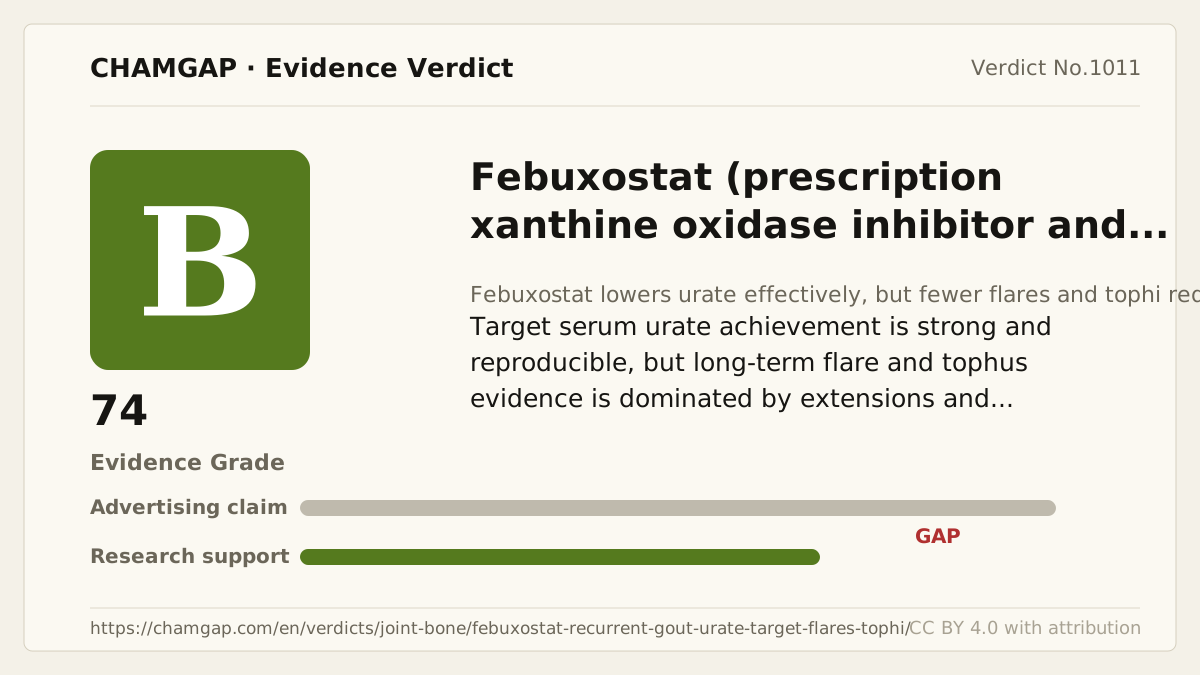
[Chamgap] Febuxostat x urate target, long-term flare reduction, and tophus reduction in recurrent gout — Evidence Grade B·74. 5 cited sources checked. Source: https://chamgap.com/en/verdicts/joint-bone/febuxostat-recurrent-gout-urate-target-flares-tophi/ · CC BY 4.0CC BY 4.0 — free to use with attribution; do not distort grades, numbers, or verdict meaning.
What this document does and does not do
Chamgap is an information source. It reports what research has and has not confirmed; it does not tell readers what to take or buy. That decision belongs to readers and, when needed, medical or legal professionals. This verdict reflects literature available up to the search date and may change as new research appears. Nothing here is medical advice.