
Far-infrared sauna,
does it really help with Relief of joint pain and morning stiffness in rheumatoid arthritis and ankylosing spondylitis?
research showsFar-infrared sauna is rated D for relieving joint pain and morning stiffness in rheumatoid arthritis or ankylosing spondylitis. The central direct evidence is essentially an uncontrolled four-week pilot with 18 participants in each disease group. Pain and stiffness fell immediately around sessions, but without a control group the study cannot separate heat, rest, expectation, and natural variation. Randomized evidence for disease activity and lasting benefit is lacking.
ads claimMarketing expands temporary comfort from warmth into removal of inflammation, immune normalization, or control of disease activity. Infrared sauna does not replace disease-modifying antirheumatic drugs or biologic therapy.
Useful facts when choosing a product
- A far-infrared sauna uses radiant heat for whole-body warming and is not standard disease-modifying treatment for inflammatory rheumatic disease.
- Fluid and electrolyte loss, dizziness, hypotension, fainting, heat intolerance, and skin burns can occur, so temperature and duration should be conservative.
- It should be avoided during alcohol use, fever, acute illness, or dehydration; people with cardiovascular disease, low blood pressure, or pregnancy should seek medical advice first.
- Stop if heat worsens pain or an acutely swollen and hot joint, and obtain assessment of inflammatory disease activity.
Chamgap Semantic Classification Code
Candidate index · review held
P.far-infrared-sauna.device.joint-pain-and-morning-stiffness-in-rheumatoid-arthritis-and-ankylosing-spondylitis.relieve.UNKProcedures, devices and tests > Far-infrared sauna > Device delivered > joint pain and morning stiffness in rheumatoid arthritis and ankylosing spondylitis > Symptom-relief claim > Unknown
An automated migration candidate, not an issued permanent code; exact claim scope remains under review. This machine-generated migration candidate helps retrieval but is not a permanent assignment. The original verdict ID and URL remain authoritative.
What the research actually shows
The 2009 pilot enrolled 18 participants with rheumatoid arthritis and 18 with ankylosing spondylitis for two infrared-sauna sessions weekly over four weeks. Pain and stiffness decreased during treatment, but there was no control or masking and each disease sample was very small. A 2018 systematic review covered 40 dry-sauna studies across many conditions but did not identify an independent randomized replication for rheumatoid arthritis or ankylosing spondylitis.
Why this is classified as D (27)
An uncontrolled pilot with 18 participants per disease found short-term subjective symptom improvement, but no control, masking, adequate sample, or long-term disease-activity endpoint exists, giving D with 27 points. The systematic review did not add independent randomized replication.
Counterpoint. Anyone trying it for adjunctive comfort should use a short, low-intensity exposure and monitor symptoms and blood pressure while continuing medication and regular disease-activity assessment.
Rejudgment record. New verdict — Applied boundary rule ② because direct evidence is concentrated in a four-week uncontrolled pilot with 18 rheumatoid-arthritis and 18 ankylosing-spondylitis participants, subjective short-term pain and stiffness outcomes, and no independent randomized replication or long-term disease-activity endpoint
Sub-claim grades by effect
This ingredient is marketed for several effects. A single overall grade blends strong and weak claims together, so each effect is graded separately here. The overall grade reflects the strongest disconfirming or core claim.
| Effect (sub-claim) | Grade | Basis |
|---|---|---|
| Relief of joint pain | D | Only immediate subjective pain decreased in an uncontrolled study with 18 participants per disease. |
| Relief of morning stiffness | D | The signal was uncontrolled and short term, without separation of natural variation, rest, or expectation effects. |
| Improved disease activity and long-term symptoms | D | Adequate randomized control and long-term follow-up are absent, so a sustained anti-inflammatory effect is unproven. |
Cross-check — AI research and Codex final gate
Evidence Table
| Study | Design | Sample | Funding | Endpoint | Result | Weight |
|---|---|---|---|---|---|---|
| Oosterveld FGJ et al. 2009 | Four-week uncontrolled before-after pilot study | Eighteen participants with rheumatoid arthritis and eighteen with ankylosing spondylitis | Inadequately reported | Pre-to-post-session pain, stiffness, fatigue, and four-week disease measures | Pain and stiffness decreased during sessions, but there was no control group and long-term disease-activity improvement was not established. | Only key direct evidence with very low certainty |
| Hussain J and Cohen M. 2018 | Systematic review of human dry-sauna studies | Forty studies across conditions, including 25 infrared-sauna studies | Academic research | Condition-specific clinical effects and adverse events | It noted possible rheumatic benefits, but rheumatoid-arthritis and ankylosing-spondylitis evidence relied on a small uncontrolled study and required further trials. | Evidence-gap assessment |
Receipt — 2 References
All 2 cited sources were verified for existence at the original page (as of 2026-07-23).
Final verification and publication gate: Codex · Evidence date: 2026-07-23 · Corrections: none
Cite this verdict
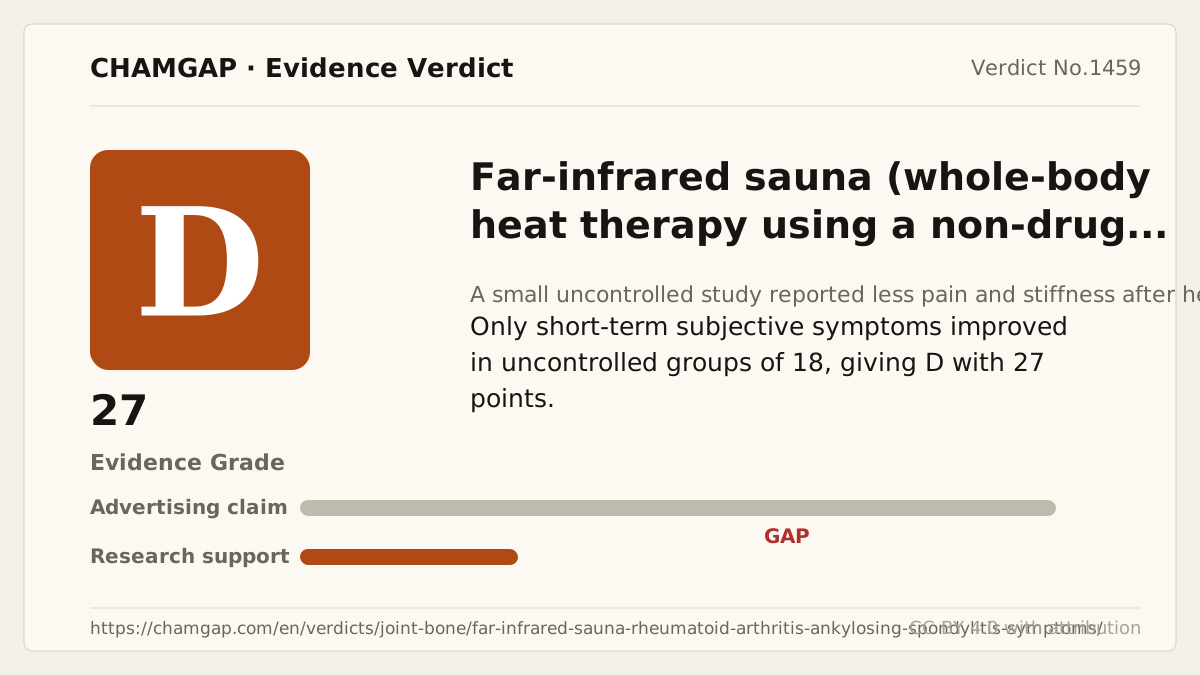
[Chamgap] Far-infrared sauna x symptom relief in rheumatoid arthritis and ankylosing spondylitis — Evidence Grade D·27. 2 cited sources checked. Source: https://chamgap.com/en/verdicts/joint-bone/far-infrared-sauna-rheumatoid-arthritis-ankylosing-spondylitis-symptoms/ · CC BY 4.0CC BY 4.0 — free to use with attribution; do not distort grades, numbers, or verdict meaning.
What this document does and does not do
Chamgap is an information source. It reports what research has and has not confirmed; it does not tell readers what to take or buy. That decision belongs to readers and, when needed, medical or legal professionals. This verdict reflects literature available up to the search date and may change as new research appears. Nothing here is medical advice.