
Extracorporeal shock-wave therapy,
does it really help with Improvement of morning first-step pain and function in chronic plantar fasciitis?
research showsExtracorporeal shock-wave therapy is rated C. The 245-participant Gerdesmeyer 2008 AJSM trial, associated with support from manufacturer EMS Electro Medical Systems, was positive for 12-week composite VAS reduction at 72.1% versus 44.7%, P=0.022. In contrast, the independent double-blind Buchbinder 2002 trial, publicly funded by the Australian NHMRC and others, was null with a difference of 0.6 on a 100-mm scale. The Thomson 2005 meta-analytic effect was also small at about 0.42 on a 10-cm scale. Rule ①-ⓒ gives C with 48 points.
ads claimMarketing can claim that shock waves regenerate tissue and remove the cause, but clinical evidence mainly concerns short-term pain and does not establish structural regeneration or reliable cure. Devices and protocols differ substantially.
Useful facts when choosing a product
- Radial and focused ESWT have different physical properties and energy delivery and cannot be treated as automatically equivalent.
- Several sessions over weeks are common, but impulse count, energy, and anesthesia vary by device and clinic.
- Treatment pain, transient redness, swelling, bruising, and numbness can occur.
- It is generally considered after stretching, load modification, footwear, orthoses, and other conservative care have not resolved chronic symptoms.
Chamgap Semantic Classification Code
Candidate index · review held
P.extracorporeal-shock-wave-therapy.procedural.morning-first-step-pain-and-function-in-chronic-plantar-fasciitis.improve.shamProcedures, devices and tests > Extracorporeal shock-wave therapy > Procedural > morning first-step pain and function in chronic plantar fasciitis > Improvement claim > Sham procedure or device
An automated migration candidate, not an issued permanent code; exact claim scope remains under review. This machine-generated migration candidate helps retrieval but is not a permanent assignment. The original verdict ID and URL remain authoritative.
What the research actually shows
Gerdesmeyer et al. 2008 in AJSM randomized 245 patients. This manufacturer-supported trial was associated with EMS Electro Medical Systems and found 12-week composite VAS reduction of 72.1% versus 44.7%, P=0.022. Buchbinder et al. 2002 was an independent double-blind trial publicly funded by the Australian NHMRC and others; it randomized 166 and analyzed 160 at 12 weeks, finding a null difference of 0.6 on a 100-mm scale. The Thomson et al. 2005 meta-analytic effect was also small at about 0.42 on a 10-cm scale. Thus, the manufacturer trial was positive, the publicly funded independent trial was null, and the meta-analytic effect was small, meeting rule ①-ⓒ. This indication differs from verdict 1574, which is C with 52 points, so that evidence was not mixed into this verdict.
Why this is classified as C (48)
The 245-participant manufacturer-supported Gerdesmeyer trial was positive, while the publicly funded independent double-blind Buchbinder trial was null at 0.6 of 100 mm. The Thomson meta-analytic effect was small at about 0.42 of 10 cm, so rule ①-ⓒ gives C with 48 points.
Counterpoint. It may be tried in selected chronic cases that have not responded to conservative care, but it should not be presented as guaranteed large pain relief or tissue regeneration.
Rejudgment record. Cross-check applied — The 245-participant Gerdesmeyer 2008 AJSM trial, associated with support from manufacturer EMS Electro Medical Systems, was positive for 12-week composite VAS reduction at 72.1% versus 44.7%, P=0.022. The independent double-blind Buchbinder 2002 trial, publicly funded by the Australian NHMRC and others, was null at 0.6 of 100 mm, and the Thomson 2005 meta-analytic effect was small at about 0.42 of 10 cm. Rule ①-ⓒ applies.
Sub-claim grades by effect
This ingredient is marketed for several effects. A single overall grade blends strong and weak claims together, so each effect is graded separately here. The overall grade reflects the strongest disconfirming or core claim.
| Effect (sub-claim) | Grade | Basis |
|---|---|---|
| Reduction in morning first-step pain at 12 weeks | C | The pooled difference was statistically positive at 0.42 cm on a 10-cm VAS but below clinical importance. |
| Reduction in overall heel pain at 12 weeks | D | The prespecified primary endpoint in the independent 160-patient analysis failed with P=0.99. |
| Improvement in foot function | C | Some trials were positive, but walking and Maryland Foot Score were null in the independent trial, making results inconsistent. |
Cross-check — AI research and Codex final gate
Evidence Table
| Study | Design | Sample | Funding | Endpoint | Result | Weight |
|---|---|---|---|---|---|---|
| Gerdesmeyer L et al. 2008 | Multicenter randomized double-blind sham-controlled radial ESWT trial | 245 randomized and 245 included in the full-analysis-set primary analysis | Support and product-development context from device manufacturer EMS Electro Medical Systems | Change and success rate for the three-component VAS composite at 12 weeks | Primary endpoint succeeded: composite VAS reduction 72.1% versus 44.7%, P=0.022. | Key positive direct randomized trial |
| Buchbinder R et al. 2002 | Randomized double-blind low-dose-sham-controlled ultrasound-guided ESWT trial | 166 randomized; 161 in the postbaseline intention-to-treat population; 160 actually analyzed at 12 weeks | Public funding from the Australian NHMRC and other sources; independent research | Overall heel pain on a 100-mm VAS at 12 weeks | Primary endpoint failed: improvement 26.3 versus 25.7 mm, between-group difference 0.6 mm (95% CI -10.3 to 11.5), P=0.99. | Key independent null randomized trial |
| Thomson CE et al. 2005 | Systematic review and meta-analysis of randomized trials | Six randomized trials and 897 patients | Academic research at Queen Margaret University, University of Dundee, and University of Edinburgh; no manufacturer funding reported | Morning first-step pain on a 10-cm VAS at about 12 weeks | WMD 0.42 cm (95% CI 0.02 to 0.83), statistically positive but clinically very small and null when restricted to high-quality trials. | Pooled evidence below clinical importance |
Receipt — 3 References
All 3 cited sources were verified for existence at the original page (as of 2026-07-24).
Final verification and publication gate: Codex · Evidence date: 2026-07-24 · Corrections: none
Cite this verdict
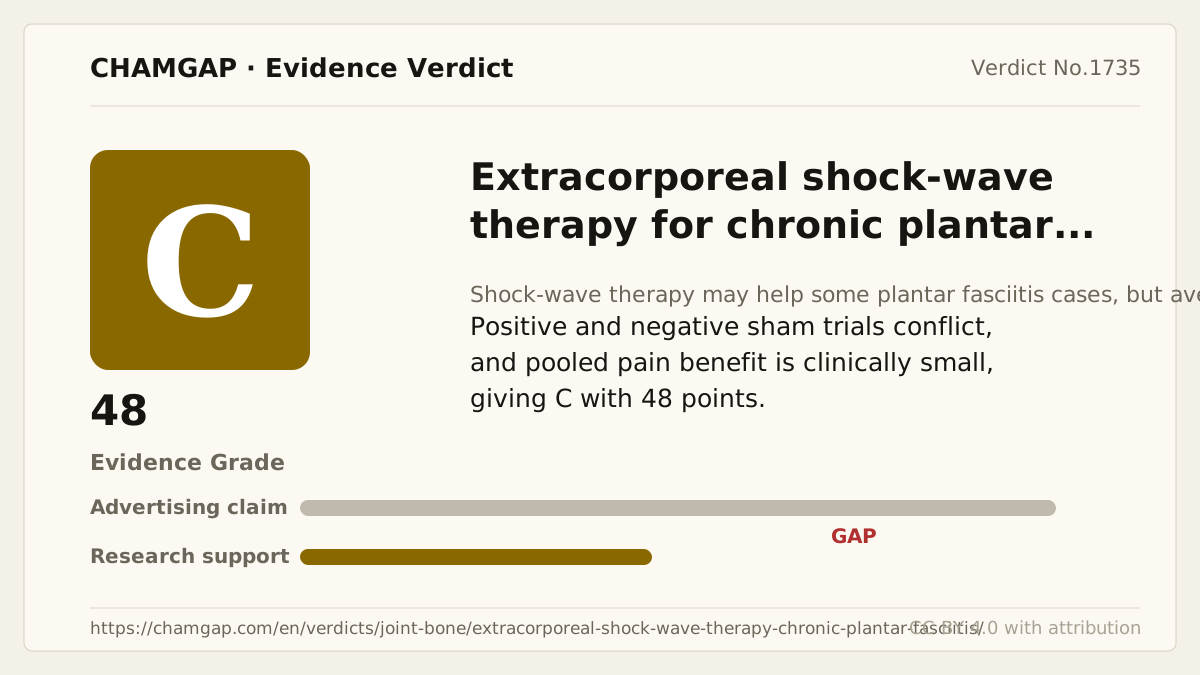
[Chamgap] Extracorporeal shock-wave therapy x pain improvement in chronic plantar fasciitis — Evidence Grade C·48. 3 cited sources checked. Source: https://chamgap.com/en/verdicts/joint-bone/extracorporeal-shock-wave-therapy-chronic-plantar-fasciitis/ · CC BY 4.0CC BY 4.0 — free to use with attribution; do not distort grades, numbers, or verdict meaning.
What this document does and does not do
Chamgap is an information source. It reports what research has and has not confirmed; it does not tell readers what to take or buy. That decision belongs to readers and, when needed, medical or legal professionals. This verdict reflects literature available up to the search date and may change as new research appears. Nothing here is medical advice.