
External hip protector,
does it really help with Prevention of hip fractures in older adults at high risk of falls?
research showsExternal hip protectors are rated C because they may slightly reduce hip fractures in nursing or residential care but show no benefit in community-dwelling older adults. The 2014 Cochrane review synthesized 19 trials with about 17,000 participants: RR 0.82 (95% CI 0.67 to 1.00) among 11,808 institutional residents and RR 1.15 (0.84 to 1.58) among 5,614 community residents. Long-term adherence is poor, and fit, comfort, and impact attenuation vary by product, so provision is not equivalent to protection at the moment of a fall. Skin irritation and discomfort are usually minor, but the uncertain pelvic-fracture signal and the danger of substituting the device for broader fall prevention remain relevant.
ads claimMarketing can turn laboratory impact-attenuation demonstrations into a promise of real-world fracture prevention. Laboratory attenuation is not the same as clinical effectiveness; the best-supported use is a suitable device worn consistently by high-risk institutional residents.
Useful facts when choosing a product
- An external hip protector places a hard shell or soft foam pad over the greater trochanter in specialized underwear to absorb or divert energy during a sideways fall.
- It can work only while worn and correctly positioned, making fit and use during periods of fall risk essential.
- Pad materials and impact attenuation differ across products, so results for one design cannot be generalized to all protectors.
- Skin irritation, heat, pressure, and toileting inconvenience can occur. Fall-risk assessment, strength and balance training, environmental measures, and osteoporosis care remain necessary.
Chamgap Semantic Classification Code
Candidate index · review held
UNK.external-hip-protector.UNK.hip-fractures-at-high-risk-of-falls.prevent.UNKUnknown > External hip protector > Unknown > hip fractures at high risk of falls > Occurrence-prevention claim > Unknown
An automated migration candidate, not an issued permanent code; exact claim scope remains under review. This machine-generated migration candidate helps retrieval but is not a permanent assignment. The original verdict ID and URL remain authoritative.
What the research actually shows
The Santesso Cochrane review included 19 randomized or quasi-randomized trials and about 17,000 people. The institutional estimate corresponded to about 11 fewer hip fractures per 1,000 people, but its confidence interval reached no effect; the community estimate showed little or no difference. Fall rates did not change, and reported adverse events such as skin irritation ranged from 0% to 5%. Pelvic fracture had an uncertain increase signal, RR 1.27 (0.78 to 2.08). A separate adherence review found median initial acceptance of 68% and median adherence of 56%; discomfort, effort, incontinence, and physical difficulty were common reasons for nonuse.
Why this is classified as C (52)
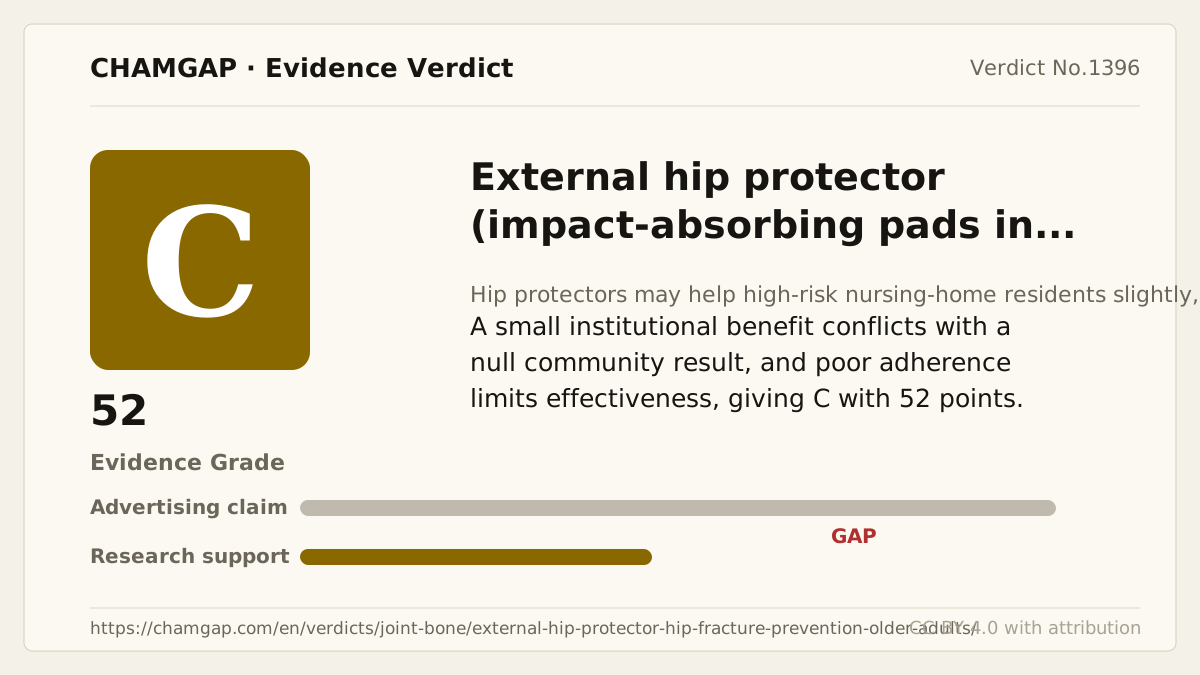
In the approximately 17,000-person Cochrane synthesis, institutional care showed a small benefit at RR 0.82 while community use was null at RR 1.15. A direct fracture outcome is valuable, but conflict by setting and poor long-term adherence yield C with 52 points.
Counterpoint. A trial may be reasonable for institutional residents with repeated falls when staff can support use. If discomfort leads to nonuse, fit, product choice, and wearing schedule should be reassessed.
Rejudgment record. New verdict — Applied boundary rule ② for conflicting evidence because a small reduction in hip fractures among institutional residents contrasts with no effect among community residents and real-world long-term adherence is poor
Sub-claim grades by effect
This ingredient is marketed for several effects. A single overall grade blends strong and weak claims together, so each effect is graded separately here. The overall grade reflects the strongest disconfirming or core claim.
| Effect (sub-claim) | Grade | Basis |
|---|---|---|
| Prevention of hip fractures in nursing or residential care residents | C | Fourteen trials with 11,808 participants found a small benefit at RR 0.82, but the confidence interval reached 1.00 and adherence was poor. |
| Prevention of hip fractures in community-dwelling older adults | D | Five trials with 5,614 participants found no significant preventive effect, with RR 1.15. |
| Reduction in falls themselves | D | The device attenuates impact rather than preventing falls, and the pooled fall rate ratio was null at 1.02. |
Cross-check — AI research and Codex final gate
Evidence Table
| Study | Design | Sample | Funding | Endpoint | Result | Weight |
|---|---|---|---|---|---|---|
| Santesso N et al. 2014 | Cochrane systematic review of randomized and quasi-randomized trials | 19 trials and approximately 17,000 participants | Academic Cochrane review; funding varied across included trials | Hip fracture, falls, pelvic fracture, and adverse events | Results differed by setting: RR 0.82 (95% CI 0.67 to 1.00) in institutions and RR 1.15 (0.84 to 1.58) in the community. | Key large direct synthesis |
| van Schoor NM et al. 2002 | Systematic review of acceptance and adherence | 14 reports; acceptance 37% to 72% and adherence 20% to 92% | Academic research; funding varied by report | Initial acceptance and real-world wearing adherence | Median acceptance was 68% and median adherence was 56%, with discomfort and effort as major barriers. | Key implementation evidence |
Receipt — 2 References
All 2 cited sources were verified for existence at the original page (as of 2026-07-23).
Final verification and publication gate: Codex · Evidence date: 2026-07-23 · Corrections: none
Cite this verdict
[Chamgap] External hip protector x prevention of hip fractures in older adults at high risk of falls — Evidence Grade C·52. 2 cited sources checked. Source: https://chamgap.com/en/verdicts/joint-bone/external-hip-protector-hip-fracture-prevention-older-adults/ · CC BY 4.0CC BY 4.0 — free to use with attribution; do not distort grades, numbers, or verdict meaning.
What this document does and does not do
Chamgap is an information source. It reports what research has and has not confirmed; it does not tell readers what to take or buy. That decision belongs to readers and, when needed, medical or legal professionals. This verdict reflects literature available up to the search date and may change as new research appears. Nothing here is medical advice.