
Etoricoxib 30 mg,
does it really help with Reduced pain and improved physical function in symptomatic knee or hip osteoarthritis?
research showsEtoricoxib 30 mg is rated B because it reduces pain and improves self-reported physical function in symptomatic knee or hip osteoarthritis. In a 12-week randomized trial of 548 participants, WOMAC pain improved by 11.66 mm and physical function by 10.15 mm more than placebo. Two identically designed trials enrolling 599 and 608 participants also found both etoricoxib and celecoxib superior to placebo on all three co-primary endpoints. A separate 528-participant trial replicated improvements in WOMAC pain, function, and patient global assessment. Pain and daily function are directly important to patients, but the measures are subjective, positive trials are concentrated in manufacturer-sponsored programs, and the studies do not establish structural modification or prevention of long-term disability. The grade is therefore B with 76 points. Cardiovascular, blood-pressure, kidney, and gastrointestinal risks are kept separate under safety.
ads claimMarketing can expand osteoarthritis treatment into cartilage restoration or slowing of disease progression. The evidence supports short-term relief of pain and self-reported functional limitation while taking the drug, not replacement of weight management, exercise, physical therapy, or surgical assessment, and not restoration of joint structure.
Useful facts when choosing a product
- For symptomatic osteoarthritis, etoricoxib 30 mg is generally taken once daily, using the lowest effective dose for the shortest possible duration with periodic reassessment of need.
- Selective COX-2 inhibition can still increase the risks of myocardial infarction, stroke, higher blood pressure, edema, and heart failure, requiring avoidance or strict assessment in cardiovascular disease or uncontrolled hypertension.
- The risk of upper gastrointestinal ulceration or bleeding may be lower than with some nonselective drugs but is not eliminated, and anticoagulants, antiplatelet agents, or other nonsteroidal anti-inflammatory drugs can increase it.
- Dehydration, older age, diuretics, angiotensin-converting-enzyme inhibitors, angiotensin-receptor blockers, and preexisting kidney disease raise concern for acute kidney injury and electrolyte abnormalities, and use in pregnancy requires separate clinical judgment.
Chamgap Semantic Classification Code
Candidate index · review held
M.etoricoxib.UNK.pain-and-improved-physical-function-in-symptomatic-knee-or-hip-osteoarthritis.reduce.placeboMedicinal interventions > Etoricoxib > Unknown > pain and improved physical function in symptomatic knee or hip osteoarthritis > Reduction claim > Placebo
An automated migration candidate, not an issued permanent code; exact claim scope remains under review. This machine-generated migration candidate helps retrieval but is not a permanent assignment. The original verdict ID and URL remain authoritative.
What the research actually shows
Puopolo and colleagues randomized 548 patients with knee or hip osteoarthritis to placebo, etoricoxib 30 mg once daily, or ibuprofen 800 mg three times daily. All three co-primary endpoints were superior to placebo over 12 weeks and clinically comparable with ibuprofen. Bingham and colleagues randomized 599 and 608 participants to etoricoxib 30 mg, celecoxib 200 mg, or placebo; both active treatments improved WOMAC pain, function, and global assessment at 12 weeks, with comparative efficacy maintained through 26 weeks. The 34,701-participant MEDAL program found thrombotic cardiovascular event rates with higher-dose etoricoxib, 60 or 90 mg, similar to diclofenac, but diclofenac itself carries cardiovascular risk, so this does not establish absence of harm.
Why this is classified as B (76)
A 548-participant trial, two identically designed repeated trials totaling 1,207 participants, and a separate 528-participant trial consistently improved WOMAC pain, function, and patient global assessment. Direct patient-important symptom outcomes are a strength, but they are largely 12-week and self-reported and the evidence is concentrated in manufacturer-sponsored work, resulting in B rather than A, with 76 points. Cardiovascular, blood-pressure, kidney, and gastrointestinal risks are separate from the efficacy score.
Counterpoint. Short-term treatment may restore function when other pain-control approaches are insufficient. Cardiovascular, kidney, and gastrointestinal risks and concomitant drugs should determine the lowest effective dose and planned stopping point.
Rejudgment record. Cross-verification incorporated — Applied B rather than A because a 548-participant trial, two identically designed repeated trials totaling 1,207 participants, and a separate 528-participant trial consistently improved patient-important WOMAC pain and function, while the evidence remains largely 12-week, self-reported, and concentrated in manufacturer sponsorship
Sub-claim grades by effect
This ingredient is marketed for several effects. A single overall grade blends strong and weak claims together, so each effect is graded separately here. The overall grade reflects the strongest disconfirming or core claim.
| Effect (sub-claim) | Grade | Basis |
|---|---|---|
| Pain reduction in symptomatic knee or hip osteoarthritis | B | WOMAC pain improved consistently across placebo-controlled trials, but the evidence is short-term and self-reported. |
| Improved physical function in symptomatic knee or hip osteoarthritis | B | WOMAC physical-function improvement was replicated but does not establish objective walking performance or prevention of long-term disability. |
| Improved patient global assessment of disease status | B | This co-primary endpoint improved repeatedly, but it is subjective and concentrated in manufacturer-sponsored trials. |
Cross-check — AI research and Codex final gate
Evidence Table
| Study | Design | Sample | Funding | Endpoint | Result | Weight |
|---|---|---|---|---|---|---|
| Puopolo et al. 2007 | Twelve-week randomized double-blind placebo- and ibuprofen-controlled trial | 548 participants with knee or hip osteoarthritis | Merck study with multiple company-affiliated authors | WOMAC pain, physical function, and patient global assessment | Differences versus placebo were -11.66 mm for pain, -10.15 mm for function, and -11.65 mm for global assessment; all were significant and efficacy was comparable to ibuprofen. | Key dose-specific direct efficacy evidence |
| Bingham et al. 2007 | Two identically designed 26-week randomized double-blind placebo-controlled noninferiority trials | 599 and 608 participants; 1,207 total | Merck studies with company-affiliated authors | WOMAC pain, physical function, and patient global assessment at 12 weeks; active comparison through 26 weeks | In both trials, etoricoxib and celecoxib were superior to placebo on all three endpoints, and etoricoxib was noninferior to celecoxib. | Large replication evidence |
| MEDAL program, Cannon et al. 2006 | Prespecified pooled cardiovascular safety analysis of three long-term randomized trials | 34,701 participants with osteoarthritis or rheumatoid arthritis | Funded by Merck | Thrombotic cardiovascular and gastrointestinal events with etoricoxib 60 or 90 mg versus diclofenac | Thrombotic cardiovascular event rates were similar; upper gastrointestinal clinical events were fewer with etoricoxib, while complicated events were similar. | Safety context, not 30-mg efficacy evidence |
Receipt — 3 References
All 3 cited sources were verified for existence at the original page (as of 2026-07-21).
Final verification and publication gate: Codex · Evidence date: 2026-07-21 · Corrections: none
Cite this verdict
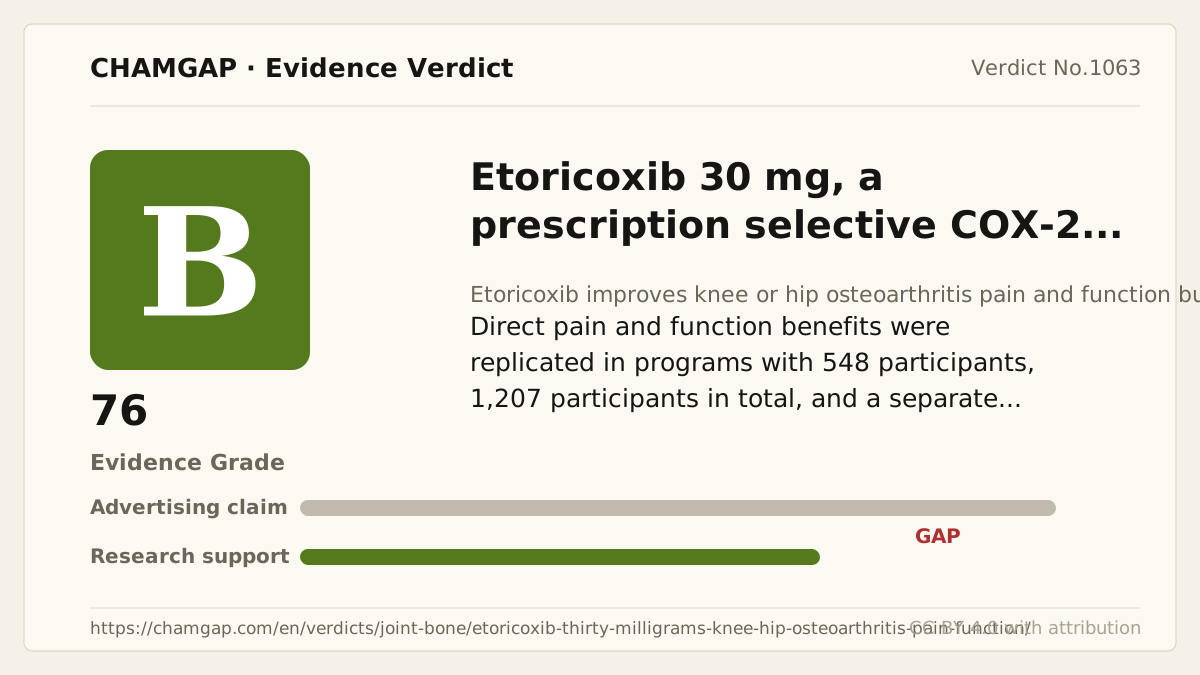
[Chamgap] Etoricoxib 30 mg x pain and function improvement in knee or hip osteoarthritis — Evidence Grade B·76. 3 cited sources checked. Source: https://chamgap.com/en/verdicts/joint-bone/etoricoxib-thirty-milligrams-knee-hip-osteoarthritis-pain-function/ · CC BY 4.0CC BY 4.0 — free to use with attribution; do not distort grades, numbers, or verdict meaning.
What this document does and does not do
Chamgap is an information source. It reports what research has and has not confirmed; it does not tell readers what to take or buy. That decision belongs to readers and, when needed, medical or legal professionals. This verdict reflects literature available up to the search date and may change as new research appears. Nothing here is medical advice.