
Dry needling,
does it really help with Reduced morning first-step and foot pain in plantar fasciitis?
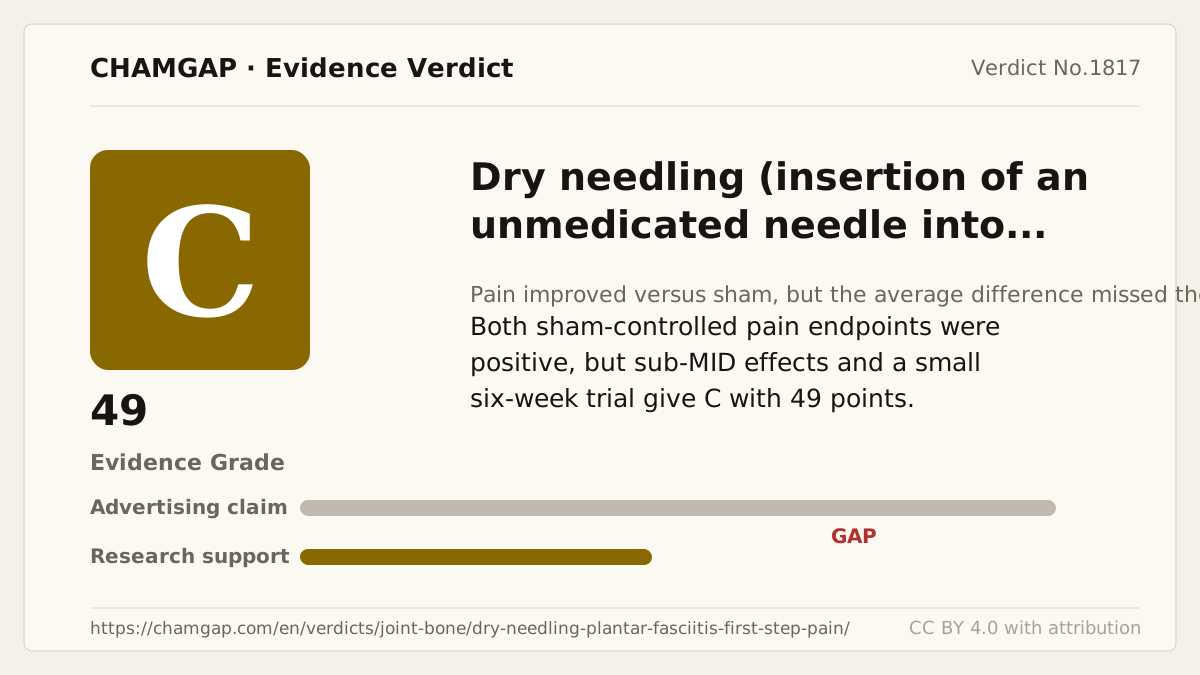
research showsDry needling is rated C for first-step pain in plantar fasciitis. Cotchett randomized and analyzed 84 participants by intention to treat. At week 6, the real-versus-sham differences were -14.4 mm on first-step VAS pain (95% CI -23.5 to -5.2) and +10.0 FHSQ foot-pain points (1.0 to 19.1). Both were statistically positive, but their point estimates were smaller than the respective sample-sizing MIDs of 19 mm and 13 points. Small size and short duration produce B2, while sub-MID benefit gives E~.
ads claimNeedles physically enter skin and trigger-point muscle. That fact does not establish structural correction or permanent cure; evidence supports a modest short-term pain difference.
Useful facts when choosing a product
- verdict 1725, which is C with 44 points, concerns dry needling for chronic neck pain, a different indication.
- verdict 1735, which is C with 48 points, concerns extracorporeal shockwave therapy, while verdict 1789, which is D with 30 points, concerns night splints; both use different interventions for plantar fasciitis.
Chamgap Semantic Classification Code
Candidate index · review held
P.dry-needling.procedural.morning-first-step-and-foot-pain-in-plantar-fasciitis.reduce.shamProcedures, devices and tests > Dry needling > Procedural > morning first-step and foot pain in plantar fasciitis > Reduction claim > Sham procedure or device
An automated migration candidate, not an issued permanent code; exact claim scope remains under review. This machine-generated migration candidate helps retrieval but is not a permanent assignment. The original verdict ID and URL remain authoritative.
What the research actually shows
Cotchett and colleagues assigned 84 participants to real or sham needling and analyzed all 84 by intention to treat with multiple imputation. Week-6 differences were -14.4 mm on first-step VAS (95% CI -23.5 to -5.2; P=.002) and +10.0 FHSQ pain points (1.0 to 19.1; P=.029). The Landorf source used for sample sizing set MIDs at 19 mm for VAS and 13 points for FHSQ pain, so both point estimates were smaller. A 2021 meta-analysis of six randomized trials reported short-term pain MD -1.70/10 (-2.80 to -0.60) and long-term -1.77 (-2.44 to -1.11), with low-to-moderate certainty.
Why this is classified as C (54)
The profile is P, R2, I2, E~, and B2. Sham-controlled statistical success is retained, but sub-MID effect and small short trials give C with 54 points.
Counterpoint. A modest short-term benefit is possible, but it should accompany load management, stretching, footwear, and other foundational care.
Rejudgment record. Cross-check applied — Accepted sham-controlled differences of -14.4 mm VAS and +10.0 FHSQ while applying E~ for missing the 19 mm and 13 point MIDs and B2 for small short evidence
| Endpoint | P | Symptom or function itself is the target - including patient reports and performance tests |
| Replication | R2 | Independently replicated across trials |
| Independence | I2 | Decisive evidence is publicly or non-profit funded |
| Effect size | E~ | Statistically positive but below the threshold |
Stored derived and displayed grades match; this is not a current recalculation or validity check (C).
Sub-claim grades by effect
This ingredient is marketed for several effects. A single overall grade blends strong and weak claims together, so each effect is graded separately here. The overall grade reflects the strongest disconfirming or core claim.
| Effect (sub-claim) | Grade | Basis |
|---|---|---|
| Reduced morning first-step pain at six weeks | C | Statistically positive versus sham, but below the prespecified MID. |
| Improved foot pain at six weeks | C | FHSQ pain was positive in a small short trial. |
| Improved plantar-fasciitis-related disability | C | Meta-analytic signals exist with low-to-moderate certainty. |
Cross-check — AI research and Codex final gate
Evidence Table
| Study | Design | Sample | Funding | Endpoint | Result | Weight |
|---|---|---|---|---|---|---|
| Cotchett MP et al. 2014 | Participant-blinded randomized sham-controlled trial | 84 randomized; actual intention-to-treat primary analysis 84 | Academic funding from the Australian Podiatry Education and Research Foundation and La Trobe University | Coprimary week-6 first-step VAS and FHSQ foot pain | Both succeeded at -14.4 mm and +10.0 points, but point estimates missed the MIDs used for sample sizing. | Pivotal sham-controlled trial |
| Llurda-Almuzara L et al. 2021 | Systematic review and meta-analysis of six randomized trials | Six randomized trials; individual studies were small | Academic research with no manufacturer-only sponsorship reported | Short- and long-term pain and disability | Pain signals were positive, with low-to-moderate certainty. | Replication and limitation assessment |
Receipt — 3 References
All 3 cited sources were verified for existence at the original page (as of 2026-07-24).
Final verification and publication gate: Codex · Evidence date: 2026-07-24 · Corrections: none
Cite this verdict
[Chamgap] Dry needling x reduced first-step pain in plantar fasciitis — Evidence Grade C·54. 3 cited sources checked. Source: https://chamgap.com/en/verdicts/joint-bone/dry-needling-plantar-fasciitis-first-step-pain/ · CC BY 4.0CC BY 4.0 — free to use with attribution; do not distort grades, numbers, or verdict meaning.
What this document does and does not do
Chamgap is an information source. It reports what research has and has not confirmed; it does not tell readers what to take or buy. That decision belongs to readers and, when needed, medical or legal professionals. This verdict reflects literature available up to the search date and may change as new research appears. Nothing here is medical advice.