
Dry needling,
does it really help with Reduction of chronic nonspecific neck muscle pain and disability?
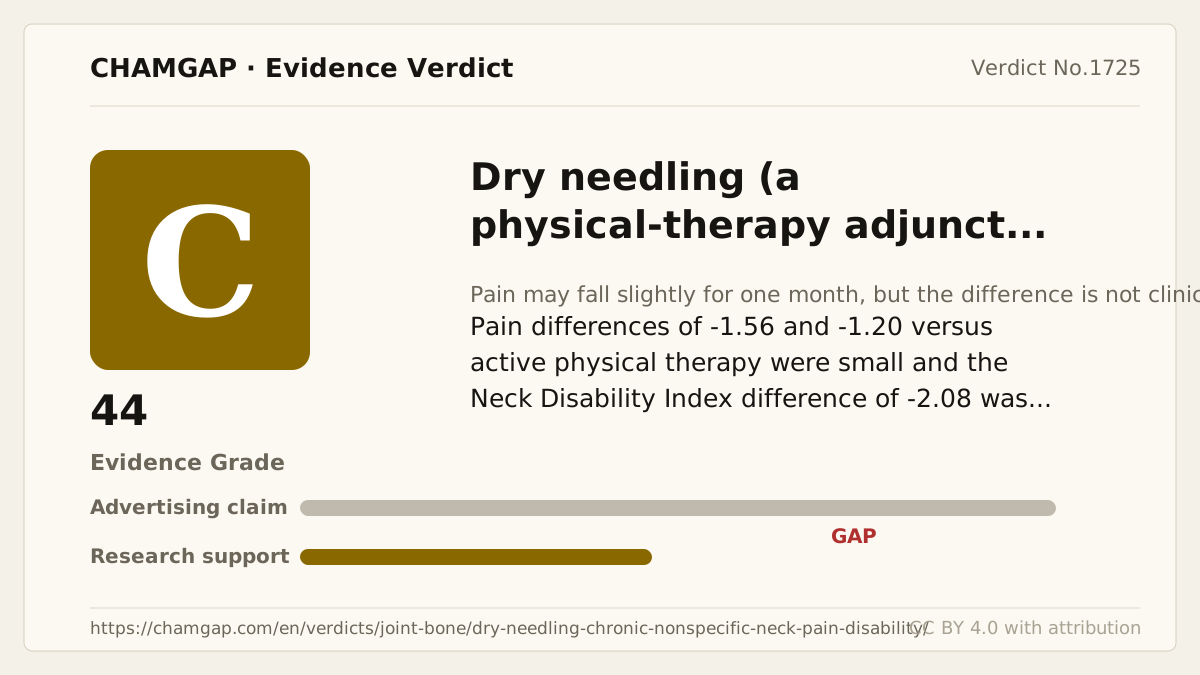
research showsDry needling added to identical active physical therapy is rated C because it produces only a small statistical reduction in chronic nonspecific neck pain at one month. The control was not sham needling. Neck-pain NRS has no single absolute minimal clinically important difference: Pool and colleagues reported a 2.5-point ROC threshold, Cleland and colleagues reported 1.3 points, and trials commonly use about 2 points or 30% improvement. Differences of -1.56 and -1.20 are small under these standards, and the Neck Disability Index difference of -2.08 was null.
ads claimMarketing may promise release of the cause and restoration of function. When added to guideline-based exercise and manual therapy, evidence is limited to a small one-month pain difference, without established disability or durable benefit.
Useful facts when choosing a product
- Dry needling injects no medicine and is not identical to acupuncture theory or indications.
- It has been studied as an adjunct rather than a replacement for exercise, education, and manual therapy.
- Temporary soreness, bruising, bleeding, and dizziness are common; infection and pneumothorax are rare possibilities.
- Needling around the neck and chest requires a qualified practitioner with anatomical training.
Chamgap Semantic Classification Code
Candidate index · review held
M.dry-needling.UNK.chronic-nonspecific-neck-muscle-pain-and-disability.reduce.shamMedicinal interventions > Dry needling > Unknown > chronic nonspecific neck muscle pain and disability > Reduction claim > Sham procedure or device
An automated migration candidate, not an issued permanent code; exact claim scope remains under review. This machine-generated migration candidate helps retrieval but is not a permanent assignment. The original verdict ID and URL remain authoritative.
What the research actually shows
Stieven 2020 randomized 116 people with chronic neck pain to identical guideline-based active physical therapy alone or with dry needling and analyzed all 116 by intention to treat; the control was not sham needling. At one month, between-group differences were -1.56 for 24-hour pain and -1.20 for one-week pain, both small, while the Neck Disability Index difference of -2.08 was null. Neck-pain NRS has no single absolute minimal clinically important difference: reported standards include a 2.5-point ROC threshold from Pool and colleagues, 1.3 points from Cleland and colleagues, and commonly about 2 points or 30% improvement in trials.
Why this is classified as C (44)
Pain was statistically positive but below clinical importance in 116 intention-to-treat participants, disability failed, and meta-analytic effects were small, giving C with 44 points.
Counterpoint. A short adjunctive trial may assess individual response, but repeated procedures are weakly justified when no benefit appears.
Rejudgment record. Cross-check applied — Accepted statistical success of pain co-primary endpoints versus identical active physical therapy, but applied the boundary rule because differences of -1.56 and -1.20 were small across reported clinical-importance standards, the Neck Disability Index difference of -2.08 was null, and the meta-analytic effect was small
Sub-claim grades by effect
This ingredient is marketed for several effects. A single overall grade blends strong and weak claims together, so each effect is graded separately here. The overall grade reflects the strongest disconfirming or core claim.
| Effect (sub-claim) | Grade | Basis |
|---|---|---|
| Reduction of neck pain at one month | C | Neck-pain NRS has no single absolute threshold; differences of -1.56 and -1.20 versus active physical therapy are small across reported standards. |
| Improvement in neck-related disability | D | The Neck Disability Index co-primary endpoint failed in the pivotal 116-participant trial, and the pooled subgroup versus active physical therapy was null. |
| Sustained pain improvement at three to six months | D | Mid- and longer-term secondary outcomes in the pivotal trial and pooled mid-term results were not significant. |
Cross-check — AI research and Codex final gate
Evidence Table
| Study | Design | Sample | Funding | Endpoint | Result | Weight |
|---|---|---|---|---|---|---|
| Stieven FF et al. 2020 | Assessor-masked randomized active-physical-therapy-controlled trial | 116 randomized; 116 in the actual intention-to-treat analysis | No specific manufacturer funding reported; investigator-led academic study in Brazil | Co-primary endpoints of 24-hour and one-week average pain and Neck Disability Index at one month | Pain differences of -1.56 and -1.20 versus active physical therapy were small, and the Neck Disability Index difference of -2.08 was null. | Key direct added-benefit evidence |
| Navarro-Santana MJ et al. 2020 | Systematic review and meta-analysis of randomized trials | 20 trials and 924 participants for short-term disability | Reported no external funding; academic investigators | Neck-pain intensity, pain-related disability, and mid-term durability | Short-term disability effect was small, SMD -0.26 (95% CI -0.48 to -0.05), P=.001, and null versus other physical therapy at SMD -0.07. | Small heterogeneous pooled effect |
Receipt — 2 References
All 2 cited sources were verified for existence at the original page (as of 2026-07-24).
Final verification and publication gate: Codex · Evidence date: 2026-07-24 · Corrections: none
Cite this verdict
[Chamgap] Dry needling x reduced chronic nonspecific neck pain and disability — Evidence Grade C·44. 2 cited sources checked. Source: https://chamgap.com/en/verdicts/joint-bone/dry-needling-chronic-nonspecific-neck-pain-disability/ · CC BY 4.0CC BY 4.0 — free to use with attribution; do not distort grades, numbers, or verdict meaning.
What this document does and does not do
Chamgap is an information source. It reports what research has and has not confirmed; it does not tell readers what to take or buy. That decision belongs to readers and, when needed, medical or legal professionals. This verdict reflects literature available up to the search date and may change as new research appears. Nothing here is medical advice.