
Diazepam,
does it really help with Rapid reduction of pain and disability in acute nonspecific low back pain?
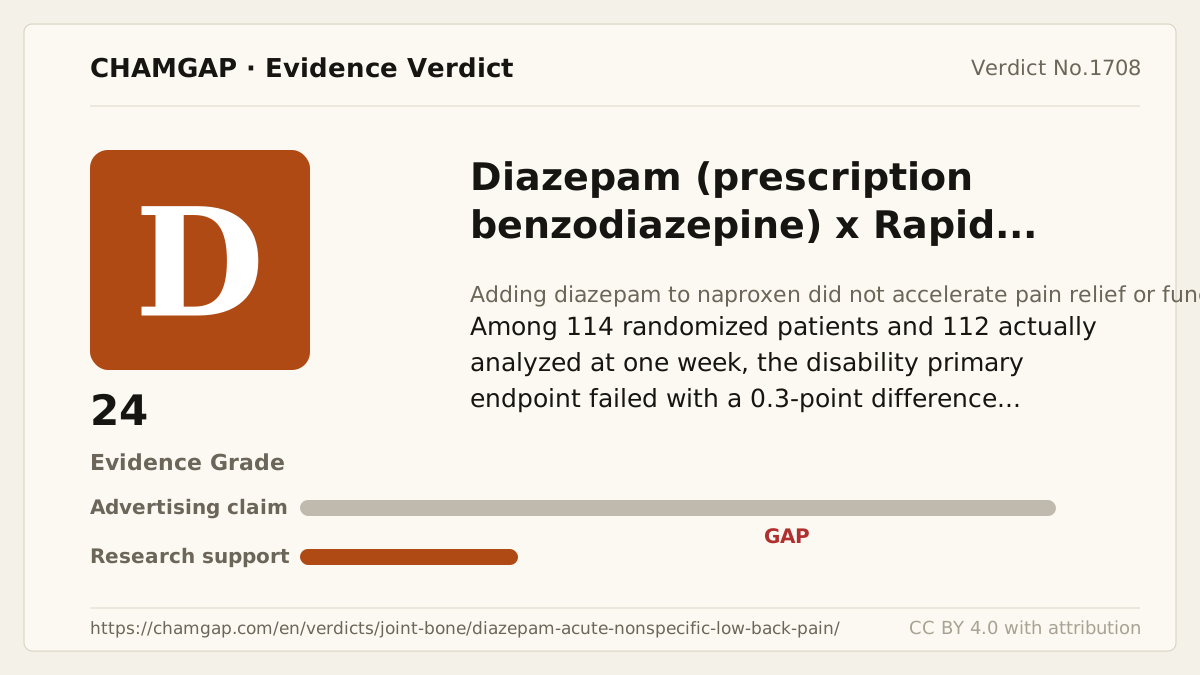
research showsDiazepam is rated D for the claim that muscle relaxation rapidly reduces pain and disability in acute nonspecific low back pain. The pivotal double-blind trial randomized 114 emergency-department patients to naproxen plus diazepam or naproxen plus placebo and included the 112 patients with one-week data, 57 and 55 respectively, in the actual intention-to-treat primary analysis. The primary endpoint, improvement in Roland-Morris Disability Questionnaire score, averaged 11 points in both groups; the between-group difference was 0.3 points (95% CI -2.8 to 3.5), so it failed. The result was also far below the prespecified clinically important between-group difference of 5 points, and the pain secondary endpoint showed no superiority. A 2021 systematic review of 49 trials likewise found no immediate or short-term benefit of benzodiazepines for pain or disability. The modern direct evidence for acute nonspecific low back pain is essentially one trial and some older small evidence conflicts, so this is D rather than repeated-failure F, with 24 points.
ads claimPromotion and common practice suggest that releasing lumbar muscle spasm should quickly remove pain and movement limitation. In the direct trial, adding diazepam to naproxen did not improve one-week function or pain compared with adding placebo.
Useful facts when choosing a product
- Diazepam is a prescription benzodiazepine with sedative, anxiolytic, anticonvulsant, and centrally mediated muscle-relaxant effects.
- The pivotal trial tested add-on diazepam rather than diazepam monotherapy because every participant received naproxen and low back pain education.
- Acute nonspecific low back pain often improves over time, so large within-group improvement in both arms does not establish a diazepam effect.
- Drowsiness, dizziness, driving impairment, falls, memory and cognitive effects, and dependence can occur; combining it with alcohol, opioids, or other central nervous system depressants increases risk.
Chamgap Semantic Classification Code
Candidate index · review held
M.diazepam.UNK.rapid-reduction-of-pain-and-disability-in-acute-nonspecific-low-back-pain.reduce.MULTIMedicinal interventions > Diazepam > Unknown > Rapid reduction of pain and disability in acute nonspecific low back pain > Reduction claim > Multiple: primary unresolved
An automated migration candidate, not an issued permanent code; exact claim scope remains under review. This machine-generated migration candidate helps retrieval but is not a permanent assignment. The original verdict ID and URL remain authoritative.
What the research actually shows
The pivotal trial enrolled emergency-department patients with nontraumatic, nonradicular musculoskeletal low back pain lasting no more than two weeks. Every participant received naproxen 500 mg twice daily and low back pain education, with diazepam 5 to 10 mg or matched placebo every 12 hours for up to one week. After 114 were randomized, 57 diazepam and 55 placebo participants, 112 total, supplied one-week data for the actual intention-to-treat primary analysis. The primary endpoint was change in RMDQ from discharge to one week and failed with a between-group difference of 0.3 points (95% CI -2.8 to 3.5). The Harold and Muriel Block Institute for Clinical and Translational Research at Einstein and Montefiore supported the work through NIH Clinical and Translational Science Award UL1TR001073; no manufacturer funding or relevant conflict was reported. The 2021 review by Cashin and colleagues included 49 muscle-relaxant trials and quantitatively synthesized 31 trials with 6,505 participants. Benzodiazepines showed no immediate or short-term pain or disability benefit, although one older 103-person trial was positive for disability at 3 to 13 weeks, leaving conflicting rather than uniformly repeated evidence.
Why this is classified as D (24)
In a non-industry-funded double-blind trial, 114 patients were randomized and 112 entered the actual one-week primary analysis. The RMDQ improvement primary endpoint failed with a between-group difference of 0.3 points (95% CI -2.8 to 3.5), far below the 5-point minimally important difference. The pain secondary endpoint and the current benzodiazepine synthesis were also null. Because independent modern confirmation in the exact indication is sparse and some older results conflict, the verdict is D with 24 points rather than F. Safety concerns are recorded independently of efficacy.
Counterpoint. Most acute nonspecific low back pain is managed with reassurance, continued activity as tolerated, heat, and a brief course of an appropriate analgesic when needed. New severe leg weakness, bowel or bladder dysfunction, saddle numbness, fever, major trauma, or a cancer history requires prompt clinical assessment.
Rejudgment record. Cross-check applied — Prioritized the direct failure of the one-week RMDQ improvement primary endpoint, with a 0.3-point difference far below the 5-point minimally important difference among 114 randomized and 112 actually analyzed participants, and used the null immediate and short-term benzodiazepine synthesis as supporting evidence; applied D rather than F because independent modern repetition in the exact acute nonspecific indication is limited
Sub-claim grades by effect
This ingredient is marketed for several effects. A single overall grade blends strong and weak claims together, so each effect is graded separately here. The overall grade reflects the strongest disconfirming or core claim.
| Effect (sub-claim) | Grade | Basis |
|---|---|---|
| Rapid improvement in disability at one week | D | Among 114 randomized and 112 analyzed participants, the RMDQ difference was 0.3 points and failed, far below the 5-point clinical threshold. |
| Reduction in low back pain at one week | D | Moderate or severe pain occurred in 32% with diazepam and 22% with placebo, showing no superiority and no confirmed benefit. |
| Functional and pain recovery at three months | D | Three-month function and pain in the pivotal trial were also not better with added diazepam than with added placebo. |
Cross-check — AI research and Codex final gate
Evidence Table
| Study | Design | Sample | Funding | Endpoint | Result | Weight |
|---|---|---|---|---|---|---|
| Friedman BW et al. 2017 | Emergency-department randomized double-blind placebo-controlled add-on trial | 114 randomized; 112 with one-week data in the actual intention-to-treat analysis (57 diazepam and 55 placebo) | Harold and Muriel Block Institute for Clinical and Translational Research at Einstein and Montefiore through NIH CTSA UL1TR001073; no manufacturer funding or relevant conflict reported | Primary endpoint: improvement in Roland-Morris Disability Questionnaire score from discharge to one week | Primary endpoint failed: both groups improved by a mean of 11 points, with a 0.3-point difference (95% CI -2.8 to 3.5). This was far below the prespecified 5-point clinical threshold, and one-week pain was not superior. | Pivotal modern direct trial |
| Cashin AG et al. 2021 | Systematic review and meta-analysis of randomized muscle-relaxant trials for nonspecific low back pain | 49 trials included; 31 trials and 6,505 participants quantitatively analyzed | No specific grant for the review; authors disclosed scholarships and public support from UNSW, NeuRA, the Australian Government, NHMRC, and others, with no manufacturer support | Pain, disability, treatment discontinuation, and adverse events | Benzodiazepines had no overall immediate or short-term benefit for pain or disability. Disability at 3 to 13 weeks was positive only in one trial of 103 participants, MD -6.9 points (95% CI -12.1 to -1.7). | Current synthesis showing both the null pattern and residual conflict |
Receipt — 2 References
All 2 cited sources were verified for existence at the original page (as of 2026-07-24).
Final verification and publication gate: Codex · Evidence date: 2026-07-24 · Corrections: none
Cite this verdict
[Chamgap] Diazepam x rapid reduction of pain and disability in acute nonspecific low back pain — Evidence Grade D·24. 2 cited sources checked. Source: https://chamgap.com/en/verdicts/joint-bone/diazepam-acute-nonspecific-low-back-pain/ · CC BY 4.0CC BY 4.0 — free to use with attribution; do not distort grades, numbers, or verdict meaning.
What this document does and does not do
Chamgap is an information source. It reports what research has and has not confirmed; it does not tell readers what to take or buy. That decision belongs to readers and, when needed, medical or legal professionals. This verdict reflects literature available up to the search date and may change as new research appears. Nothing here is medical advice.