
Devil's claw root,
does it really help with Relief of osteoarthritis and low-back pain?
research showsFor low-back pain, short-term RCT signals exist for specific preparations standardized to 50-100 mg/day harpagoside. Osteoarthritis results vary by preparation and high-quality placebo-controlled evidence is limited. The studies are old and even the low-back-pain evidence was rated low quality by Cochrane, so the combined claim is C.
ads claimAdvertising describes it as a 'natural anti-inflammatory analgesic' that improves arthritis and back pain together. Research is limited to specific harpagoside-standardized preparations and short-term pain endpoints.
Useful facts when choosing a product
- Key trial doses were standardized to 50-100 mg/day harpagoside.
- Powders and aqueous and ethanolic extracts are not interchangeable.
- Main low-back-pain RCTs lasted 4-6 weeks.
- Gastrointestinal effects and possible interactions with blood-pressure, glucose-lowering, anticoagulant, and antiplatelet drugs require product-specific distinction.
Chamgap Semantic Classification Code
Candidate index · review held
UNK.devils-claw-root.UNK.osteoarthritis-and-low-back-pain.relieve.MULTIUnknown > Devil's claw root > Unknown > osteoarthritis and low-back pain > Symptom-relief claim > Multiple: primary unresolved
An automated migration candidate, not an issued permanent code; exact claim scope remains under review. This machine-generated migration candidate helps retrieval but is not a permanent assignment. The original verdict ID and URL remain authoritative.
What the research actually shows
Chrubasik 1999 randomized 197 people with exacerbations of chronic low-back pain for 4 weeks to placebo or 50 or 100 mg/day harpagoside; 3, 6, and 10 participants, respectively, were pain-free without rescue medication for five days in the final week. Chrubasik 2003 compared Doloteffin with rofecoxib for 6 weeks in 88 people, but was not sized to establish equivalence. Gagnier 2004 reviewed 12 trials and separated findings by preparation and condition. The 2014 Cochrane review downgraded the low-back-pain evidence to low quality.
Why this is classified as C (47)
Low-back pain has clinical pain-endpoint RCTs, but evidence is low quality, short term, and preparation-specific. Osteoarthritis evidence is weaker and more heterogeneous. The combined claim is C with 47 points.
Counterpoint. A specific aqueous preparation providing 50-100 mg/day harpagoside may affect short-term nonspecific low-back pain.
Rejudgment record. New judgment — Low-back pain has short-term clinical RCT signals but Cochrane-rated low quality and preparation specificity; osteoarthritis evidence is more limited, so the combined claim is C
Sub-claim grades by effect
This ingredient is marketed for several effects. A single overall grade blends strong and weak claims together, so each effect is graded separately here. The overall grade reflects the strongest disconfirming or core claim.
| Effect (sub-claim) | Grade | Basis |
|---|---|---|
| Osteoarthritis pain relief | C | Large heterogeneity across preparations and limited high-quality placebo-controlled evidence |
| Low-back pain relief | C | Short-term RCT signals for 50-100 mg harpagoside preparations, but Cochrane-rated low quality |
Cross-check — AI research and Codex final gate
Evidence Table
| Study | Design | Sample | Funding | Endpoint | Result | Weight |
|---|---|---|---|---|---|---|
| Oltean et al. 2014 | Cochrane systematic review | 2 low-back-pain trials, 315 participants | Independent review; one author's former industry relationship disclosed | Pain, function, and rescue medication | 50-100 mg/day harpagoside may reduce short-term pain, but evidence quality was low. | Key |
| Chrubasik et al. 1999 | 4-week randomized, double-blind, placebo-controlled RCT | 197 participants; 183 completed | Specific WS 1531 preparation; funding unverified | Pain-free for five days without rescue medication and Arhus index | Dose-response of 3/6/10 pain-free participants; most major indices did not differ. | Key |
| Gagnier et al. 2004 | Systematic review | 12 trials | Unverified | Osteoarthritis and low-back pain | Osteoarthritis evidence ranged from limited to moderate by preparation; low-back-pain signals involved specific higher-dose preparations. | Key |
| Chrubasik et al. 2003 | 6-week randomized, double-blind active-control pilot RCT | 88 participants | Specific Doloteffin preparation; details unverified | Pain, Arhus index, and rescue medication | No significant difference from rofecoxib, but the trial was not sized to establish equivalence. | Supportive |
Receipt — 4 References
All 4 cited sources were verified for existence at the original page (as of 2026-07-11).
Final verification and publication gate: Codex · Evidence date: 2026-07-11 · Corrections: none
Cite this verdict
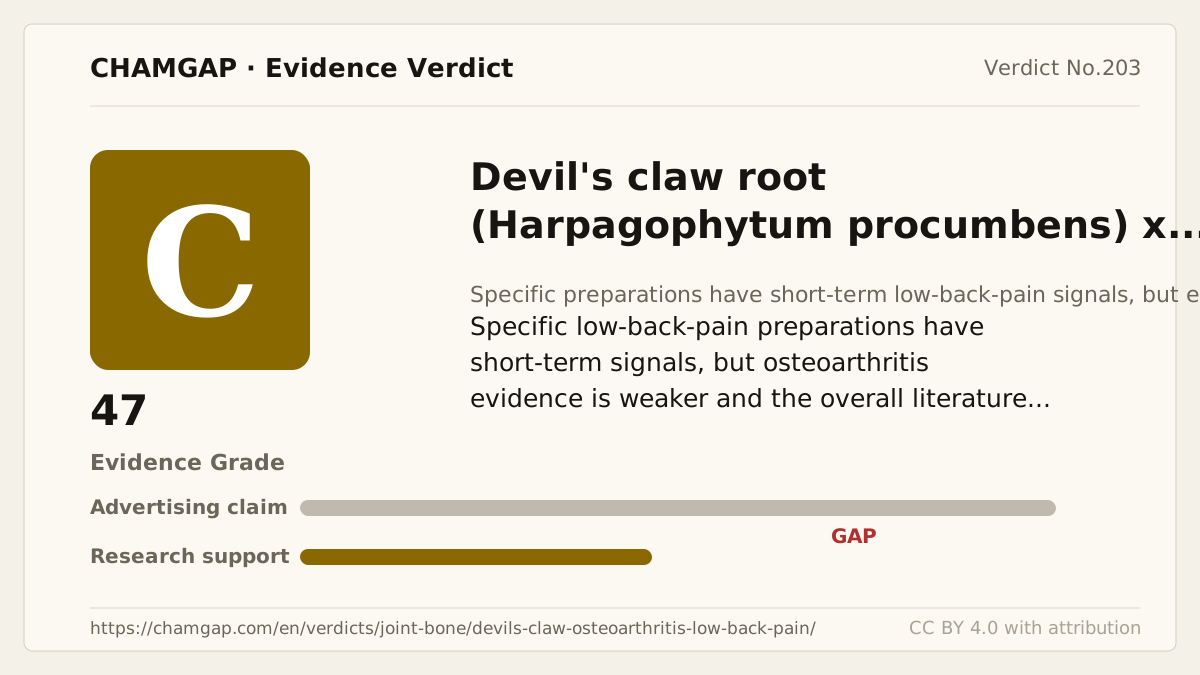
[Chamgap] Devil's claw root (Harpagophytum procumbens) x relief of osteoarthritis and low-back pain — Evidence Grade C·47. 4 cited sources checked. Source: https://chamgap.com/en/verdicts/joint-bone/devils-claw-osteoarthritis-low-back-pain/ · CC BY 4.0CC BY 4.0 — free to use with attribution; do not distort grades, numbers, or verdict meaning.
What this document does and does not do
Chamgap is an information source. It reports what research has and has not confirmed; it does not tell readers what to take or buy. That decision belongs to readers and, when needed, medical or legal professionals. This verdict reflects literature available up to the search date and may change as new research appears. Nothing here is medical advice.