
Desk-mounted forearm support,
does it really help with Reduced incidence of new neck and shoulder musculoskeletal disorders?
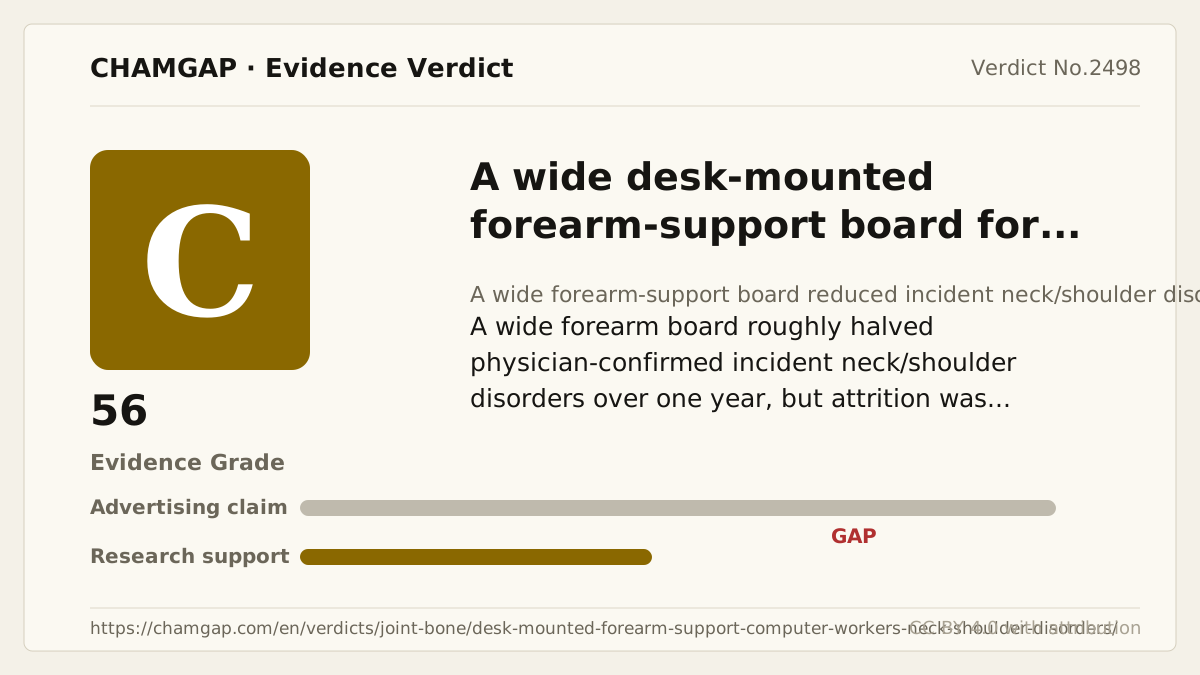
research showsThe grade is C. In a one-year 2x2 factorial randomized trial of 182 call-center workers, the forearm-support hazard ratio for incident neck/shoulder disorders was 0.49 (95% CI 0.24-0.97). This was a real clinical event confirmed by a physician masked to intervention, in a publicly funded CDC/NIOSH trial. However, 57/182 (31%) left before 12 months and the sample was under 200. A 59-participant supportive trial did not significantly reduce six-week discomfort between groups and did not replicate the same incident-disorder outcome. The result gives C with 56 points.
ads claimA narrow wrist rest is not the 30.5-cm-deep padded forearm board tested here. The finding arose with ergonomic training in a call-center setting and does not automatically apply to every computer user or every desk-armrest product.
Useful facts when choosing a product
- The pivotal armboard was a 30.5-cm-deep padded support attached to the front of the desk and supporting the middle forearms.
- All four groups received ergonomic training, so the estimate is the main effect of adding the board to training.
- Verdict 2430 addresses an adjacent workplace-ergonomics intervention, an anti-fatigue mat, but differs in intervention and endpoint; a targeted search found no duplicate forearm-support verdict or pivotal PMID/DOI.
Chamgap Semantic Classification Code
Candidate index · review held
UNK.wide-desk-mounted-forearm-support-board.UNK.incidence-of-new-neck-and-shoulder-musculoskeletal-disorders.reduce.factorialUnknown > wide desk-mounted forearm-support board > Unknown > incidence of new neck and shoulder musculoskeletal disorders > Reduction claim > Defined factorial contrast
An automated migration candidate, not an issued permanent code; exact claim scope remains under review. This machine-generated migration candidate helps retrieval but is not a permanent assignment. The original verdict ID and URL remain authoritative.
What the research actually shows
The pivotal trial used weekly pain surveys to trigger evaluation and a physician masked to intervention to diagnose disorders. Fifty-seven of 182 participants dropped out before 12 months, and seven who qualified for examination did not receive it. A sensitivity analysis counting those seven as cases remained positive, HR 0.52 (0.28-0.98). Nevertheless, 31% attrition and a sample under 200 are two avoidable limitations. Funding came from CDC/NIOSH grant RO1 OH04253.
Why this is classified as C (56)
A publicly funded randomized trial showed a statistically significant reduction in a physician-masked clinical event, providing three strength axes. High attrition, a sample under 200, and no independent same-event replication cap the result at C with 56 points.
Counterpoint. Right upper-extremity disorders were nonsignificant, HR 0.64 (0.28-1.45), and left upper-extremity disorders also missed significance, 0.29 (0.08-1.05). The clear result is limited to the neck/shoulder region.
Rejudgment record. Cross-check applied — We cross-checked randomization, factorial main-effect analysis, incident events, attrition, missing examinations, funding, and comparability of the supportive trial against the Rempel full text and Cook abstract.
| Endpoint | H | Hard endpoint - actual events such as death |
| Replication | R1 | Single confirmatory trial |
| Independence | I2 | Decisive evidence is publicly or non-profit funded |
| Effect size | E+ | Meets the clinically important threshold |
Stored derived and displayed grades match; this is not a current recalculation or validity check (C).
Sub-claim grades by effect
This ingredient is marketed for several effects. A single overall grade blends strong and weak claims together, so each effect is graded separately here. The overall grade reflects the strongest disconfirming or core claim.
| Effect (sub-claim) | Grade | Basis |
|---|---|---|
| A desk-mounted forearm board reduces incident neck/shoulder disorders in computer workers. | C | The masked physician-diagnosed HR was 0.49, but attrition was 31% and independent replication is absent. |
| Forearm support reduces musculoskeletal discomfort at six weeks. | D | The 59-participant trial found no significant between-group difference, and absolute values and CIs were not verified. |
Cross-check — AI research and Codex final gate
Evidence Table
| Study | Design | Sample | Funding | Endpoint | Result | Weight |
|---|---|---|---|---|---|---|
| Rempel et al., Occup Environ Med 2006 | One-year 2x2 factorial randomized workplace trial | 182 randomized; 57 dropped out before 12 months; 7 missed indicated physical examinations | CDC/NIOSH grant RO1 OH04253 | Incident neck/shoulder musculoskeletal disorder confirmed by a masked physician | Incident neck/shoulder disorders 14/80 versus 25/78; four groups: training 19/43, trackball 6/35, armboard 6/40, combined 8/40; adjusted HR 0.49 (95% CI 0.24-0.97), sensitivity HR 0.52 (0.28-0.98) | Pivotal publicly funded event trial |
| Cook and Burgess-Limerick, Appl Ergon 2004 | Six-week parallel randomized trial followed by provision to controls | 59 randomized (30 support, 29 control); withdrawals after beginning support 6/30 versus 3/29 | Funding statement not verified | Self-reported neck, back, and upper-extremity discomfort | Fewer discomfort reports at six weeks, but the between-group difference was not significant; symptom-specific absolute values and CIs were not verified | Supportive trial with a different outcome and duration |
Receipt — 2 References
All 2 cited sources were verified for existence at the original page (as of 2026-08-14).
Final verification and publication gate: Codex · Evidence date: 2026-08-14 · Corrections: none
Cite this verdict
[Chamgap] Desk-mounted forearm support x prevention of neck and shoulder disorders in computer workers — Evidence Grade C·56. 2 cited sources checked. Source: https://chamgap.com/en/verdicts/joint-bone/desk-mounted-forearm-support-computer-workers-neck-shoulder-disorders/ · CC BY 4.0CC BY 4.0 — free to use with attribution; do not distort grades, numbers, or verdict meaning.
What this document does and does not do
Chamgap is an information source. It reports what research has and has not confirmed; it does not tell readers what to take or buy. That decision belongs to readers and, when needed, medical or legal professionals. This verdict reflects literature available up to the search date and may change as new research appears. Nothing here is medical advice.