
Customized orthotic insoles,
does it really help with Prevention of low back pain and duty suspension during prolonged walking or training?
research showsGeneral or customized insoles for low-back-pain prevention or treatment are rated D because benefit is unproven. Mattila 2011, Eur Spine J 20(1):100-104, was an untreated-control prevention trial, and its direct primary endpoint failed with P=.37 in 220 actually randomized and analyzed participants. Chuter et al., BMC Musculoskeletal Disorders 2014;15:140, pooled six prevention trials and 2,379 participants: RR 0.78 (95% CI 0.50 to 1.23), I-squared=76.8%, which does not exclude prevention benefit as large as 50%. Repeated failure is present, but this interval does not meet the F criterion, yielding D with 24 points. No formal GRADE rating was provided; the authors judged trials few, heterogeneity high, and methodological quality limited.
ads claimMarketing expands a biomechanical account of foot alignment and shock absorption into prevention of back injury. The military-training trial and pooled evidence do not support that clinical claim.
Useful facts when choosing a product
- Customized insoles are made from foot shape or gait assessment, but design and materials vary substantially.
- Use for foot pain or a specific foot disorder is a different claim from prevention of nonspecific low back pain.
- Fit should be reassessed if pressure points, blisters, or persistent discomfort occur.
Chamgap Semantic Classification Code
Candidate index · review held
P.customized-orthotic-insoles.device.low-back-pain-and-duty-suspension-during-prolonged-walking-or-training.prevent.noneProcedures, devices and tests > Customized orthotic insoles > Device delivered > low back pain and duty suspension during prolonged walking or training > Occurrence-prevention claim > No intervention
An automated migration candidate, not an issued permanent code; exact claim scope remains under review. This machine-generated migration candidate helps retrieval but is not a permanent assignment. The original verdict ID and URL remain authoritative.
What the research actually shows
Mattila 2011, Eur Spine J 20(1):100-104, was an untreated-control prevention trial assigning healthy military conscripts to customized orthotic insoles (73) or no insoles (147). Article flow and group totals show 220 actually randomized and analyzed by intention to treat, and the primary endpoint failed at 33% versus 27%, P=.37. Chuter et al., BMC Musculoskeletal Disorders 2014;15:140, found RR 0.78 (95% CI 0.50 to 1.23), I-squared=76.8%, across six prevention trials and 2,379 participants, which does not exclude benefit as large as 50%. No formal GRADE rating was provided; the authors judged trials few, heterogeneity high, and methodological quality limited. For comparison, verdict 1439, which is F with 12 points, concerns lateral-wedge insoles for treatment of knee osteoarthritis, whereas this evidence concerns general or customized insoles for prevention or treatment of low back pain; the target disease, purpose, and trials differ.
Why this is classified as D (24)
Failure was repeated, but RR 0.78 (0.50 to 1.23), I-squared=76.8%, across six prevention trials and 2,379 participants does not exclude benefit as large as 50%. The F criterion is unmet, yielding D with 24 points.
Counterpoint. The value of an orthosis prescribed for a diagnosed foot condition should be evaluated separately from this low-back-pain prevention verdict.
Rejudgment record. Cross-check applied — Failure was repeated, but RR 0.78 (0.50 to 1.23), I-squared=76.8%, across six prevention trials and 2,379 participants did not exclude prevention benefit as large as 50%, so the F criterion was unmet
Sub-claim grades by effect
This ingredient is marketed for several effects. A single overall grade blends strong and weak claims together, so each effect is graded separately here. The overall grade reflects the strongest disconfirming or core claim.
| Effect (sub-claim) | Grade | Basis |
|---|---|---|
| Prevention of low back pain during prolonged walking or training | D | Results were repeatedly null, but the meta-analytic interval did not exclude prevention benefit as large as 50%. |
| Prevention of duty suspension caused by low back pain | D | The direct primary endpoint failed at 33% versus 27%, P=.37. |
| Reduction in incidence of nonspecific low back pain | D | The prevention meta-analysis of 2,379 participants had RR 0.78 (0.50 to 1.23), I-squared=76.8%, and did not exclude large benefit. |
Cross-check — AI research and Codex final gate
Evidence Table
| Study | Design | Sample | Funding | Endpoint | Result | Weight |
|---|---|---|---|---|---|---|
| Mattila VM et al. 2011 | Randomized no-intervention-controlled intention-to-treat trial | Abstract states 228; article flow and group totals show 220 actually randomized and analyzed by intention to treat (73/147) | No funding | Primary low back pain requiring a physician visit and at least one day of duty suspension | The primary endpoint failed at 33% versus 27%, risk difference 4.3 percentage points (95% CI -8.7 to 17.3), P=.37. | Pivotal direct prevention trial |
| Chuter V et al. 2014 | Systematic review and meta-analysis of randomized trials | Six prevention trials with 2,379 participants and five treatment trials with 293 participants | No specific external funding reported; academic research at the University of Newcastle | Incidence of low back pain for prevention | Prevention RR was 0.78 (95% CI 0.50 to 1.23), I-squared=76.8%, which did not exclude benefit as large as 50%. No formal GRADE rating was provided. | Imprecise synthesis not meeting the F criterion |
Receipt — 2 References
All 2 cited sources were verified for existence at the original page (as of 2026-07-24).
Final verification and publication gate: Codex · Evidence date: 2026-07-24 · Corrections: none
Cite this verdict
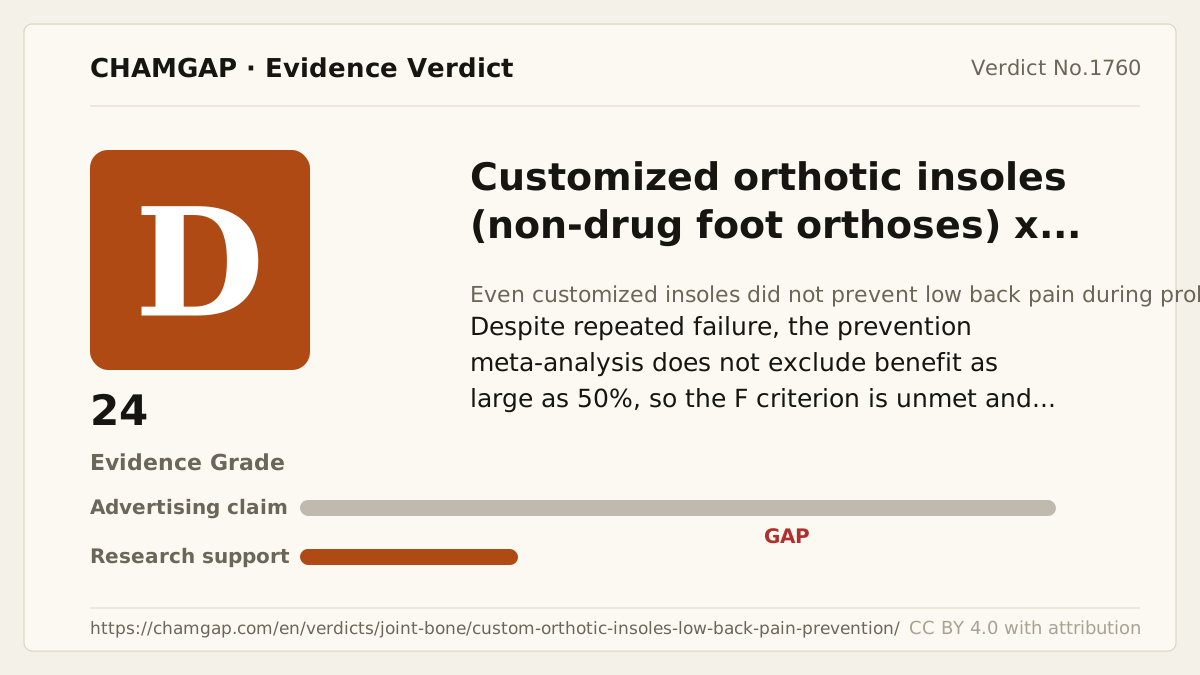
[Chamgap] Customized orthotic insoles x prevention of low back pain during prolonged walking or training — Evidence Grade D·24. 2 cited sources checked. Source: https://chamgap.com/en/verdicts/joint-bone/custom-orthotic-insoles-low-back-pain-prevention/ · CC BY 4.0CC BY 4.0 — free to use with attribution; do not distort grades, numbers, or verdict meaning.
What this document does and does not do
Chamgap is an information source. It reports what research has and has not confirmed; it does not tell readers what to take or buy. That decision belongs to readers and, when needed, medical or legal professionals. This verdict reflects literature available up to the search date and may change as new research appears. Nothing here is medical advice.