
Corticosteroid injection,
does it really help with Improved sustained one-year recovery and prevention of recurrence in lateral epicondylalgia?
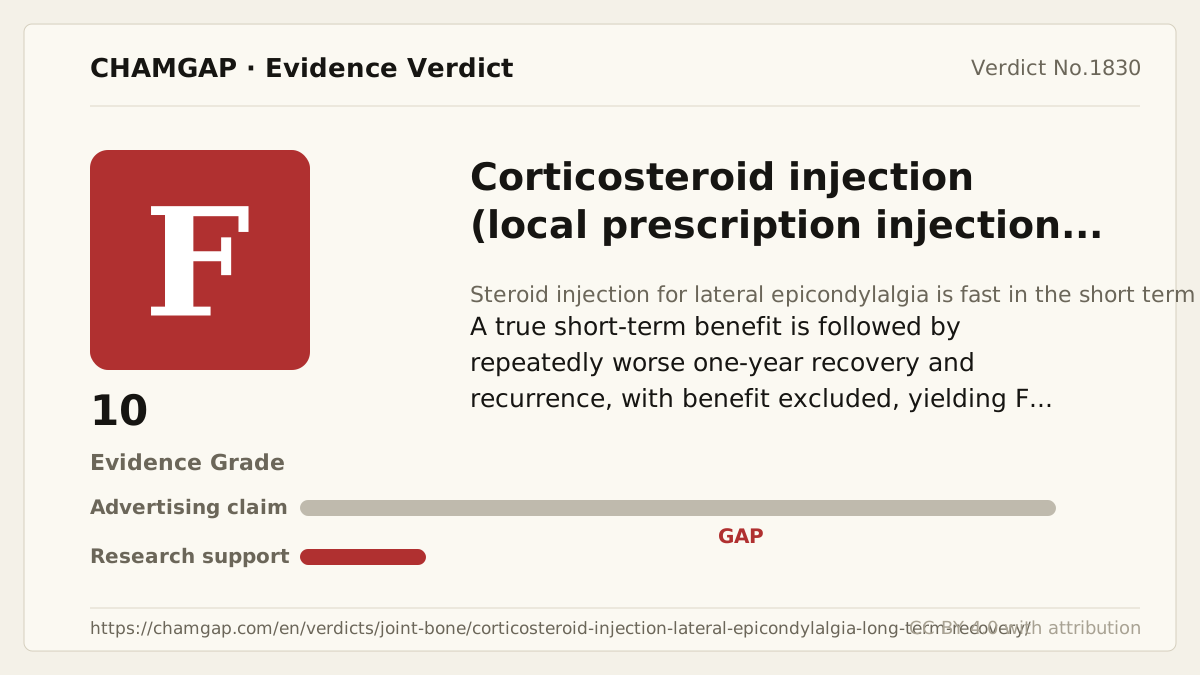
research showsInjection for lateral epicondylalgia looks rapidly effective at about four weeks, but claims of sustained one-year recovery and recurrence prevention are repeatedly refuted, yielding F. Coombes 2013 randomized 165 people and 163 provided the coprimary one-year outcomes. Complete recovery or much improvement at four weeks with injection alone was 71% versus 10% with saline, a real short-term benefit. At 52 weeks, however, pooled injection groups had recovery of 83% versus 96%, RR 0.86 (99% CI 0.75 to 0.99), P=0.01, and recurrence of 54% versus 12%, P<0.001. Both long-term primary claims failed and outcomes were worse. Bisset 2006 independently reproduced relapse in 47 of 65 initial responders, 72%.
ads claimRapid four-week analgesia is recast as durable tendon healing and recurrence prevention. The evidence does not merely stop after short-term benefit; long-term outcomes reverse direction.
Useful facts when choosing a product
- The Coombes injection was 1 mL triamcinolone acetonide 10 mg/mL plus 1 mL of 1% lignocaine; placebo was 0.5 mL of 0.9% saline.
- Verdict 1804, C with 58 points, concerns intra-articular steroid for adhesive capsulitis and has only a short-term positive result; this lateral epicondylalgia injection was worse than placebo at one year.
- For comparison, verdict 1678, which is D with 28 points, concerns repeated intra-articular triamcinolone for long-term knee-osteoarthritis pain. Knee-joint evidence was not transferred to peri-tendon injection at the lateral epicondyle.
Chamgap Semantic Classification Code
Candidate index · review held
M.corticosteroid-injection.UNK.sustained-recovery-and-prevention-of-recurrence-in-lateral-epicondylalgia.prevent.factorialMedicinal interventions > Corticosteroid injection > Unknown > sustained recovery and prevention of recurrence in lateral epicondylalgia > Occurrence-prevention claim > Defined factorial contrast
An automated migration candidate, not an issued permanent code; exact claim scope remains under review. This machine-generated migration candidate helps retrieval but is not a permanent assignment. The original verdict ID and URL remain authoritative.
What the research actually shows
Coombes and colleagues randomized 165 people in a 2-by-2 factorial design of triamcinolone or saline injection with or without physiotherapy; 163, or 99%, provided the one-year coprimary outcomes. Within the factorial design, the injection-alone versus saline-alone comparison at four weeks showed complete recovery or much improvement in 30 of 42, 71%, versus 4 of 41, 10%. At 52 weeks, pooled corticosteroid comparison showed recovery of 83% versus 96%, RR 0.86 (99% CI 0.75 to 0.99), P=0.01, and recurrence rates of 54% versus 12%, P<0.001. Both long-term coprimary outcomes failed. Bisset and colleagues randomized 198 people independently and found early superiority at six weeks followed by recurrence in 47 of 65 initial injection successes, 72%, and poorer long-term outcomes.
Why this is classified as F (12)
The profile is P, RX, I2, E-, B1, and C1. One-year recovery deterioration and recurrence increase were replicated in the same indication, and the 99% interval excludes meaningful long-term benefit, yielding F with 12 points.
Counterpoint. When long-term recovery is the goal, patients can discuss activity modification, education, progressive loading, and the tradeoff between rapid relief and recurrence risk.
Rejudgment record. Cross-check applied — Applied RX, E-, and C1 because independent same-indication trials repeatedly showed worse long-term recovery and recurrence after early benefit, with the 99% confidence interval excluding benefit
| Endpoint | P | Symptom or function itself is the target - including patient reports and performance tests |
| Replication | RX | Repeatedly refuted in the same indication |
| Independence | I2 | Decisive evidence is publicly or non-profit funded |
| Effect size | E- | Harm increased in the trials |
| Precision | C1 | The confidence interval excludes meaningful benefit |
Stored derived and displayed grades match; this is not a current recalculation or validity check (F).
Sub-claim grades by effect
This ingredient is marketed for several effects. A single overall grade blends strong and weak claims together, so each effect is graded separately here. The overall grade reflects the strongest disconfirming or core claim.
| Effect (sub-claim) | Grade | Basis |
|---|---|---|
| Pain and global improvement at four weeks | B | A large short-term benefit versus saline is real. |
| Increased complete recovery or much improvement at one year | F | It was lower than placebo, 83% versus 96%, and the 99% interval excluded benefit. |
| Prevention of recurrence over one year | F | Recurrence was 54% versus 12% and was replicated independently. |
Cross-check — AI research and Codex final gate
Evidence Table
| Study | Design | Sample | Funding | Endpoint | Result | Weight |
|---|---|---|---|---|---|---|
| Coombes BK et al. 2013 | Two-by-two factorial randomized injection-blinded saline-controlled trial | 165 randomized and 163 (99%) analyzed for one-year coprimary outcomes | Public funding from the Australian National Health and Medical Research Council | Coprimary one-year complete recovery or much improvement and one-year recurrence | Injection alone was positive at four weeks, 71% versus 10%; at 52 weeks recovery was 83% versus 96%, RR 0.86 (99% CI 0.75 to 0.99), and recurrence 54% versus 12%; both long-term coprimary outcomes failed and worsened. | Decisive long-term refutation |
| Bisset L et al. 2006 | Single-blind randomized comparison of injection, physiotherapy, and wait-and-see | 198 randomized and analyzed by intention to treat; recurrence analyzed among 65 initial injection successes | Public and academic support from the University of Queensland and Australian National Health and Medical Research Council | Global improvement, grip force, severity, and recurrence at six and 52 weeks | Injection was superior at six weeks, but 47 of 65 initial successes (72%) recurred and long-term outcomes were poorer than physiotherapy. | Independent replication of long-term worsening |
Receipt — 2 References
All 2 cited sources were verified for existence at the original page (as of 2026-07-24).
Final verification and publication gate: Codex · Evidence date: 2026-07-24 · Corrections: none
Cite this verdict
[Chamgap] Corticosteroid injection x long-term recovery in lateral epicondylalgia — Evidence Grade F·12. 2 cited sources checked. Source: https://chamgap.com/en/verdicts/joint-bone/corticosteroid-injection-lateral-epicondylalgia-long-term-recovery/ · CC BY 4.0CC BY 4.0 — free to use with attribution; do not distort grades, numbers, or verdict meaning.
What this document does and does not do
Chamgap is an information source. It reports what research has and has not confirmed; it does not tell readers what to take or buy. That decision belongs to readers and, when needed, medical or legal professionals. This verdict reflects literature available up to the search date and may change as new research appears. Nothing here is medical advice.