
Copper bracelet,
does it really help with Relief of pain and inflammation in rheumatoid arthritis?
research showsThe claim that a copper bracelet relieves rheumatoid-arthritis pain and inflammation is rated F. In a randomized double-blind placebo-controlled crossover trial, 70 people with painful rheumatoid arthritis wore four devices in random sequence for five weeks each; there was no meaningful difference in pain, C-reactive protein, plasma viscosity, swollen joints, function, disease activity, or medication use. The trial was not enormous, but it directly tested the claimed device exposure in humans under controlled conditions and found a clear null result. A skin-worn copper device differs from dietary copper and joint supplements and cannot replace disease-modifying antirheumatic therapy.
ads claimMarketing presents green skin staining or loss of bracelet mass as proof that absorbed copper removes inflammation. These findings can reflect oxidation and wear from sweat and use, and the clinical trial found no corresponding improvement in pain, inflammation, or function.
Useful facts when choosing a product
- A copper bracelet is a skin-worn device and is not equivalent to an oral copper supplement, dietary copper, a standalone magnetic device, or a joint supplement.
- Green or blue-green skin staining can result from reactions between sweat and copper oxides or salts and is not a marker of therapeutic activity.
- Contact irritation or allergic dermatitis can occur. Seven participants in the 2013 trial reported skin irritation from the copper bracelet.
- Even if the bracelet itself is tolerable, substituting it for disease-modifying antirheumatic medicines, clinical review, or inflammation monitoring can delay prevention of irreversible joint damage.
Chamgap Semantic Classification Code
Candidate index · review held
P.copper-bracelet.device.pain-and-inflammation-in-rheumatoid-arthritis.relieve.placeboProcedures, devices and tests > Copper bracelet > Device delivered > pain and inflammation in rheumatoid arthritis > Symptom-relief claim > Placebo
An automated migration candidate, not an issued permanent code; exact claim scope remains under review. This machine-generated migration candidate helps retrieval but is not a permanent assignment. The original verdict ID and URL remain authoritative.
What the research actually shows
Richmond and colleagues randomized the device sequence for 70 people with painful rheumatoid arthritis and had each device worn for five weeks, separated by a one-week washout. The 100-mm pain visual-analogue scale was primary, with McGill pain, tender and swollen joint counts, C-reactive protein, plasma viscosity, Health Assessment Questionnaire function, disease activity, and medication use also measured; all device comparisons had P values above 0.05. A 2009 double-blind placebo crossover trial by Richmond and colleagues in 45 people with osteoarthritis likewise found no improvement in pain, stiffness, physical function, or medication use from copper or magnetic bracelets. A 1976 study by Walker and Keats suggested possible benefit from questionnaires and bracelet-weight changes, but its inadequately reported methods do not overturn the two modern direct null trials.
Why this is classified as F (10)
Copper bracelets lack an established therapeutic mechanism, and a 70-participant double-blind placebo crossover trial in rheumatoid arthritis found P values above 0.05 for pain, C-reactive protein, plasma viscosity, joint counts, function, and disease activity. A 45-participant osteoarthritis placebo crossover trial independently repeated the null result for pain, stiffness, and function, consistent with expert consensus that the device is ineffective. F is therefore retained rather than D: the direct rheumatoid-arthritis trial was small, not a large definitive null trial. Repeated refutation supports F with 10 points while acknowledging the single-trial size limitation; staining and skin irritation remain separate safety issues.
Counterpoint. It may be worn as jewelry, but there is no evidence-based reason to pay for a medical effect or delay disease-modifying therapy. Persistent symptoms require assessment of inflammatory activity and treatment response by a rheumatology clinician.
Rejudgment record. New verdict — Retained F because there is no established therapeutic mechanism, a 70-participant double-blind placebo crossover trial in rheumatoid arthritis found null results across pain, inflammation, function, and disease activity, and a 45-participant osteoarthritis placebo crossover trial repeated null findings for pain, stiffness, and function. This aligns with expert consensus and the treatment remains a repeatedly refuted mechanism-free claim; the small direct trial makes D for a large human null trial inappropriate and supports 10 points
Sub-claim grades by effect
This ingredient is marketed for several effects. A single overall grade blends strong and weak claims together, so each effect is graded separately here. The overall grade reflects the strongest disconfirming or core claim.
| Effect (sub-claim) | Grade | Basis |
|---|---|---|
| Relief of pain and inflammation in rheumatoid arthritis | F | A direct double-blind placebo crossover trial found null results for both subjective pain and objective inflammation. |
| Improved joint function in rheumatoid arthritis | F | Health Assessment Questionnaire function, joint counts, and disease activity showed no meaningful improvement. |
| General analgesic effect of copper or magnetic wearable devices | F | Comparisons of standard, weak, demagnetized, and copper devices in the same crossover trial showed no device-specific analgesic effect. |
Cross-check — AI research and Codex final gate
Evidence Table
| Study | Design | Sample | Funding | Endpoint | Result | Weight |
|---|---|---|---|---|---|---|
| Richmond SJ et al. 2013 CAMBRA | Randomized double-blind placebo-controlled four-device crossover trial | 70 participants with painful rheumatoid arthritis; 65 complete datasets | United Kingdom NIHR doctoral training support; no commercial funding | Pain VAS, McGill pain, tender and swollen joints, C-reactive protein, plasma viscosity, HAQ function, disease activity, and medication use | No significant differences among devices were found for any pain, inflammation, function, or disease-activity outcome. | Decisive direct null evidence |
| Walker WR and Keats DM. 1976 | Preliminary clinical and questionnaire study alternating copper and look-alike aluminum bracelets | Groups drawn from more than 300 recruits; group sizes and analysis inadequately reported | Not reported | Self-reported therapeutic value, bracelet mass change, and copper solubility in sweat | Suggested a preliminary perceived-benefit signal in some participants but lacked objective disease outcomes and modern statistical reporting. | Very-low-weight historical counterevidence |
Receipt — 3 References
All 3 cited sources were verified for existence at the original page (as of 2026-07-19).
Final verification and publication gate: Codex · Evidence date: 2026-07-19 · Corrections: none
Cite this verdict
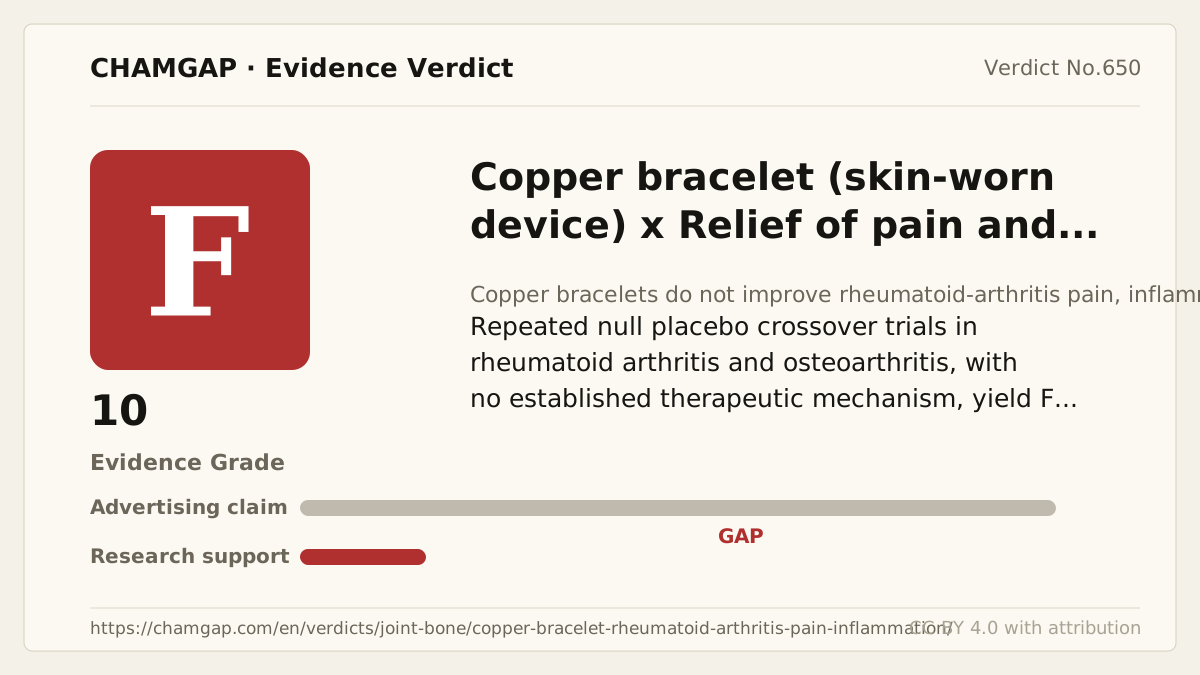
[Chamgap] Copper bracelet x relief of rheumatoid-arthritis pain and inflammation — Evidence Grade F·10. 3 cited sources checked. Source: https://chamgap.com/en/verdicts/joint-bone/copper-bracelet-rheumatoid-arthritis-pain-inflammation/ · CC BY 4.0CC BY 4.0 — free to use with attribution; do not distort grades, numbers, or verdict meaning.
What this document does and does not do
Chamgap is an information source. It reports what research has and has not confirmed; it does not tell readers what to take or buy. That decision belongs to readers and, when needed, medical or legal professionals. This verdict reflects literature available up to the search date and may change as new research appears. Nothing here is medical advice.