
Constraint-induced movement therapy,
does it really help with Improved upper-limb performance and real-world use 3 to 9 months after stroke?
research showsThe grade is C. EXCITE randomized 222 participants to original CIMT (106) or usual care with delayed treatment at 12 months (116). At one year, WMFT performance time changed from 19.3 to 9.3 seconds versus 24.0 to 17.7 seconds, a 34% between-group improvement (95% CI 12% to 51%); the between-group change in self-reported MAL amount of use was 0.43 points (0.05 to 0.80). Yet only 80 versus 86 contributed one-year outcome data, and only the intervention group received up to 60 hours of structured training in two weeks. Standardized effects were below the conventional medium threshold, giving C with 50 points.
ads claimKorean insurance recognizes stroke rehabilitation and occupational therapy according to functional recovery, but that does not make EXCITE's two-week, up-to-60-hour original CIMT a separately guaranteed reimbursement package. Clinics often use modified programs adapted to function, fatigue, safety, and home feasibility, so the original trial result should not be promised unchanged.
Useful facts when choosing a product
- Original CIMT combines restraint of the less-affected hand with high-dose repetitive task practice of the affected arm.
- EXCITE used usual care or delayed treatment, not placebo, as control.
- WMFT is a laboratory performance test; MAL is a structured self-report interview about daily arm use.
Chamgap Semantic Classification Code
Candidate index · review held
X.original-constraint-induced-movement-therapy-combining-less-affected-hand-restraint-with-intensive-task-training.behavioral.upper-limb-performance-and-real-world-use-after-stroke.improve.MULTIBehaviors, exposures and policies > Original constraint-induced movement therapy combining less-affected-hand restraint with intensive task training > Behavioral delivery > upper-limb performance and real-world use after stroke > Improvement claim > Multiple: primary unresolved
An automated migration candidate, not an issued permanent code; exact claim scope remains under review. This machine-generated migration candidate helps retrieval but is not a permanent assignment. The original verdict ID and URL remain authoritative.
What the research actually shows
EXCITE was a prospective single-blind randomized trial at seven US centers in 222 people 3 to 9 months after a first ischemic or hemorrhagic stroke. Eligibility required at least 10 degrees of wrist extension plus 10 degrees of thumb and at least two-finger extension, repeatable three times in one minute; baseline upper-extremity Fugl-Meyer scores were 42.5 and 41.1. Original CIMT used a protective mitt on the less-affected hand for a goal of 90% of waking hours across 14 days and up to six hours of shaping and standard task practice on each of ten weekdays. Control was usual care, not placebo, with the same CIMT offered after 12 months. All testing was performed by trained staff blinded to assignment, and WMFT movement quality was video-rated by observers blinded to both assignment and testing occasion. Only 169/222 returned at 12 months, with 80 and 86 in the displayed WMFT and MAL analyses. Baseline-value imputation moved the MAL amount-of-use difference to 0.33 points (-0.02 to 0.68), including no effect.
Why this is classified as C (50)
A publicly funded multisite trial improved objective performance and self-reported use, but standardized effects were below medium and 24% attrition plus major therapy-dose imbalance limit confidence, giving C with 50 points.
Counterpoint. Some patients may gain newly completable tasks, so a modest average effect does not erase the value of individualized rehabilitation goals.
Rejudgment record. Cross-check applied — Assessor-blinded publicly funded EXCITE trial, standardized WMFT and MAL effects near 0.31 to 0.36, 24% attrition, and an up-to-60-hour therapy-dose imbalance
| Endpoint | P | Symptom or function itself is the target - including patient reports and performance tests |
| Replication | R1 | Single confirmatory trial |
| Independence | I2 | Decisive evidence is publicly or non-profit funded |
| Effect size | E~ | Statistically positive but below the threshold |
Stored derived and displayed grades match; this is not a current recalculation or validity check (C).
Sub-claim grades by effect
This ingredient is marketed for several effects. A single overall grade blends strong and weak claims together, so each effect is graded separately here. The overall grade reflects the strongest disconfirming or core claim.
| Effect (sub-claim) | Grade | Basis |
|---|---|---|
| Improved objective upper-limb task performance | C | WMFT performance improved by 34% (95% CI 12% to 51%), without an equal-dose comparator. |
| Improved self-reported daily arm use | C | The 0.43-point MAL amount-of-use difference was positive, but baseline-value imputation included no effect. |
Cross-check — AI research and Codex final gate
Evidence Table
| Study | Design | Sample | Funding | Endpoint | Result | Weight |
|---|---|---|---|---|---|---|
| Wolf et al. EXCITE 2006 | Seven-center prospective single-blind randomized trial | 222 randomized: CIMT 106, usual/delayed care 116; 12-month analyses 80 and 86 | Paper: 'supported by National Institutes of Health grant HD 37606'; Financial Disclosures: 'None reported.' | Key co-outcomes: assessor-blinded WMFT performance and self-reported MAL at post-treatment, 4, 8, and 12 months | At 12 months: WMFT 34% improvement difference (95% CI 12% to 51%); MAL amount 0.43 (0.05 to 0.80), quality 0.48 (0.13 to 0.84) | Pivotal publicly funded trial with substantial missingness and therapy-dose imbalance |
Receipt — 4 References
All 4 cited sources were verified for existence at the original page (as of 2026-08-08).
Final verification and publication gate: Codex · Evidence date: 2026-08-08 · Corrections: none
Cite this verdict
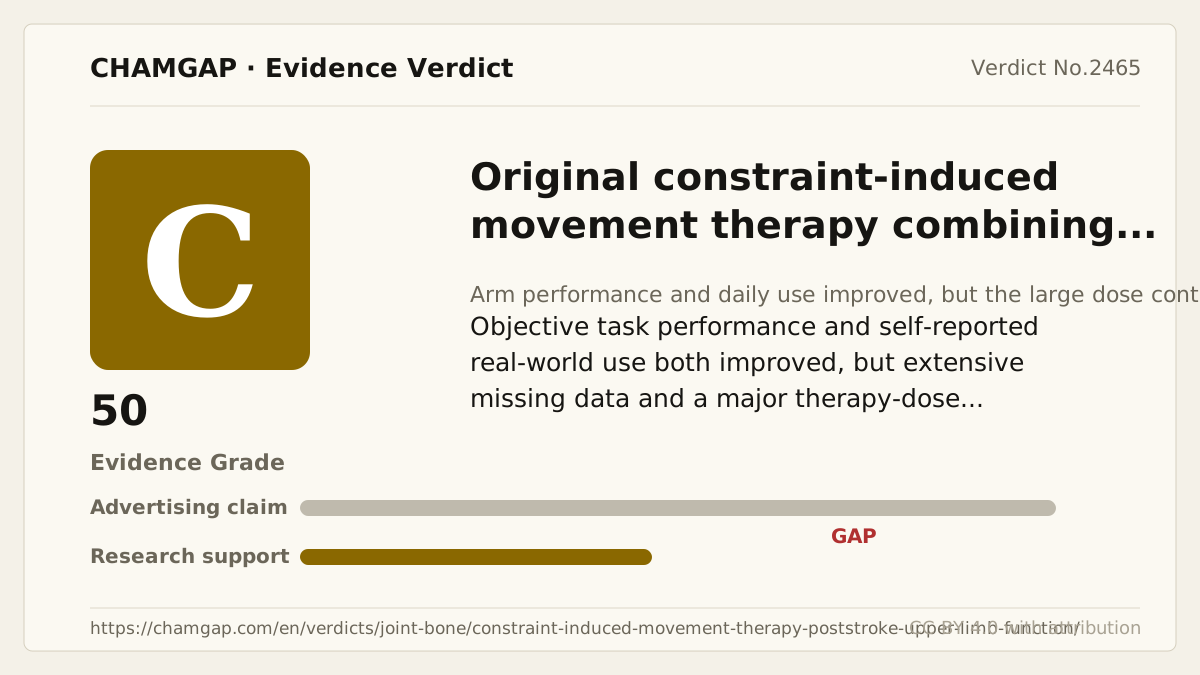
[Chamgap] Constraint-induced movement therapy x upper-limb function after stroke — Evidence Grade C·50. 4 cited sources checked. Source: https://chamgap.com/en/verdicts/joint-bone/constraint-induced-movement-therapy-poststroke-upper-limb-function/ · CC BY 4.0CC BY 4.0 — free to use with attribution; do not distort grades, numbers, or verdict meaning.
What this document does and does not do
Chamgap is an information source. It reports what research has and has not confirmed; it does not tell readers what to take or buy. That decision belongs to readers and, when needed, medical or legal professionals. This verdict reflects literature available up to the search date and may change as new research appears. Nothing here is medical advice.