
Conjugated equine estrogens,
does it really help with Reduced hip fractures during treatment in postmenopausal women after hysterectomy?
research showsYes. In the WHI estrogen-alone trial, which randomized 10,739 postmenopausal women with prior hysterectomy, oral CEE 0.625 mg daily reduced hip fractures during treatment (HR 0.61, 95% CI 0.41 to 0.91). In the same trial, however, stroke increased (HR 1.39), coronary heart disease was not reduced (HR 0.91), and the global disease-burden index did not improve. The specific hip-fracture benefit is therefore supported, but it must not be generalized to overall health improvement in postmenopausal women.
ads claimClaims that CEE protects bones while rejuvenating the heart, or broadly protects postmenopausal health, overextend the evidence. This verdict applies only to hip-fracture reduction during treatment after hysterectomy; it does not endorse cardiovascular prevention or long-term overall net benefit.
Useful facts when choosing a product
- Conjugated equine estrogens are systemic prescription hormones used for moderate-to-severe menopausal vasomotor symptoms and, in selected women, prevention of osteoporosis.
- The pivotal evidence here concerns estrogen alone in women who have undergone hysterectomy. Women with a uterus require a separate decision about progestogen for endometrial protection.
- Systemic hormone therapy should be individualized, using an effective dose for the needed duration with periodic reassessment.
- Fewer fractures during treatment do not establish overall net benefit. Stroke and venous-thromboembolism risks require separate review, and breast-cancer evidence for estrogen plus progestogen should not be conflated with the estrogen-alone trial.
Chamgap Semantic Classification Code
Candidate index · review held
M.conjugated-equine-estrogens.UNK.hip-fractures-during-treatment-after-hysterectomy.reduce.placeboMedicinal interventions > Conjugated equine estrogens > Unknown > hip fractures during treatment after hysterectomy > Reduction claim > Placebo
An automated migration candidate, not an issued permanent code; exact claim scope remains under review. This machine-generated migration candidate helps retrieval but is not a permanent assignment. The original verdict ID and URL remain authoritative.
What the research actually shows
The WHI estrogen-alone trial assigned 10,739 postmenopausal women aged 50 to 79 years with prior hysterectomy to CEE 0.625 mg daily or placebo and followed them for an average of 6.8 years. The HR was 0.61 for hip fracture and 0.70 for total fracture, but 1.39 for stroke; the coronary heart disease HR of 0.91 was not significant. Later evidence reviews likewise found fewer fractures alongside more stroke and venous thromboembolism with estrogen alone.
Why this is classified as B (64)
A large placebo-controlled randomized trial directly demonstrated fewer hip fractures with CEE after hysterectomy. The finding was a secondary hard endpoint from one pivotal trial, however, while stroke increased and neither coronary heart disease nor the global disease-burden index improved. The specific fracture claim earns B; a broad health-benefit claim does not.
Counterpoint. Absolute hip-fracture counts were modest, and the wide age range means absolute benefit depends strongly on baseline fracture risk. Long-term effects after discontinuation cannot be assumed to equal the on-treatment result.
Rejudgment record. New verdict — The hip-fracture and total-fracture hard endpoints from a large placebo-controlled trial were separated from stroke and coronary outcomes, then checked against a later systematic evidence review. Concentration in one trial, secondary-endpoint status, and competing harm reduced the score.
Sub-claim grades by effect
This ingredient is marketed for several effects. A single overall grade blends strong and weak claims together, so each effect is graded separately here. The overall grade reflects the strongest disconfirming or core claim.
| Effect (sub-claim) | Grade | Basis |
|---|---|---|
| Reduced hip fractures during CEE treatment in postmenopausal women after hysterectomy | B | The WHI HR was 0.61 (95% CI 0.41 to 0.91). Increased stroke in the same trial is not a null efficacy result but a separate important harm. |
| Reduced all clinical fractures during CEE treatment in postmenopausal women after hysterectomy | B | The WHI total-fracture HR was 0.70 (95% CI 0.63 to 0.79). Fewer fractures alone do not establish overall net benefit. |
| Reduced coronary heart disease with CEE after hysterectomy | D | The large WHI trial found no significant reduction in coronary heart disease, HR 0.91 (95% CI 0.75 to 1.12). Increased stroke is a separate safety outcome. |
Cross-check — AI research and Codex final gate
Evidence Table
| Study | Design | Sample | Funding | Endpoint | Result | Weight |
|---|---|---|---|---|---|---|
| Anderson GL et al. WHI estrogen-alone trial | Multicenter double-blind placebo-controlled randomized trial | 10,739 postmenopausal women with prior hysterectomy | US National Heart, Lung, and Blood Institute; study pills supplied by Wyeth-Ayerst | Hip fracture, total fracture, and major chronic-disease events | Hip-fracture HR 0.61 (95% CI 0.41 to 0.91) and total-fracture HR 0.70 (0.63 to 0.79). Stroke HR 1.39 (1.10 to 1.77), coronary-heart-disease HR 0.91 (0.75 to 1.12), and global-index HR 1.01 (0.91 to 1.12). | Pivotal direct randomized trial |
| Hendrix SL et al. WHI stroke analysis | Prespecified stroke analysis of the randomized WHI estrogen-alone trial | 5,310 assigned to CEE and 5,429 to placebo | US National Heart, Lung, and Blood Institute | Total, ischemic, and hemorrhagic stroke | Total stroke increased, HR 1.37 (95% CI 1.09 to 1.73), as did ischemic stroke, HR 1.55 (1.19 to 2.01). | Direct confirmation of competing harm |
| Gartlehner G et al. USPSTF evidence review | Systematic review of menopausal hormone therapy for primary prevention of chronic conditions | 39,145 participants in 20 randomized trials plus 3 cohort studies | US Agency for Healthcare Research and Quality | Clinical outcomes including fractures, cardiovascular disease, cancer, and thromboembolism | Estrogen alone reduced fractures but increased stroke and venous thromboembolism, with no net benefit for primary prevention of chronic conditions. | Independent evidence synthesis |
Receipt — 4 References
All 4 cited sources were verified for existence at the original page (as of 2026-07-24).
Final verification and publication gate: Codex · Evidence date: 2026-07-24 · Corrections: none
Cite this verdict
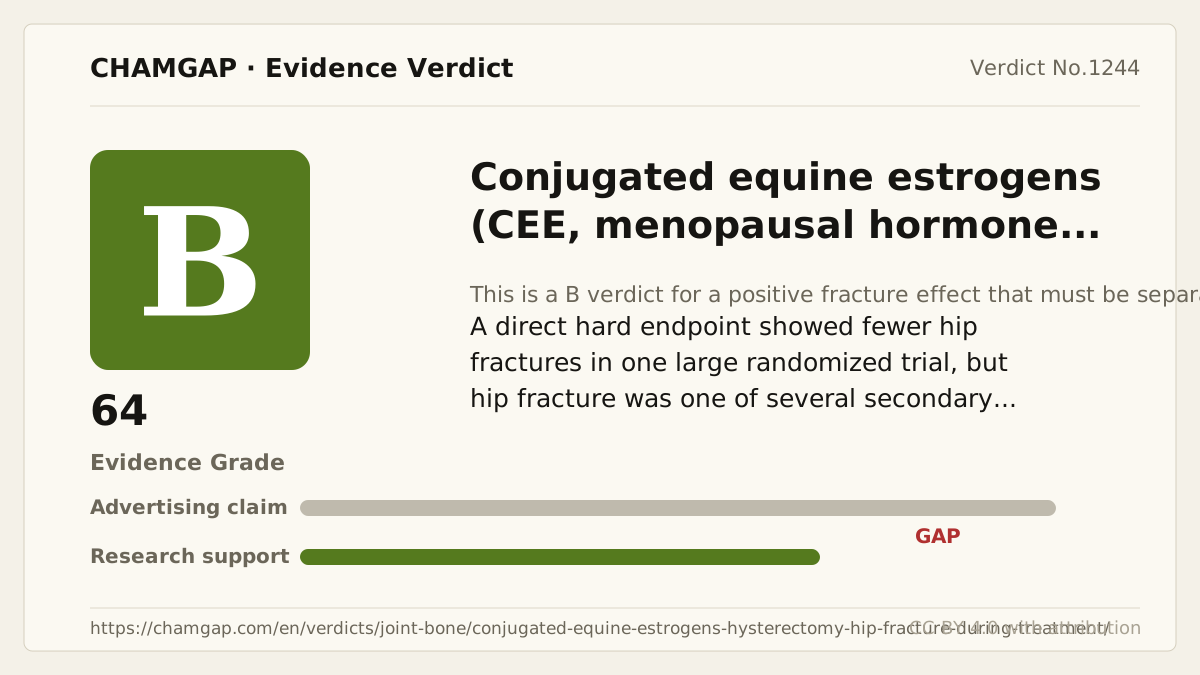
[Chamgap] Do conjugated equine estrogens reduce hip fractures during treatment after hysterectomy? — Evidence Grade B·64. 4 cited sources checked. Source: https://chamgap.com/en/verdicts/joint-bone/conjugated-equine-estrogens-hysterectomy-hip-fracture-during-treatment/ · CC BY 4.0CC BY 4.0 — free to use with attribution; do not distort grades, numbers, or verdict meaning.
What this document does and does not do
Chamgap is an information source. It reports what research has and has not confirmed; it does not tell readers what to take or buy. That decision belongs to readers and, when needed, medical or legal professionals. This verdict reflects literature available up to the search date and may change as new research appears. Nothing here is medical advice.