
Colchicine,
does it really help with Treatment-level improvement in pain, stiffness, and physical function in knee osteoarthritis?
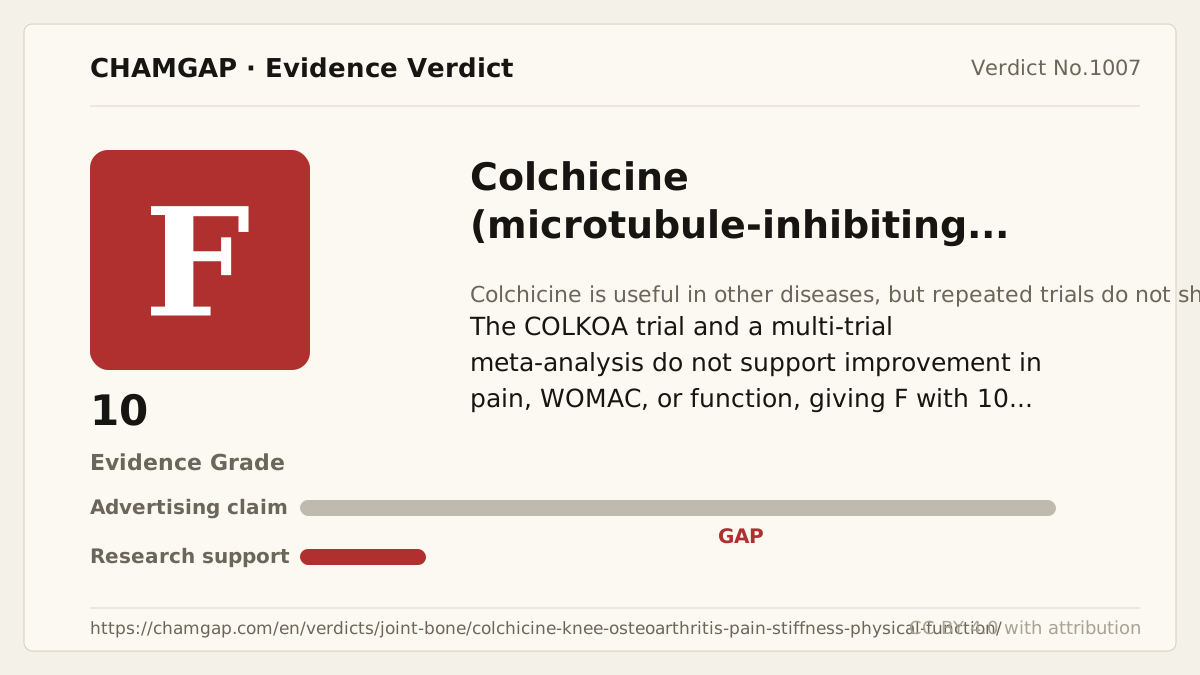
research showsThe claim that colchicine produces treatment-level improvement in knee osteoarthritis symptoms is graded F. In the double-blind COLKOA trial, 109 participants received 0.5 mg twice daily or placebo for 16 weeks, but at least 30% improvement in total WOMAC occurred in 39% with colchicine and 49% with placebo, with no meaningful difference in clinical secondary outcomes. A 2023 meta-analysis of 10 intervention trials and 847 participants likewise found no clinically important pain reduction or improvement in knee function. Some inflammatory and bone-turnover biomarkers fell, but those surrogate changes are not improvements in pain, stiffness, or function. Cardiovascular or gout evidence in other indications cannot be transferred to knee osteoarthritis, so repeated negative direct evidence gives F with 10 points.
ads claimPromotional or off-label claims may say that suppressing inflammation treats cartilage pain or that a gout medicine must also work for osteoarthritis. A change in inflammatory biomarkers does not demonstrate that patients experience less pain or better function.
Useful facts when choosing a product
- Colchicine is a prescription drug with a narrow therapeutic index, and symptomatic knee osteoarthritis is not a routine approved indication. A prescription for gout or another indication must not be repurposed without medical direction.
- Common adverse effects include diarrhea, nausea, vomiting, and abdominal pain. Severe diarrhea can be an early sign of toxicity and warrants stopping the drug and promptly contacting the prescriber.
- Overdose can cause bone-marrow suppression, multiorgan failure, arrhythmia, and death. It must be kept away from children and never taken above the prescribed amount.
- Kidney or liver impairment and inhibitors of CYP3A4 or P-glycoprotein can raise colchicine exposure and the risk of myopathy or rhabdomyolysis. Some macrolides, azole antifungals, calcium-channel blockers, cyclosporine, and statins require expert interaction review.
Chamgap Semantic Classification Code
Candidate index · review held
M.colchicine.UNK.treatment-level-improvement-in-pain-stiffness-and-physical-function-in-knee-osteoarthritis.improve.placeboMedicinal interventions > colchicine > Unknown > Treatment-level improvement in pain, stiffness, and physical function in knee osteoarthritis > Improvement claim > Placebo
An automated migration candidate, not an issued permanent code; exact claim scope remains under review. This machine-generated migration candidate helps retrieval but is not a permanent assignment. The original verdict ID and URL remain authoritative.
What the research actually shows
The COLKOA trial by Leung and colleagues evaluated 0.5 mg twice daily for 16 weeks in 109 participants. WOMAC response, pain, and function were no better than placebo, although high-sensitivity C-reactive protein and synovial-fluid CTX-I fell, illustrating the separation between surrogate biomarkers and patient-experienced outcomes. Singh and colleagues synthesized nine knee and one hand osteoarthritis trial, involving 847 participants, and reported moderate-quality evidence of no clinically important benefit for pain or physical function. Some older small trials were positive, but high risk of bias and heterogeneity prevent them from overturning the larger negative trial and pooled estimates. This verdict concerns the knee-osteoarthritis symptom axis only and does not mix cardiovascular, gout, or COVID-19 evidence.
Why this is classified as F (10)
A direct double-blind knee-osteoarthritis trial failed on the primary WOMAC response and on pain and function, and a meta-analysis of 10 trials and 847 participants also found no benefit for pain or function. Selected biomarker reductions and older small positive trials do not outweigh repeated negative patient-centered outcomes. Repeated contradiction gives F with 10 points; gastrointestinal harm and serious overdose toxicity are separate safety issues.
Counterpoint. Exercise, strengthening, weight management, topical nonsteroidal anti-inflammatory drugs, and individualized analgesic strategies form the basis of knee osteoarthritis care. A suddenly hot, swollen joint requires assessment for gout, calcium pyrophosphate disease, or infection rather than self-treatment with colchicine.
Rejudgment record. New verdict — Applied the repeated-contradiction standard because the direct knee-osteoarthritis COLKOA double-blind trial was negative for its primary WOMAC endpoint and pain and function, while a meta-analysis of 10 intervention trials also found no clinical benefit; evidence from other colchicine indications and surrogate biomarkers was not transferred
Sub-claim grades by effect
This ingredient is marketed for several effects. A single overall grade blends strong and weak claims together, so each effect is graded separately here. The overall grade reflects the strongest disconfirming or core claim.
| Effect (sub-claim) | Grade | Basis |
|---|---|---|
| Improvement in knee osteoarthritis pain with colchicine | F | COLKOA pain outcomes and the multi-trial meta-analysis did not support clinically important pain reduction. |
| Improvement in knee osteoarthritis stiffness and total WOMAC with colchicine | F | The primary total WOMAC response in COLKOA was no better than placebo. |
| Improvement in physical function in knee osteoarthritis with colchicine | F | In the moderate-quality meta-analysis, the confidence interval around the function SMD of -0.37 included no effect. |
Cross-check — AI research and Codex final gate
Evidence Table
| Study | Design | Sample | Funding | Endpoint | Result | Weight |
|---|---|---|---|---|---|---|
| Leung YY et al. 2018 COLKOA | Randomized double-blind placebo-controlled trial | 109 patients with symptomatic knee osteoarthritis | Academic clinical trial; no commercial sponsorship stated in the public abstract | At least 30% improvement in total WOMAC at 16 weeks, pain, function, OARSI-OMERACT response, and biomarkers | The primary response was negative, 39% with colchicine versus 49% with placebo, and clinical secondary outcomes did not differ; selected inflammatory and bone-turnover biomarkers fell. | Key direct negative randomized trial |
| Singh A et al. 2023 | Systematic review and meta-analysis of osteoarthritis intervention trials | 10 randomized trials and 847 participants; nine knee and one hand trial | Academic research; no specific commercial sponsorship reported beyond open-access support | Pain, knee physical function, quality of life, and adverse events | Moderate-quality evidence found no clinical benefit because confidence intervals for pain, SMD -0.17, and function, SMD -0.37, both included no effect. | Key synthesis confirming repeated negative evidence |
Receipt — 3 References
All 3 cited sources were verified for existence at the original page (as of 2026-07-21).
Final verification and publication gate: Codex · Evidence date: 2026-07-21 · Corrections: none
Cite this verdict
[Chamgap] Colchicine x treatment-level improvement in knee osteoarthritis pain, stiffness, and physical function — Evidence Grade F·10. 3 cited sources checked. Source: https://chamgap.com/en/verdicts/joint-bone/colchicine-knee-osteoarthritis-pain-stiffness-physical-function/ · CC BY 4.0CC BY 4.0 — free to use with attribution; do not distort grades, numbers, or verdict meaning.
What this document does and does not do
Chamgap is an information source. It reports what research has and has not confirmed; it does not tell readers what to take or buy. That decision belongs to readers and, when needed, medical or legal professionals. This verdict reflects literature available up to the search date and may change as new research appears. Nothing here is medical advice.