
At least 600 mL coffee or 330 mg caffeine daily,
does it really help with Prevention of osteoporotic fractures in women?
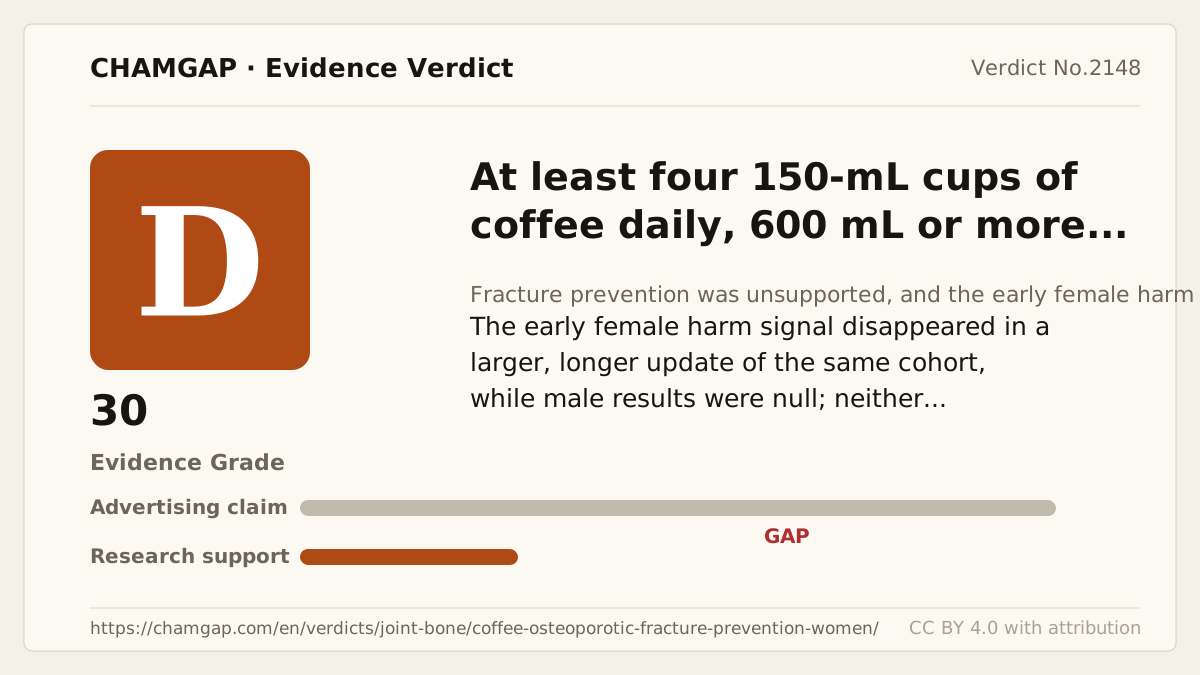
research showsThe grade is D. Evidence does not support coffee for fracture prevention. The early female harm signal was not reproduced in a larger, longer update of the same cohort. Among 61,433 women, estimates per 200 mL were 0.99 (0.98 to 1.00) for any fracture and 0.97 (0.95 to 1.00) for hip fracture. Long-term male results were also null, and directions differed by sex.
ads claimIncreased calcium excretion is a physiological fact, not clinical efficacy. Fracture data do not support prevention, and the early female harm signal was not reproduced in the longer update.
Useful facts when choosing a product
- The study defined one cup as 150 mL, making four cups 600 mL.
- The paper described 330 mg caffeine as roughly four cups; this was questionnaire-based exposure estimation, not laboratory measurement of a study product.
- Brewing method, cafestol, and decaffeinated intake were unreported.
Chamgap Semantic Classification Code
Candidate index · review held
F.at-least-four-cups-of-coffee.food.osteoporotic-fractures.prevent.UNKFoods and beverages > At least four cups of coffee > Food consumption > osteoporotic fractures > Occurrence-prevention claim > Unknown
An automated migration candidate, not an issued permanent code; exact claim scope remains under review. This machine-generated migration candidate helps retrieval but is not a permanent assignment. The original verdict ID and URL remain authoritative.
What the research actually shows
The 2006 female paper analyzed 31,527 women and 3,279 osteoporotic fractures. The 2013 update of the same cohort expanded to 61,433 women, 14,738 total fractures, and 3,871 hip fractures. The male paper followed 42,978 men for a mean 11.2 years. Brewing method and study-measured caffeine content were unreported. Sex-specific directions differed and the initial female signal disappeared with longer follow-up, providing no causal efficacy evidence.
Why this is classified as D (30)
Prevention was unsupported, the early female harm signal was not reproduced in the same cohort's longer update, and sex-specific directions differed, giving D with 30 points.
Counterpoint. Bone-density change and actual fracture are different outcomes; this verdict centers on fracture events in women, particularly those with low calcium intake.
Rejudgment record. Cross-check applied — An early female harm signal was not reproduced in a larger longer analysis of the same cohort, male findings were null, and pooled directions differed by sex
| Endpoint | H | Hard endpoint - actual events such as death |
| Replication | R1 | Single confirmatory trial |
| Independence | I1 | Mixed funding sources |
| Effect size | E0 | Null |
| Precision | C0 | The confidence interval leaves room for benefit |
Stored derived and displayed grades match; this is not a current recalculation or validity check (D).
Sub-claim grades by effect
This ingredient is marketed for several effects. A single overall grade blends strong and weak claims together, so each effect is graded separately here. The overall grade reflects the strongest disconfirming or core claim.
| Effect (sub-claim) | Grade | Basis |
|---|---|---|
| Prevention of osteoporotic fracture in women | D | Prevention was unsupported and the early increase was not reproduced in the long-term update. |
| Prevention of any fracture in men | D | The per-200-mL estimate was null. |
Cross-check — AI research and Codex final gate
Evidence Table
| Study | Design | Sample | Funding | Endpoint | Result | Weight |
|---|---|---|---|---|---|---|
| Hallström et al. 2006 SMC | Prospective female cohort | 31,527 women, mean 10.3 years, 3,279 osteoporotic fractures | Non-U.S. government support indexed, but detailed funding was not confirmed | Osteoporotic fracture | >330 versus <200 mg/day HR 1.20 (1.07 to 1.35); in low-calcium women, at least four versus under one cup HR 1.33 (1.07 to 1.65) | Pivotal female evidence opposite to prevention |
| Hallström et al. 2014 COSM | Prospective male cohort | 42,978 men, mean 11.2 years, 5,066 total fractures and 1,186 hip fractures | Swedish public research support | Any fracture and hip fracture | Per 200 mL: total 1.00 (0.99 to 1.02), hip 1.02 (0.99 to 1.06); four or more versus under one cup: 0.91 (0.80 to 1.02), 0.89 (0.70 to 1.14) | Not directly comparable because sex and estimand differ |
| Hallstrom et al. 2013 long-term female update | Expanded long-term analysis of the same female cohort | 61,433 women, 14,738 total fractures, 3,871 hip fractures | Swedish public research support | Any fracture and hip fracture | Per 200 mL: total 0.99 (0.98 to 1.00), hip 0.97 (0.95 to 1.00); four or more versus under one cup: 0.96 (0.90 to 1.02), 0.88 (0.78 to 1.00) | Did not reproduce the early female harm signal |
Receipt — 4 References
All 4 cited sources were verified for existence at the original page (as of 2026-08-04).
Final verification and publication gate: Codex · Evidence date: 2026-08-04 · Corrections: none
Cite this verdict
[Chamgap] At least 600 mL coffee or 330 mg caffeine daily x osteoporotic-fracture prevention — Evidence Grade D·30. 4 cited sources checked. Source: https://chamgap.com/en/verdicts/joint-bone/coffee-osteoporotic-fracture-prevention-women/ · CC BY 4.0CC BY 4.0 — free to use with attribution; do not distort grades, numbers, or verdict meaning.
What this document does and does not do
Chamgap is an information source. It reports what research has and has not confirmed; it does not tell readers what to take or buy. That decision belongs to readers and, when needed, medical or legal professionals. This verdict reflects literature available up to the search date and may change as new research appears. Nothing here is medical advice.