
Close contact casting,
does it really help with Equivalent 6-month function to surgery in older adults with unstable ankle fracture?
research showsThe grade is B. AIM randomized 620 patients. Six-month OMAS, where higher scores mean better function, differed by -0.6 points for casting versus surgery (95% CI -3.9 to 2.6), wholly within the prespecified -6 to +6 equivalence limits.
ads claimAvoiding initial fixation means fewer incisions, implants, wound complications, and repeat operations; it does not mean avoiding anesthesia, and it trades against loss of reduction and malunion.
Useful facts when choosing a product
- Close contact casting uses minimal padding and close molding.
- Both initial treatments used an operating room and general or spinal anesthesia.
- The pivotal trial had public NIHR HTA funding.
Chamgap Semantic Classification Code
Candidate index · review held
P.close-contact-casting.UNK.function-to-surgery-with-unstable-ankle-fracture.equivalent.UNKProcedures, devices and tests > Close contact casting > Unknown > function to surgery with unstable ankle fracture > Equivalence claim > Unknown
An automated migration candidate, not an issued permanent code; exact claim scope remains under review. This machine-generated migration candidate helps retrieval but is not a permanent assignment. The original verdict ID and URL remain authoritative.
What the research actually shows
Axis 6 B1 evidence ① Allocation concealment: "using a 24-hour telephone service at an independent organization (Aberdeen University). Concealment was ensured by registering participants before computer generation of the allocation." ② Blinding: "A blinded health professional performed outcome assessments at the primary end point (6 months)." Participant masking was inherently impossible for surgery versus casting, so under clause 105 this was not counted as a defect. Ankles were covered at six months and the James index was 0.8. ③ Analysis set and missingness: "The primary analysis was per protocol" as appropriate for equivalence, with a concordant ITT analysis; primary-endpoint missingness was 0% in PP and 0.2% in ITT. ④ Prespecified primary endpoint: "The primary end point was 6 months." Six-month OMAS and the ±6-point margin matched ISRCTN04180738 and the protocol.
Four gates: ① defect name: noninferiority/equivalence design; ② listed item: noninferiority design; ③ the paper prespecified ±6 points and both PP and ITT supported equivalence; ④ equivalence was avoidable for the surgery-versus-casting question, so one defect is counted. An unblinded subjective endpoint is not counted because participant masking was inherently impossible. Funding was: "funded by the National Institute of Health Research (NIHR) Health Technology Assessment program (project 07/37/61)."
Why this is classified as B (70)
A large publicly funded single randomized trial met both sides of a prespecified functional-equivalence margin. One noninferiority/equivalence-design defect gives B with 70 points.
Counterpoint. Equivalent function does not mean equivalent alignment; malunion and later conversion were important disadvantages.
Rejudgment record. Cross-check applied — The entire six-month OMAS confidence interval fell within the prespecified ±6-point equivalence limits in a publicly funded RCT
| Endpoint | P | Symptom or function itself is the target - including patient reports and performance tests |
| Replication | R1 | Single confirmatory trial |
| Independence | I2 | Decisive evidence is publicly or non-profit funded |
| Effect size | E+ | Meets the clinically important threshold |
Stored derived and displayed grades match; this is not a current recalculation or validity check (B).
Sub-claim grades by effect
This ingredient is marketed for several effects. A single overall grade blends strong and weak claims together, so each effect is graded separately here. The overall grade reflects the strongest disconfirming or core claim.
| Effect (sub-claim) | Grade | Basis |
|---|---|---|
| Equivalent six-month function | B | The entire OMAS interval was within ±6 points. |
Cross-check — AI research and Codex final gate
Evidence Table
| Study | Design | Sample | Funding | Endpoint | Result | Weight |
|---|---|---|---|---|---|---|
| Keene DJ et al. 2016 AIM | Multicenter randomized equivalence trial | 620 randomized; 558 in six-month PP and 593 in ITT analyses | NIHR HTA programme (project 07/37/61); pilot funded by AO Research Foundation | Six-month OMAS, higher is better, prespecified equivalence margin ±6 points | Casting 64.5 vs surgery 66.0; difference -0.6 (95% CI -3.9 to 2.6), within both margins | Pivotal publicly funded functional-equivalence evidence |
Receipt — 1 References
All 1 cited sources were verified for existence at the original page (as of 2026-08-26).
Final verification and publication gate: Codex · Evidence date: 2026-08-26 · Corrections: none
Cite this verdict
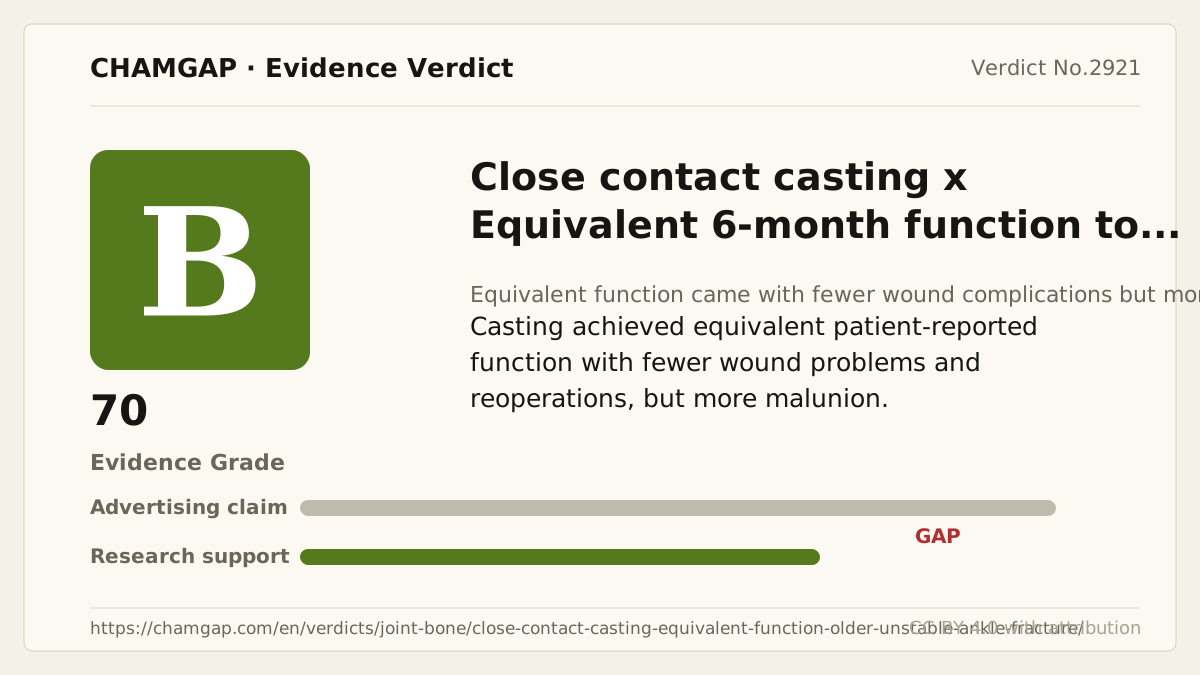
[Chamgap] Benefit of Close Contact Casting × Equivalent 6-Month Function in Unstable Ankle Fractures in Older Adults — Evidence Grade B·70. 1 cited sources checked. Source: https://chamgap.com/en/verdicts/joint-bone/close-contact-casting-equivalent-function-older-unstable-ankle-fracture/ · CC BY 4.0CC BY 4.0 — free to use with attribution; do not distort grades, numbers, or verdict meaning.
What this document does and does not do
Chamgap is an information source. It reports what research has and has not confirmed; it does not tell readers what to take or buy. That decision belongs to readers and, when needed, medical or legal professionals. This verdict reflects literature available up to the search date and may change as new research appears. Nothing here is medical advice.