
Choline-stabilized orthosilicic acid,
does it really help with Improved bone formation and femoral bone density when added to calcium and vitamin D in women with osteopenia?
research showsCholine-stabilized orthosilicic acid is rated D. In a randomized placebo-controlled trial of 184 women, every group received calcium and vitamin D, and the overall 12-month analysis found no significant improvement in lumbar or femoral bone mineral density. Some bone-formation marker changes and a femoral-neck signal appeared only at selected doses or in a post hoc subgroup, and fracture outcomes were unavailable.
ads claimMarketing expands bioavailable silicon and collagen-marker changes into bone rebuilding, restored density, and osteoporosis prevention. Overall BMD and fracture evidence do not support those claims.
Useful facts when choosing a product
- Choline-stabilized orthosilicic acid stabilizes orthosilicic acid with choline and is used in products such as BioSil. It is not interchangeable with ordinary silica or every other silicon compound.
- The key trial did not test ch-OSA alone: all groups received 1,000 mg calcium and 20 micrograms vitamin D3, so findings apply only to this adjunctive setting.
- The trial suggested general tolerability, but long-term safety data for high-dose silicon supplementation are limited. Kidney disease or use of multiple supplements warrants professional review.
- This supplement is fundamentally different in composition, regulation, and fracture-evidence strength from osteoporosis medicines such as denosumab, romosozumab, and abaloparatide.
Chamgap Semantic Classification Code
Candidate index · review held
S.choline-stabilized-orthosilicic-acid.UNK.bone-formation-and-femoral-bone-density-when-added-to-calcium-and-vitamin-d-with-osteopenia.improve.MULTISupplements and nutraceuticals > Choline-stabilized orthosilicic acid > Unknown > bone formation and femoral bone density when added to calcium and vitamin D with osteopenia > Improvement claim > Multiple: primary unresolved
An automated migration candidate, not an issued permanent code; exact claim scope remains under review. This machine-generated migration candidate helps retrieval but is not a permanent assignment. The original verdict ID and URL remain authoritative.
What the research actually shows
In the 12-month double-blind trial, 184 women were randomized and 136 completed treatment. Every group received 1,000 mg calcium and 20 micrograms vitamin D3, while ch-OSA groups additionally received 3, 6, or 12 mg silicon. Lumbar and femoral BMD did not significantly improve overall. Formation markers such as PINP changed at selected doses, and only the 6-mg group showed better femoral-neck BMD in a post hoc subgroup with baseline femoral T-scores below -1; the 3- and 12-mg doses did not reproduce it. Fractures were not evaluated.
Why this is classified as D (31)
The 184-person randomized trial found no significant overall lumbar or femoral BMD benefit, while bone-formation markers changed only at selected doses. The femoral-neck signal was confined to a post hoc 6-mg subgroup and fracture data were absent, so negative primary outcomes and subgroup-only evidence give D with 31 points.
Counterpoint. Calcium and vitamin D adequacy and fracture-risk assessment remain important, while treatment decisions should use age, T-score, FRAX, prior fracture, and overall risk.
Rejudgment record. New verdict — Applied boundary rule ② because the 184-person trial adding ch-OSA to calcium and vitamin D found no significant overall lumbar or femoral BMD benefit, while the femoral-neck signal was limited to a post hoc 6-mg subgroup and fracture outcomes were absent
Sub-claim grades by effect
This ingredient is marketed for several effects. A single overall grade blends strong and weak claims together, so each effect is graded separately here. The overall grade reflects the strongest disconfirming or core claim.
| Effect (sub-claim) | Grade | Basis |
|---|---|---|
| Improved femoral bone mineral density | D | The overall analysis was negative, and the femoral-neck signal was limited to a post hoc 6-mg subgroup. |
| Improved bone-formation markers | D | Selected markers changed at selected doses, without a consistent dose response or demonstrated clinical consequence. |
| Prevention of fractures | D | The trial did not evaluate fractures, leaving no evidence of fracture prevention. |
Cross-check — AI research and Codex final gate
Evidence Table
| Study | Design | Sample | Funding | Endpoint | Result | Weight |
|---|---|---|---|---|---|---|
| Spector TD et al. 2008 | Twelve-month randomized double-blind placebo-controlled dose-ranging trial | 184 osteopenic women randomized and 136 completed | Supported and supplied by Bio Minerals n.v.; relevant author interests were reported | Bone formation and resorption markers and lumbar and femoral BMD | Overall lumbar and femoral BMD were not significant; the 6-mg femoral-neck signal appeared only in a post hoc subgroup. | Only key direct randomized trial |
| Rondanelli M et al. 2021 | Narrative review of human silicon intake, supplementation, and bone health | Eight eligible human studies; four dietary-intake and four supplementation studies | No external funding; some authors were affiliated with a supplement-ingredient company | Human bone mineral density and silicon intake or supplementation | Human evidence was sparse and insufficient for precise guidance; the potential ch-OSA signal depended on the 6-mg adjunctive finding. | Evidence-scope and limitation assessment |
Receipt — 2 References
All 2 cited sources were verified for existence at the original page (as of 2026-07-23).
Final verification and publication gate: Codex · Evidence date: 2026-07-23 · Corrections: none
Cite this verdict
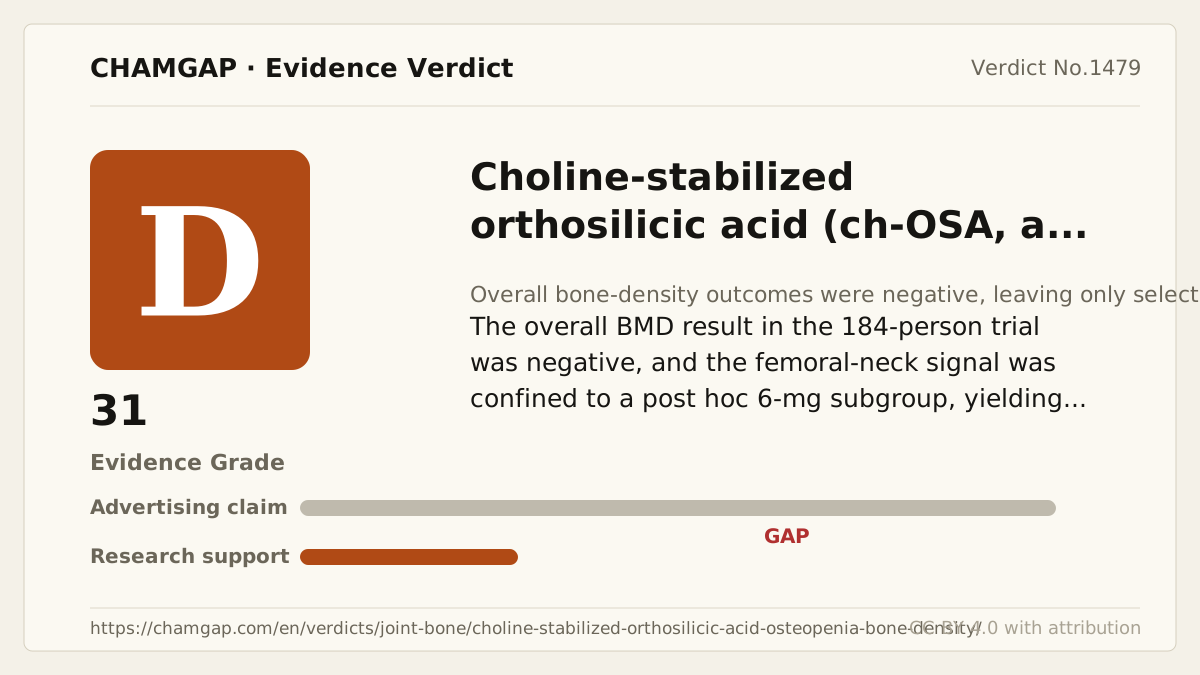
[Chamgap] Choline-stabilized orthosilicic acid x improved bone formation and femoral bone density in osteopenic women — Evidence Grade D·31. 2 cited sources checked. Source: https://chamgap.com/en/verdicts/joint-bone/choline-stabilized-orthosilicic-acid-osteopenia-bone-density/ · CC BY 4.0CC BY 4.0 — free to use with attribution; do not distort grades, numbers, or verdict meaning.
What this document does and does not do
Chamgap is an information source. It reports what research has and has not confirmed; it does not tell readers what to take or buy. That decision belongs to readers and, when needed, medical or legal professionals. This verdict reflects literature available up to the search date and may change as new research appears. Nothing here is medical advice.