
Cervical traction,
does it really help with Clinically meaningful improvement in pain and neck-related disability from cervical radiculopathy?
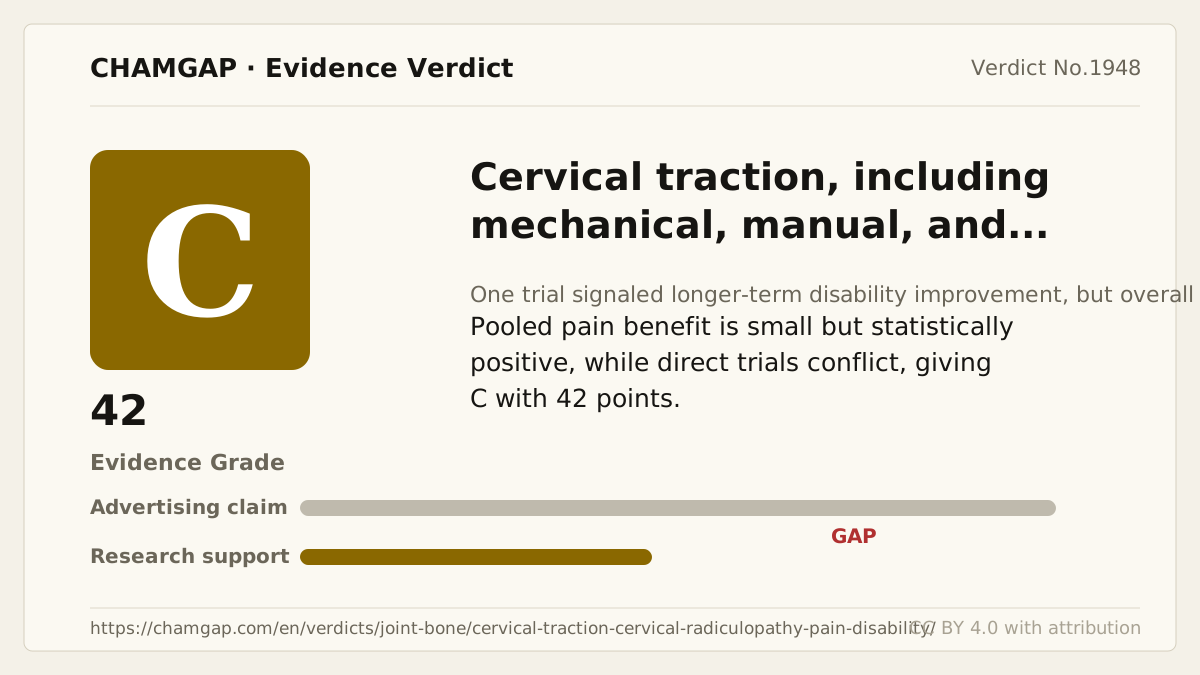
research showsThe grade is C. A seven-trial, 589-participant meta-analysis found pain MD -5.93/100 (95% CI -11.81 to -0.04), I-squared 57%, a statistically positive rather than null result. It missed the review’s prespecified 20/100 threshold, but that threshold is not a validated between-group minimal important difference for cervical traction, so conventional interpretation was used. Direct trials genuinely conflict, giving 42 points.
ads claimApplying a pulling force to the neck does not itself prove lasting pain or functional improvement. Adding traction to exercise has some longer-term disability signals, but average pain reduction was small and results varied with device, positioning, and patient selection.
Useful facts when choosing a product
- Every arm in the pivotal trial received exercise, so the estimate concerns adding traction rather than traction alone.
- Mechanical traction treatment lasted four weeks, with key comparisons reported at six and 12 months.
- A prior cervical-brace verdict concerns motion restriction, a different intervention from applying traction force.
Chamgap Semantic Classification Code
Candidate index · review held
X.cervical-traction.behavioral.pain-and-neck-related-disability-from-cervical-radiculopathy.improve.MULTIBehaviors, exposures and policies > Cervical traction > Behavioral delivery > pain and neck-related disability from cervical radiculopathy > Improvement claim > Multiple: primary unresolved
An automated migration candidate, not an issued permanent code; exact claim scope remains under review. This machine-generated migration candidate helps retrieval but is not a permanent assignment. The original verdict ID and URL remain authoritative.
What the research actually shows
Fritz randomized and analyzed all 86 participants: exercise 28, mechanical traction plus exercise 31, and over-door traction plus exercise 27. Mechanical traction versus exercise alone produced NDI differences of -13.3/100 at six months (95% CI -21.0 to -5.6) and -9.8 at 12 months (-19.4 to -0.2). Device company DJO LLC supported the trial. Young randomized 81 to traction, 45, or sham traction, 36; six in each group withdrew, leaving 69 followed. Both groups received manual therapy and exercise, and adjusted four-week NDI difference was about 1.5/100 (95% CI -3.8 to 6.8), a null result. Young’s funding source could not be confirmed. The seven-trial, 589-participant pain meta-analysis found MD -5.93/100 (95% CI -11.81 to -0.04), I-squared 57%.
Why this is classified as C (46)
A statistically positive but small pooled pain effect and genuine conflict between direct trials, with different comparators and time points, give C with 46 points.
Counterpoint. Meaningful benefit has not been fully excluded, so this is not a repeated-refutation grade. A prospectively defined responder subgroup requires confirmation.
Rejudgment record. Cross-check applied — The seven-trial pooled pain effect is small but statistically positive, while direct Fritz and Young results genuinely conflict across different comparators and time points
| Endpoint | P | Symptom or function itself is the target - including patient reports and performance tests |
| Replication | R0 | Trials conflict in direction |
| Independence | I1 | Mixed funding sources |
| Effect size | E~ | Statistically positive but below the threshold |
| Precision | C0 | The confidence interval leaves room for benefit |
Stored derived and displayed grades match; this is not a current recalculation or validity check (C).
Sub-claim grades by effect
This ingredient is marketed for several effects. A single overall grade blends strong and weak claims together, so each effect is graded separately here. The overall grade reflects the strongest disconfirming or core claim.
| Effect (sub-claim) | Grade | Basis |
|---|---|---|
| Six-month improvement in neck-related disability | C | A manufacturer-supported 86-person trial was positive, but it is a single small result. |
| Twelve-month improvement in neck-related disability | D | The difference versus exercise alone was 9.8 points with a wide interval from 0.2 to 19.4. |
| Clinically meaningful average pain reduction | D | The seven-trial pooled difference was small at -5.93/100 with low-quality evidence. |
Cross-check — AI research and Codex final gate
Evidence Table
| Study | Design | Sample | Funding | Endpoint | Result | Weight |
|---|---|---|---|---|---|---|
| Fritz JM et al. 2014 | Three-arm randomized clinical trial | 86 randomized: exercise 28, mechanical traction 31, over-door traction 27; all 86 in intention-to-treat analysis | Grant from traction-device manufacturer DJO, LLC, reported to have no role in design, interpretation, or publication | Treatment-by-time interaction and time-specific comparisons on the 0-to-100 Neck Disability Index | Mechanical traction versus exercise alone favored traction by 13.3 points at six months (95% CI 5.6 to 21.0) and 9.8 at 12 months (0.2 to 19.4) | Small positive disability trial |
| Colombo C et al. 2020 | Systematic review, meta-analysis, and trial sequential analysis of randomized trials | Seven trials, 589 participants | Academic independent team reporting no conflicts of interest | Pain on a 0-to-100 scale for traction added to other treatment versus other treatment alone | Mean difference -5.93 (95% CI -11.81 to -0.04), P=0.05, I-squared 57%; judged not clinically meaningful | Key synthesis of overall pain effect |
Receipt — 2 References
All 2 cited sources were verified for existence at the original page (as of 2026-08-02).
Final verification and publication gate: Codex · Evidence date: 2026-08-02 · Corrections: none
Cite this verdict
[Chamgap] Cervical traction x pain and disability in cervical radiculopathy — Evidence Grade C·46. 2 cited sources checked. Source: https://chamgap.com/en/verdicts/joint-bone/cervical-traction-cervical-radiculopathy-pain-disability/ · CC BY 4.0CC BY 4.0 — free to use with attribution; do not distort grades, numbers, or verdict meaning.
What this document does and does not do
Chamgap is an information source. It reports what research has and has not confirmed; it does not tell readers what to take or buy. That decision belongs to readers and, when needed, medical or legal professionals. This verdict reflects literature available up to the search date and may change as new research appears. Nothing here is medical advice.