
Cervical collar,
does it really help with Prevention of neck pain and disability after acute whiplash?
research showsA cervical collar is rated F after uncomplicated acute whiplash. Kongsted 2007 (Spine 32(6):618-626) randomized 458 participants among three active strategies and was null long term; Schnabel 2004 (Emerg Med J 21(3):306-310) also favored early exercise over a collar. In the focused review, pain across two randomized trials had SMD -0.80 (95% CI -1.20 to -0.41), directionally favoring active intervention and disfavoring the collar, with the entire interval excluding collar benefit. This adverse direction, not merely nullity, supports F with 12 points.
ads claimThe intuition that immobilization prevents further injury is not supported for uncomplicated whiplash; prolonged collar use does not accelerate recovery or prevent chronic symptoms.
Useful facts when choosing a product
- Suspected fracture, dislocation, or neurologic injury requires emergency evaluation and appropriate immobilization and is outside this verdict.
- For uncomplicated whiplash, education and movement within tolerance are commonly recommended.
- Prolonged use can cause discomfort, skin problems, fear of movement, and neck-muscle deconditioning.
Chamgap Semantic Classification Code
Candidate index · review held
UNK.cervical-collar.UNK.neck-pain-and-disability-after-acute-whiplash.prevent.activeUnknown > Cervical collar > Unknown > neck pain and disability after acute whiplash > Occurrence-prevention claim > Active comparator
An automated migration candidate, not an issued permanent code; exact claim scope remains under review. This machine-generated migration candidate helps retrieval but is not a permanent assignment. The original verdict ID and URL remain authoritative.
What the research actually shows
Kongsted 2007 (Spine 32(6):618-626) randomized 458 participants to a collar, act-as-usual advice, or active mobilization and found no long-term difference in pain, disability, or work capacity. Schnabel 2004 (Emerg Med J 21(3):306-310) compared a collar with early exercise and favored exercise. The focused pain synthesis of two randomized trials was SMD -0.80 (95% CI -1.20 to -0.41), favoring active intervention and disfavoring the collar throughout its confidence interval.
Why this is classified as F (12)
Kongsted's 458-participant three-arm trial was null long term and Schnabel favored early exercise. More importantly, pain across two randomized trials had SMD -0.80 (95% CI -1.20 to -0.41), an interval entirely excluding collar benefit and favoring active intervention, supporting F with 12 points.
Counterpoint. After structural injury has been excluded, a graded early-activity plan is generally more defensible than routine prolonged immobilization.
Rejudgment record. Cross-check applied — Repeated failure in the same acute-whiplash indication: pain, disability, and work capacity were null among 458 randomized and 410 analyzed at one year, an independent 200-participant trial favored early exercise, and a separate 163-participant trial was also null
Sub-claim grades by effect
This ingredient is marketed for several effects. A single overall grade blends strong and weak claims together, so each effect is graded separately here. The overall grade reflects the strongest disconfirming or core claim.
| Effect (sub-claim) | Grade | Basis |
|---|---|---|
| Prevention of neck pain after whiplash | F | A large trial was null and collar therapy was inferior to early exercise. |
| Prevention of disability after whiplash | F | Independent trials did not reproduce disability reduction. |
| Improvement in return to work | F | One-year work capacity did not improve relative to other strategies. |
Cross-check — AI research and Codex final gate
Evidence Table
| Study | Design | Sample | Funding | Endpoint | Result | Weight |
|---|---|---|---|---|---|---|
| Kongsted A et al. 2007 | Three-arm randomized parallel-group trial | 458 randomized; 410 in the actual one-year analysis | Academic study at Danish university-hospital and regional research centers; no manufacturer sponsorship reported | One-year neck pain, disability, and work capacity | Neck pain, P=0.10, disability, P=0.40, and work capacity did not differ, so the primary outcome set failed. | Largest long-term direct trial |
| Schnabel M et al. 2004 | Randomized active-controlled trial | 200 randomized, 97 to collar and 103 to early exercise; 150 in the actual six-week analysis after 50 dropouts, approximately 62 versus 88 | Academic research at Philipps University Marburg; no external manufacturer funding reported | Six-week neck pain and disability | Pain and disability were significantly lower with early exercise, making collar therapy inferior. | Independent active-comparator replication |
Receipt — 2 References
All 2 cited sources were verified for existence at the original page (as of 2026-07-24).
Final verification and publication gate: Codex · Evidence date: 2026-07-24 · Corrections: none
Cite this verdict
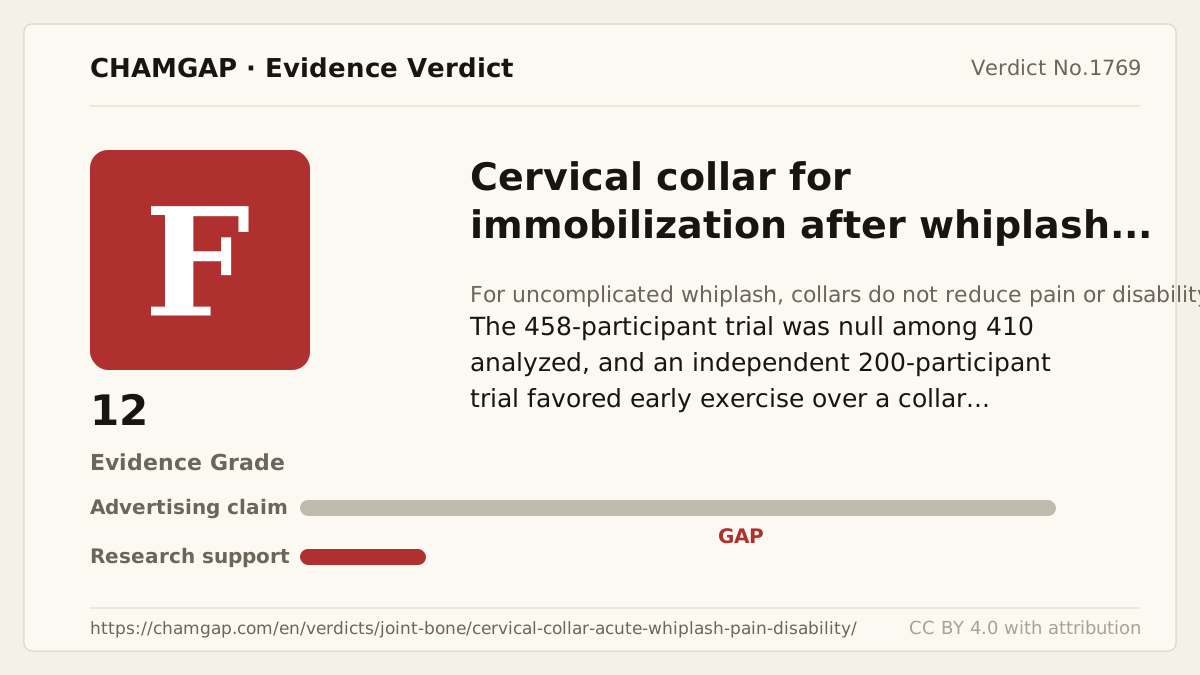
[Chamgap] Cervical collar x acute whiplash injury — Evidence Grade F·12. 2 cited sources checked. Source: https://chamgap.com/en/verdicts/joint-bone/cervical-collar-acute-whiplash-pain-disability/ · CC BY 4.0CC BY 4.0 — free to use with attribution; do not distort grades, numbers, or verdict meaning.
What this document does and does not do
Chamgap is an information source. It reports what research has and has not confirmed; it does not tell readers what to take or buy. That decision belongs to readers and, when needed, medical or legal professionals. This verdict reflects literature available up to the search date and may change as new research appears. Nothing here is medical advice.