
Cat's claw,
does it really help with Relief of pain and inflammation in osteoarthritis and rheumatoid arthritis?
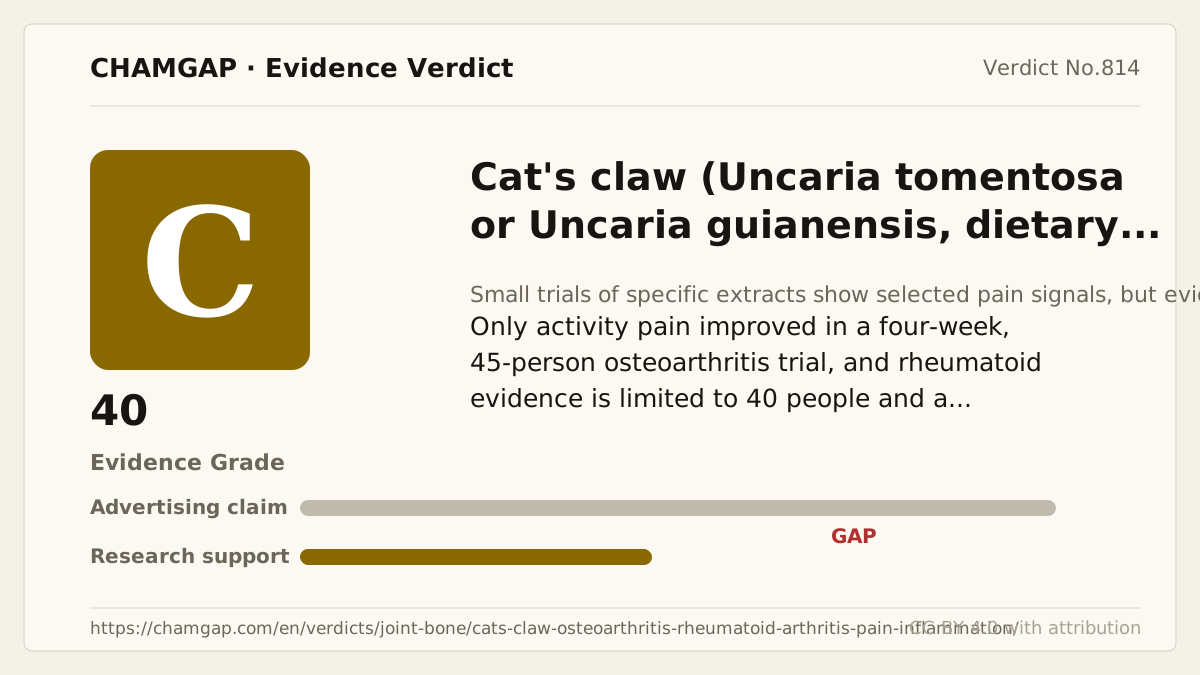
research showsCat's claw is rated C because small signals of joint-pain benefit exist, but the evidence is very limited. In a 45-person knee-osteoarthritis trial, four weeks reduced only pain with activity, not pain at rest or at night or knee circumference. A 40-person rheumatoid-arthritis trial added a specific purified U. tomentosa extract to existing disease-modifying therapy and showed only a borderline improvement in tender-joint count. Findings cannot be generalized to commercial supplements with different species, extracts, and alkaloid profiles, and disease modification or objective suppression of inflammation has not been established. Small samples, subjective endpoints, and formulation specificity yield C with 40 points.
ads claimAnti-inflammatory or immunomodulatory test-tube mechanisms are not clinical proof of arthritis control or cartilage regeneration. The phrase Amazonian natural anti-inflammatory also obscures differences in species, plant part, alkaloid chemotype, and extraction.
Useful facts when choosing a product
- The name cat's claw commonly covers both U. tomentosa and U. guianensis, and their chemical compositions should not be assumed to be identical.
- Arthritis trials used freeze-dried U. guianensis or a specific pentacyclic-alkaloid U. tomentosa extract, so their results cannot be transferred to arbitrary powders, teas, or capsules.
- The rheumatoid-arthritis study tested adjunctive use with an existing disease-modifying drug, not replacement of methotrexate, biologics, or other disease-modifying treatment.
- Labels should identify species, plant part, extraction ratio, and standardized constituents, but matching label language still does not establish equivalence to a trial product.
Chamgap Semantic Classification Code
Candidate index · review held
S.cats-claw.UNK.pain-and-inflammation-in-osteoarthritis-and-rheumatoid-arthritis.relieve.MULTISupplements and nutraceuticals > Cat's claw > Unknown > pain and inflammation in osteoarthritis and rheumatoid arthritis > Symptom-relief claim > Multiple: primary unresolved
An automated migration candidate, not an issued permanent code; exact claim scope remains under review. This machine-generated migration candidate helps retrieval but is not a permanent assignment. The original verdict ID and URL remain authoritative.
What the research actually shows
Piscoya 2001 assigned 45 knee-osteoarthritis patients to U. guianensis (30) or placebo (15) for four weeks. Pain with activity improved from week one, while rest pain, night pain, and knee circumference did not. Mur 2002 added a specific pentacyclic-alkaloid chemotype extract of U. tomentosa or placebo for 24 weeks in 40 active rheumatoid-arthritis patients taking a disease-modifying drug; tender-joint count fell 53.2% versus 24.1% (p=0.044), but this was a small preliminary trial. In a 107-person study, cat's claw was combined with a mineral supplement, preventing isolation of its effect, and sustained superiority over placebo was limited.
Why this is classified as C (40)
The four-week, 45-person osteoarthritis trial improved only activity pain, not rest or night pain, and the 40-person adjunctive rheumatoid-arthritis trial provides only a tender-joint signal from a specific extract. A human signal raises the verdict above D, while small samples, multiple subjective outcomes, product variability, and no independent replication give C with 40 points. Immune, liver, and interaction concerns remain separate safety issues.
Counterpoint. Even if used, cat's claw does not replace diagnosis, exercise, weight management, analgesic care, or disease-modifying therapy. Persistent pain, swelling, warmth, or morning stiffness calls for evaluation of inflammatory arthritis.
Rejudgment record. New verdict — Accepted selected subjective pain and tenderness signals from placebo-controlled trials of 45 osteoarthritis and 40 rheumatoid-arthritis participants, while accounting for small samples, multiple endpoints, specific species and extracts, and the lack of objective inflammatory, disease-modifying, or independent replicated evidence
Sub-claim grades by effect
This ingredient is marketed for several effects. A single overall grade blends strong and weak claims together, so each effect is graded separately here. The overall grade reflects the strongest disconfirming or core claim.
| Effect (sub-claim) | Grade | Basis |
|---|---|---|
| Relief of knee osteoarthritis pain | C | Only activity pain improved in a 45-person trial, while other pain and objective measures were neutral. |
| Adjunctive relief of tenderness and inflammation in rheumatoid arthritis | C | Evidence is limited to a tender-joint signal in a 40-person adjunctive trial of a specific extract, without independent replication. |
| Cartilage regeneration or disease modification in arthritis | ? | No human efficacy trial evaluating structural progression or disease modification was identified. |
Cross-check — AI research and Codex final gate
Evidence Table
| Study | Design | Sample | Funding | Endpoint | Result | Weight |
|---|---|---|---|---|---|---|
| Piscoya J et al. 2001 | Randomized double-blind short-term placebo-controlled trial | 45 patients with knee osteoarthritis; 30 U. guianensis and 15 placebo; four weeks | Limited reporting; evaluation of a specific freeze-dried preparation | Activity, rest, and night pain, assessment scores, and knee circumference | Pain with activity decreased, but rest pain, night pain, and knee circumference did not significantly improve. | Small direct signal limited by multiple endpoints |
| Mur E et al. 2002 | Randomized double-blind placebo-controlled preliminary phase followed by open treatment | 40 patients with active rheumatoid arthritis; 24-week double-blind phase | Non-United-States government research support; specific purified extract | Tender and swollen joint counts and Ritchie index | Tender-joint count fell 53.2% versus 24.1% (p=0.044), but this was a small adjunctive-therapy trial. | Preliminary adjunctive signal |
| Miller MJS et al. 2005 | Four-arm randomized double-blind placebo-controlled trial | 107 participants with knee osteoarthritis; eight weeks | Potential supplement product-development interests | WOMAC, VAS pain, and rescue-medication use | Cat's claw was combined with a mineral supplement, preventing isolation of its effect, and sustained superiority over placebo was limited. | Indirect mixed-product evidence with major limitations |
Receipt — 3 References
All 3 cited sources were verified for existence at the original page (as of 2026-07-20).
Final verification and publication gate: Codex · Evidence date: 2026-07-20 · Corrections: none
Cite this verdict
[Chamgap] Cat's claw x relief of osteoarthritis and rheumatoid arthritis pain and inflammation — Evidence Grade C·40. 3 cited sources checked. Source: https://chamgap.com/en/verdicts/joint-bone/cats-claw-osteoarthritis-rheumatoid-arthritis-pain-inflammation/ · CC BY 4.0CC BY 4.0 — free to use with attribution; do not distort grades, numbers, or verdict meaning.
What this document does and does not do
Chamgap is an information source. It reports what research has and has not confirmed; it does not tell readers what to take or buy. That decision belongs to readers and, when needed, medical or legal professionals. This verdict reflects literature available up to the search date and may change as new research appears. Nothing here is medical advice.