
Carpal tunnel release,
does it really help with Long-term improvement in carpal tunnel symptoms and function?
research showsCarpal tunnel release is rated B. Gerritsen 2002, JAMA 288(10):1245-1251, randomized surgery versus splinting, and Lusa 2024, Cochrane 2024(1):CD001552, found positive long-term global improvement in three trials and 210 participants, RR 2.10 (1.04 to 4.24). Symptom MD -0.26 and function MD -0.36 were clinically small. The original Kim and Jeon 2013 CTQ estimates were 1.14 points for symptoms and 0.74 points for function; Cochrane used approximately 1 and 0.7 points. Failure to reach these MCIDs, lack of masking, crossover surgery, and surgical complications give B with 62 points.
ads claimMarketing can imply that surgery permanently and immediately cures every cause of hand numbness. Selection depends on diagnostic certainty, severity, muscle wasting or persistent sensory loss, and response to conservative treatment.
Useful facts when choosing a product
- Open or endoscopic release divides the transverse carpal ligament to reduce pressure on the median nerve.
- Tingling may improve quickly, but recovery from longstanding nerve damage or muscle wasting can take months or remain incomplete.
- Scar pain, pillar pain, infection, nerve injury, incomplete release, and revision surgery should be discussed.
Chamgap Semantic Classification Code
Candidate index · review held
P.carpal-tunnel-release-by-division-of-the-transverse-carpal-ligament.procedural.carpal-tunnel-symptoms-and-function.improve.UNKProcedures, devices and tests > Carpal tunnel release by division of the transverse carpal ligament > Procedural > carpal tunnel symptoms and function > Improvement claim > Unknown
An automated migration candidate, not an issued permanent code; exact claim scope remains under review. This machine-generated migration candidate helps retrieval but is not a permanent assignment. The original verdict ID and URL remain authoritative.
What the research actually shows
Gerritsen 2002, JAMA 288(10):1245-1251, randomized 176 people with idiopathic carpal tunnel syndrome to surgery, 87, or night splinting, 89. At 18 months, 147 were assessed and global improvement was 90% versus 75%, P=.02, but 32 of 79 in the splint group, 41%, had crossed to surgery. Lusa 2024, Cochrane 2024(1):CD001552, found long-term global improvement in three trials and 210 participants, RR 2.10 (1.04 to 4.24), but symptom MD -0.26 and function MD -0.36 were small. The original Kim and Jeon 2013 CTQ MCID estimates were 1.14 points for symptoms and 0.74 points for function; Cochrane used approximately 1 and 0.7 points. Thus the clinical differences missed MCID, while lack of masking, crossover surgery, and surgical complications warranted downgrading. For comparison, verdict 1737, which is D with 28 points, concerns the same disease but a different intervention, a neutral rigid wrist splint.
Why this is classified as B (62)
Long-term global improvement was positive at RR 2.10, but symptom MD -0.26 and function MD -0.36 missed the original Kim and Jeon 2013 CTQ MCIDs of 1.14 and 0.74 points; lack of masking, crossover surgery, and surgical complications give B with 62 points.
Counterpoint. For severe nerve damage or failed conservative care, anatomical decompression and its potential for durable improvement matter.
Rejudgment record. Cross-check applied — Long-term global improvement at RR 2.10 was positive, but symptom and function differences missed the original Kim and Jeon 2013 CTQ MCIDs, and lack of masking, crossover surgery, and surgical complications limit the score to 62
Sub-claim grades by effect
This ingredient is marketed for several effects. A single overall grade blends strong and weak claims together, so each effect is graded separately here. The overall grade reflects the strongest disconfirming or core claim.
| Effect (sub-claim) | Grade | Basis |
|---|---|---|
| Global symptom improvement at 18 months | B | The result was positive, 90% versus 75%, among 147 actually assessed participants. |
| Fewer nights awakened by symptoms | B | The pivotal trial's direct patient-reported primary outcome favored surgery. |
| Long-term improvement in hand function | C | A signal exists, but incremental comparative benefit is small and uncertain in the latest synthesis. |
Cross-check — AI research and Codex final gate
Evidence Table
| Study | Design | Sample | Funding | Endpoint | Result | Weight |
|---|---|---|---|---|---|---|
| Gerritsen AAM et al. 2002 | Multicenter randomized surgery-versus-splint trial | 176 randomized, 87/89; actual 18-month analysis 147, 68/79 | Grant OG97-013 from the Health Care Insurance Council of the Netherlands | Primary: global improvement, nights awakened, and severity of the main complaint | Global improvement succeeded at 18 months, 90% versus 75%, P=.02; 41% of the splint group crossed to surgery. | Pivotal direct-symptom randomized trial |
| Lusa V et al. 2024 | Cochrane systematic review | Fourteen randomized comparisons of surgery versus non-surgical care; key long-term global improvement in 3 trials and 210 participants | Academic Cochrane review with institutional support; not manufacturer-led | Global improvement, symptoms, function, and harms | Long-term global improvement RR 2.10 (1.04 to 4.24); symptom MD -0.26 and function MD -0.36 missed the original Kim and Jeon 2013 CTQ MCIDs of 1.14 and 0.74 points. | Synthesis calibrating uncertainty |
Receipt — 2 References
All 2 cited sources were verified for existence at the original page (as of 2026-07-24).
Final verification and publication gate: Codex · Evidence date: 2026-07-24 · Corrections: none
Cite this verdict
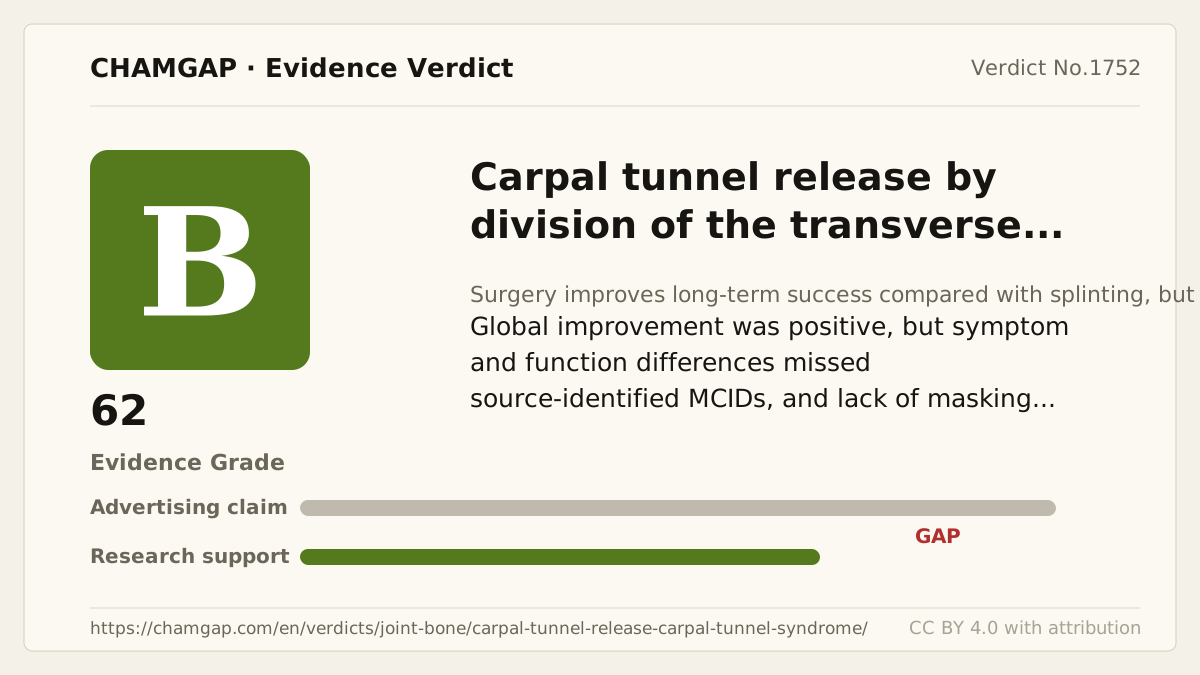
[Chamgap] Carpal tunnel release x long-term symptom improvement — Evidence Grade B·62. 2 cited sources checked. Source: https://chamgap.com/en/verdicts/joint-bone/carpal-tunnel-release-carpal-tunnel-syndrome/ · CC BY 4.0CC BY 4.0 — free to use with attribution; do not distort grades, numbers, or verdict meaning.
What this document does and does not do
Chamgap is an information source. It reports what research has and has not confirmed; it does not tell readers what to take or buy. That decision belongs to readers and, when needed, medical or legal professionals. This verdict reflects literature available up to the search date and may change as new research appears. Nothing here is medical advice.