
Calcium fructoborate,
does it really help with Improvement of knee-joint pain and function?
research showsCalcium fructoborate is rated C because randomized trials report subjective improvements in knee discomfort and function. The 60-person 14-day trial found a between-group WOMAC difference of -13.73, so D is not appropriate. Self-reported outcomes, small samples, manufacturer links, and no independent replication place the evidence in the lower C range with 46 points.
ads claimMarketing expands plant-based boron, rapid joint recovery, and cartilage protection from improvements in pain questionnaires into structural treatment. The trials did not establish cartilage regeneration, preserved joint space, or prevention of surgery.
Useful facts when choosing a product
- The trial ingredient was a patented-process calcium fructoborate product; ordinary boric acid, borax, and other boron supplements do not automatically share its clinical evidence.
- The 2014 trial used 220 mg daily and the 2018 trial used a total of 216 mg daily, once or in divided doses, for 14 to 90 days. These are compound amounts and are not the same as elemental boron amounts.
- WOMAC and McGill are patient-relevant pain and function questionnaires, but they are subjective outcomes and do not establish imaging-based cartilage preservation or disease modification.
- Elemental boron content and co-ingredients vary among products, so total boron intake from food and other supplements should be considered.
Chamgap Semantic Classification Code
Candidate index · review held
UNK.calcium-fructoborate.UNK.knee-joint-pain-and-function.improve.placeboUnknown > Calcium fructoborate > Unknown > knee-joint pain and function > Improvement claim > Placebo
An automated migration candidate, not an issued permanent code; exact claim scope remains under review. This machine-generated migration candidate helps retrieval but is not a permanent assignment. The original verdict ID and URL remain authoritative.
What the research actually shows
Pietrzkowski 2014 randomized 60 people with self-reported knee discomfort to 110 mg calcium fructoborate twice daily or placebo and measured WOMAC and McGill outcomes at 7 and 14 days. A 2021 correction added disclosure of FutureCeuticals funding and ingredient supply, employee authors, and patent interests. Pietrzkowski 2018 randomized 120 people to 216 mg once daily, 108 mg twice daily, or placebo for 90 days and reported improvement in both active groups, but most authors were affiliated with FutureCeuticals. Biomarker studies and reviews add context but are surrogate evidence or arise from the same research network.
Why this is classified as C (46)
The 60-person 14-day placebo-controlled trial reported a -13.73 between-group WOMAC difference, and a 120-person 90-day trial also reported improvement, so D is not appropriate. Self-reported outcomes, small samples, manufacturer links, and no independent replication place the evidence at C with 46 points.
Counterpoint. It may be an adjunctive option for some adults seeking short-term relief of knee discomfort, but it does not replace exercise, weight management, or evidence-based treatment of diagnosed osteoarthritis.
Rejudgment record. New verdict — Accepted the -13.73 between-group WOMAC result in the 60-person 14-day trial as sufficient to exclude D, while applying lower C for self-reported outcomes, small samples, manufacturer links, and no independent replication
Sub-claim grades by effect
This ingredient is marketed for several effects. A single overall grade blends strong and weak claims together, so each effect is graded separately here. The overall grade reflects the strongest disconfirming or core claim.
| Effect (sub-claim) | Grade | Basis |
|---|---|---|
| Improvement of knee pain and function | C | Two placebo-controlled trials were positive, but outcomes were subjective and evidence is concentrated around the branded ingredient's developer. |
| Independent clinical replication outside the developer network | ? | No verifiable independent placebo-controlled replication was found. |
| Inflammatory-biomarker improvement guarantees clinical joint benefit | C | Small human biomarker changes exist, but they are surrogate outcomes and are not equivalent to pain relief or structural improvement. |
Cross-check — AI research and Codex final gate
Evidence Table
| Study | Design | Sample | Funding | Endpoint | Result | Weight |
|---|---|---|---|---|---|---|
| Pietrzkowski Z et al. 2014 | Comparative double-blind randomized placebo-controlled trial | 60 participants with self-reported knee discomfort | Funded and supplied by FutureCeuticals; employee authors and patent interests | WOMAC and McGill pain questionnaires at days 7 and 14 | At day 14, reported between-group differences favored calcium fructoborate by -13.73 on WOMAC and -8.9 on McGill. | Direct positive evidence with substantial commercial bias |
| Pietrzkowski Z et al. 2018 | Ninety-day double-blind randomized placebo-controlled trial | 120 participants, 40 per group | Most authors were affiliated with FutureCeuticals | WOMAC and McGill at days 7, 14, 30, 60, and 90 | Both 216 mg once daily and 108 mg twice daily showed sustained improvement versus placebo, with no difference between dosing schedules. | Direct positive evidence lacking independence |
| EFSA NDA Panel. 2021 | Scientific opinion on novel-food safety | Synthesis of human, animal, and toxicology data | European regulatory assessment | Safety of calcium fructoborate and boron exposure | Assessed safety under proposed conditions of use but did not establish efficacy for knee symptoms. | Evidence separating safety from efficacy |
Receipt — 4 References
All 4 cited sources were verified for existence at the original page (as of 2026-07-20).
Final verification and publication gate: Codex · Evidence date: 2026-07-20 · Corrections: none
Cite this verdict
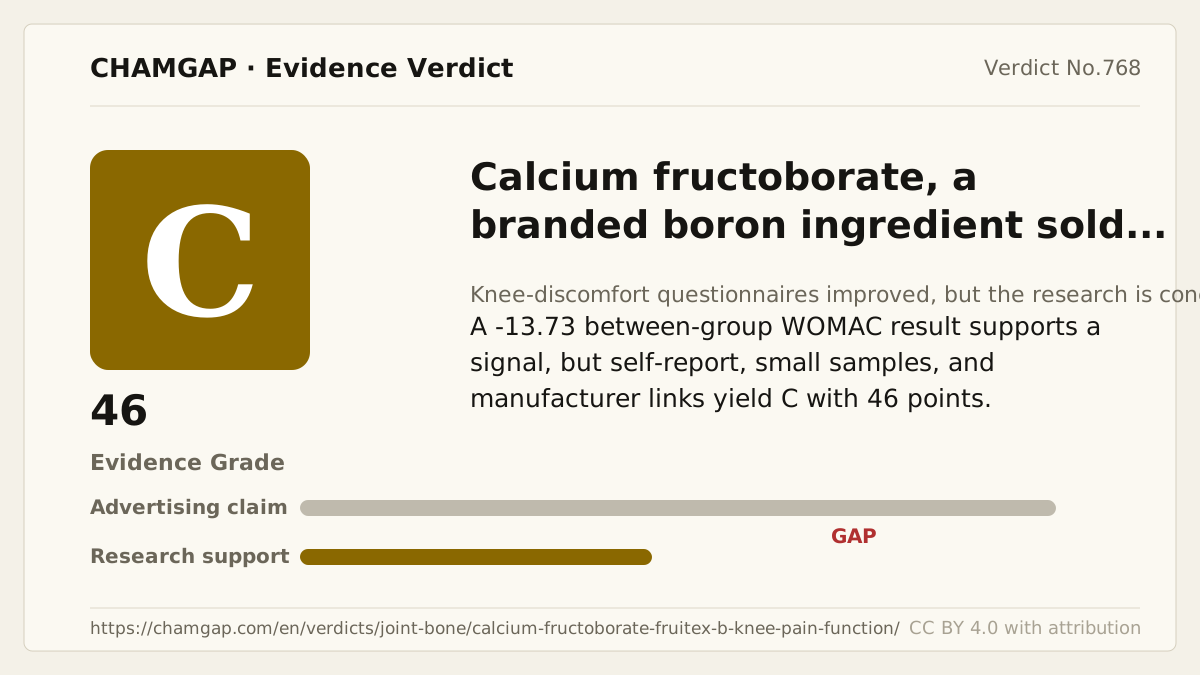
[Chamgap] Calcium fructoborate x improved knee-joint pain and function — Evidence Grade C·46. 4 cited sources checked. Source: https://chamgap.com/en/verdicts/joint-bone/calcium-fructoborate-fruitex-b-knee-pain-function/ · CC BY 4.0CC BY 4.0 — free to use with attribution; do not distort grades, numbers, or verdict meaning.
What this document does and does not do
Chamgap is an information source. It reports what research has and has not confirmed; it does not tell readers what to take or buy. That decision belongs to readers and, when needed, medical or legal professionals. This verdict reflects literature available up to the search date and may change as new research appears. Nothing here is medical advice.