
Calcitonin salmon nasal spray,
does it really help with Prevention of new vertebral fractures in postmenopausal osteoporosis?
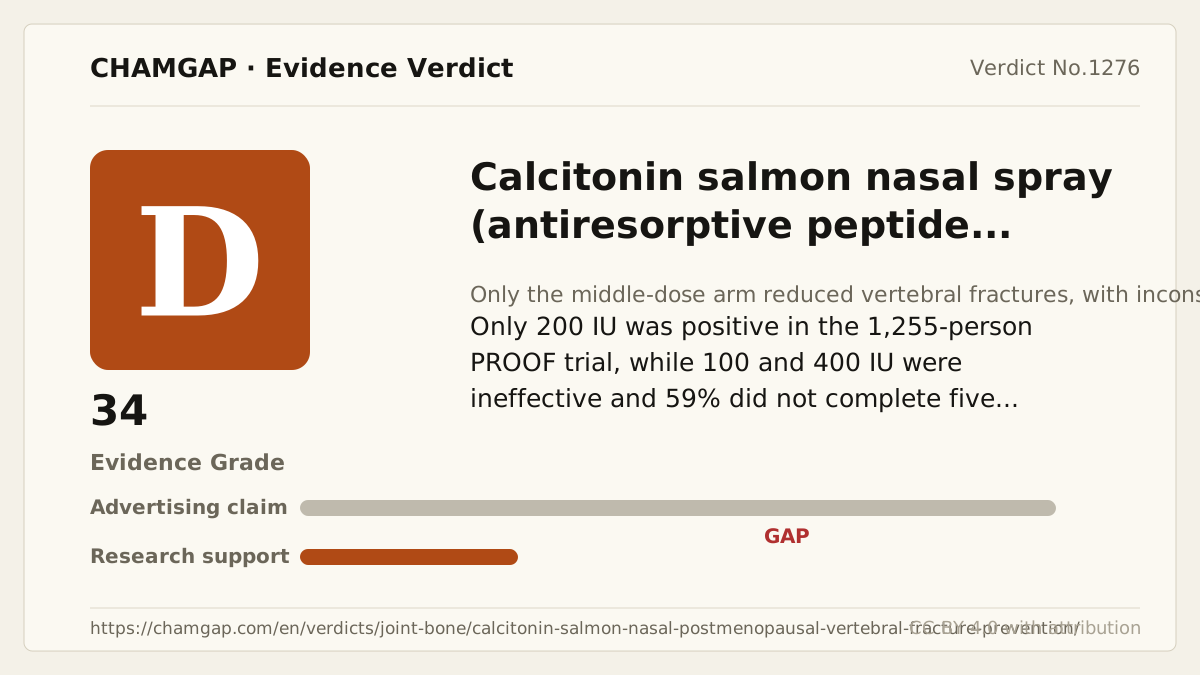
research showsCalcitonin salmon nasal spray is rated D for preventing new vertebral fractures. In the pivotal five-year PROOF trial of 1,255 participants, only 200 IU/day reduced new vertebral-fracture risk by 33% (RR 0.67, 95% CI 0.47 to 0.97); both 100 IU and 400 IU were ineffective, producing an inconsistent dose response. Only 511 participants completed five years, and reductions in nonvertebral or hip fractures were not established. Current United States labeling also states that fracture-reduction efficacy has not been demonstrated. The borderline positive result in one middle-dose arm is therefore not treated as a reliable replicated fracture-prevention effect.
ads claimMarketing can expand an antiresorptive bone-protection mechanism into proven prevention of vertebral and hip fractures alike. The pivotal result was confined to the 200-IU arm of one trial, with no consistent benefit at lower or higher doses or for nonvertebral and hip fractures.
Useful facts when choosing a product
- Calcitonin salmon is a 32-amino-acid peptide that inhibits osteoclast-mediated bone resorption; the usual United States nasal label dose is 200 IU once daily with alternating nostrils.
- United States prescribing information reserves it for women more than five years postmenopause when alternative treatments are unsuitable and states that fracture-reduction efficacy has not been demonstrated.
- Nasal dryness, irritation, epistaxis, and ulceration can occur, and rare serious hypersensitivity reactions warrant attention to nasal status and allergy history.
- A malignancy imbalance appeared in meta-analysis of long-term trials, so continued need should be reassessed periodically; this safety issue is separate from the efficacy grade.
Chamgap Semantic Classification Code
Candidate index · review held
M.calcitonin-salmon-nasal-spray.intranasal.new-vertebral-fractures-in-postmenopausal-osteoporosis.prevent.placeboMedicinal interventions > Calcitonin salmon nasal spray > Intranasal > new vertebral fractures in postmenopausal osteoporosis > Occurrence-prevention claim > Placebo
An automated migration candidate, not an issued permanent code; exact claim scope remains under review. This machine-generated migration candidate helps retrieval but is not a permanent assignment. The original verdict ID and URL remain authoritative.
What the research actually shows
The Chesnut PROOF trial compared nasal doses of 100, 200, and 400 IU with placebo while giving every group calcium 1,000 mg and vitamin D 400 IU. New vertebral fractures decreased only at 200 IU, with 51 of 287 versus 70 of 270 events; the 100- and 400-IU arms were nonsignificant. A 2002 meta-analysis of 30 trials found a pooled vertebral-fracture signal, but the effect in the one relatively large trial was smaller at RR 0.79 (95% CI 0.62 to 1.00), and nonvertebral fractures remained uncertain at RR 0.52 (95% CI 0.22 to 1.23). Current United States prescribing information reserves use for women more than five years postmenopause when alternatives are unsuitable while stating that fracture-reduction efficacy has not been demonstrated. The European Medicines Agency recommended ending nasal use for osteoporosis after weighing limited efficacy against a long-term malignancy signal.
Why this is classified as D (34)
A large randomized trial with a hard endpoint is a strength, but only 200 IU was positive at RR 0.67, while 100 and 400 IU both failed and five-year completion was only 41%. Significant reductions in nonvertebral or hip fractures and independent large replication are absent, and current labeling states that fracture reduction is unproven. Dose-response inconsistency, high attrition, and a single borderline positive arm give D with 34 points.
Counterpoint. Osteoporosis treatment should be selected with a clinician according to fracture risk, kidney function, route preferences, and contraindications. People already using calcitonin should review the rationale and alternatives with the prescriber instead of stopping it without advice.
Rejudgment record. Cross-check applied — Accepted the 33% vertebral-fracture reduction at 200 IU in PROOF, but applied failure of 100 and 400 IU, no established nonvertebral or hip benefit, five-year completion of only 511 of 1,255, no independent confirmation, and current labeling that fracture reduction is unproven
Sub-claim grades by effect
This ingredient is marketed for several effects. A single overall grade blends strong and weak claims together, so each effect is graded separately here. The overall grade reflects the strongest disconfirming or core claim.
| Effect (sub-claim) | Grade | Basis |
|---|---|---|
| Prevention of new vertebral fractures | D | Only 200 IU reduced fractures by 33% in PROOF; 100 and 400 IU failed and five-year completion was 41%. |
| Prevention of nonvertebral fractures | D | The meta-analytic RR of 0.52 had a nonsignificant 95% CI of 0.22 to 1.23, and the large trial also failed. |
| Prevention of hip fractures | D | Hip-fracture reduction in PROOF was not statistically significant, with no confirmatory large trial. |
Cross-check — AI research and Codex final gate
Evidence Table
| Study | Design | Sample | Funding | Endpoint | Result | Weight |
|---|---|---|---|---|---|---|
| Chesnut et al. PROOF 2000 | Five-year multicenter randomized double-blind placebo-controlled dose-response trial | 1,255 women with postmenopausal osteoporosis; 1,108 with follow-up radiographs; 511 five-year completers | Novartis Pharmaceuticals Corporation | Radiographic new vertebral fractures and nonvertebral and hip fractures | Only 200 IU reduced new vertebral fractures, RR 0.67 (95% CI 0.47 to 0.97); 100 and 400 IU failed, and nonvertebral or hip reductions were not established. | Key direct evidence with inconsistent dose response and high attrition |
| Cranney et al. 2002 | Systematic review and meta-analysis of calcitonin randomized trials in postmenopausal osteoporosis | 30 trials; 1,404 participants in four vertebral-fracture trials and 1,481 in three nonvertebral-fracture trials | Academic evidence synthesis; individual trial sponsorship varied | Vertebral and nonvertebral fractures and bone mineral density | A pooled vertebral signal existed, but the large-trial effect was smaller and nonvertebral RR 0.52 (95% CI 0.22 to 1.23) remained uncertain. | Synthesis and boundary evidence for nonvertebral efficacy |
| Current U.S. prescribing information | Regulatory labeling and long-term trial safety review | Twenty-one randomized controlled trials in the malignancy meta-analysis | United States regulatory labeling | Labeled indication, demonstrated fracture reduction, malignancy, and nasal adverse reactions | States that fracture-reduction efficacy has not been demonstrated and calls for reassessment because of possible malignancy association. | Current regulatory and safety context |
Receipt — 4 References
All 4 cited sources were verified for existence at the original page (as of 2026-07-24).
Final verification and publication gate: Codex · Evidence date: 2026-07-24 · Corrections: none
Cite this verdict
[Chamgap] Calcitonin salmon nasal spray x prevention of new vertebral fractures in postmenopausal osteoporosis — Evidence Grade D·34. 4 cited sources checked. Source: https://chamgap.com/en/verdicts/joint-bone/calcitonin-salmon-nasal-postmenopausal-vertebral-fracture-prevention/ · CC BY 4.0CC BY 4.0 — free to use with attribution; do not distort grades, numbers, or verdict meaning.
What this document does and does not do
Chamgap is an information source. It reports what research has and has not confirmed; it does not tell readers what to take or buy. That decision belongs to readers and, when needed, medical or legal professionals. This verdict reflects literature available up to the search date and may change as new research appears. Nothing here is medical advice.