
Burdock-root tea,
does it really help with Knee osteoarthritis pain and function?
research showsThe grade is C with 50 points. A 36-person randomized trial reported positive between-group P values for pain and function, but the magnitude could not be calculated from the publicly available information, so clinical importance cannot be assessed. Both groups also used acetaminophen and glucosamine, and warm water was not a taste-matched placebo for subjective pain outcomes.
ads claimA P value does not show how much pain changed or whether patients could feel the difference. Concomitant analgesic and glucosamine use also prevents treating this as an isolated burdock effect.
Useful facts when choosing a product
- The intervention was tea decocted from 2 g of whole burdock root in 150 mL water, not an extract capsule.
- Several papers divided clinical symptoms, inflammatory markers and oxidative stress, lipids and blood pressure, and other endpoints from the same small 36-person cohort.
- Donguibogam places burdock in Tang-aek chapter 3, lower herbs, with the seed as the main entry and the root as a short subsidiary entry; Bencao Gangmu likewise places it in chapter 15 among herbs.
- Hildegard's Physica, Liber I Cap. XCVIII, called the root useless, while Culpeper treated it as medicine or a preserve rather than a vegetable. Culinary root use is clear in Japan and Korea, not a universal tradition.
- Verdict 378 is ungraded and has no score for liver detoxification and blood purification; the present verdict concerns a different outcome, knee pain and function.
Chamgap Semantic Classification Code
Candidate index · review held
F.burdock-root-decoction-tea.food.knee-osteoarthritis-pain-and-function.assess.UNKFoods and beverages > Burdock-root decoction tea > Food consumption > Knee osteoarthritis pain and function > Association or change assessment > Unknown
An automated migration candidate, not an issued permanent code; exact claim scope remains under review. This machine-generated migration candidate helps retrieval but is not a permanent assignment. The original verdict ID and URL remain authoritative.
What the research actually shows
Thirty-six patients with bilateral knee osteoarthritis were randomized to burdock-root tea made by decocting 2 g in 150 mL water three times daily or to warm water for 42 days. Both groups used acetaminophen and glucosamine. The paper appears to analyze all 36 participants but provides inadequate attrition flow. Between-group P values were below 0.001 for VAS pain, 0.020 for KOOS, and 0.027 for TUG; the publicly available information provides no between-group mean difference, standard deviation, test statistic, or 95% confidence interval from which to calculate the magnitude. The clinical-symptom article is Alipoor B et al., 2014, Current Topics in Nutraceutical Research 12(4):149–154; no DOI was identified. Registration number IRCT201305274105N13 exists, but the official page could not be directly verified. Funding came from the research vice-chancellery of Tabriz University of Medical Sciences.
Why this is classified as C (50)
The trial measured patient-important pain and function, but it was a single small short study with distinguishable control tea and subjective pain. The magnitude could not be calculated from the publicly available information, so clinical importance remains unknown. It earns C with 50 points.
Counterpoint. All reported P values pointed in the same direction, which justifies a larger confirmatory trial but not a firm efficacy claim.
Rejudgment record. Cross-check applied — One 36-person 42-day trial with a magnitude and confidence intervals that could not be established from the publicly available information and with inadequate blinding
| Endpoint | P | Symptom or function itself is the target - including patient reports and performance tests |
| Replication | R1 | Single confirmatory trial |
| Independence | I2 | Decisive evidence is publicly or non-profit funded |
| Effect size | EX | The clinical size of the effect could not be judged |
| Precision | CX | No pooled confidence interval could be confirmed |
Stored derived and displayed grades match; this is not a current recalculation or validity check (C).
Sub-claim grades by effect
This ingredient is marketed for several effects. A single overall grade blends strong and weak claims together, so each effect is graded separately here. The overall grade reflects the strongest disconfirming or core claim.
| Effect (sub-claim) | Grade | Basis |
|---|---|---|
| Improved knee pain and function with burdock tea | C | A small single trial had positive P values but no assessable effect magnitude. |
Cross-check — AI research and Codex final gate
Evidence Table
| Study | Design | Sample | Funding | Endpoint | Result | Weight |
|---|---|---|---|---|---|---|
| Alipoor et al. 2014 | Warm-water-controlled randomized trial, 42 days | 36 randomized and apparently 36 analyzed | Public university funding from Tabriz University of Medical Sciences | VAS pain, KOOS, and TUG | P<0.001, P=0.020, and P=0.027; magnitude and 95% CIs unavailable in the public material | Direct randomized signal whose clinical magnitude cannot be calculated from public material |
Receipt — 2 References
Of 2 cited sources, 1 had limited original-page access (blocked or summary-only) and were verified via index/summary, marked partial; the rest were verified at the original page. As of 2026-08-02.
Final verification and publication gate: Codex · Evidence date: 2026-08-02 · Corrections: none
Cite this verdict
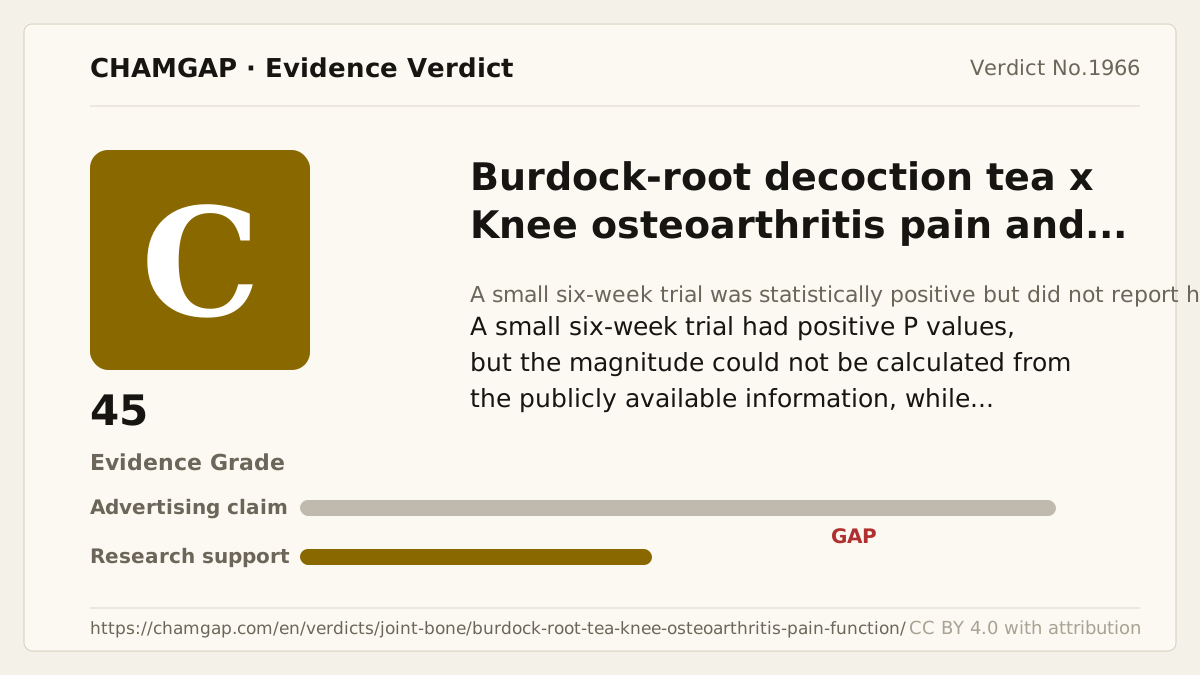
[Chamgap] Burdock-root tea x knee osteoarthritis pain and function — Evidence Grade C·50. 2 cited sources checked. Source: https://chamgap.com/en/verdicts/joint-bone/burdock-root-tea-knee-osteoarthritis-pain-function/ · CC BY 4.0CC BY 4.0 — free to use with attribution; do not distort grades, numbers, or verdict meaning.
What this document does and does not do
Chamgap is an information source. It reports what research has and has not confirmed; it does not tell readers what to take or buy. That decision belongs to readers and, when needed, medical or legal professionals. This verdict reflects literature available up to the search date and may change as new research appears. Nothing here is medical advice.