
Beer or wine 1-2 drinks/day,
does it really help with Maintained bone density and prevention of osteoporosis or fractures?
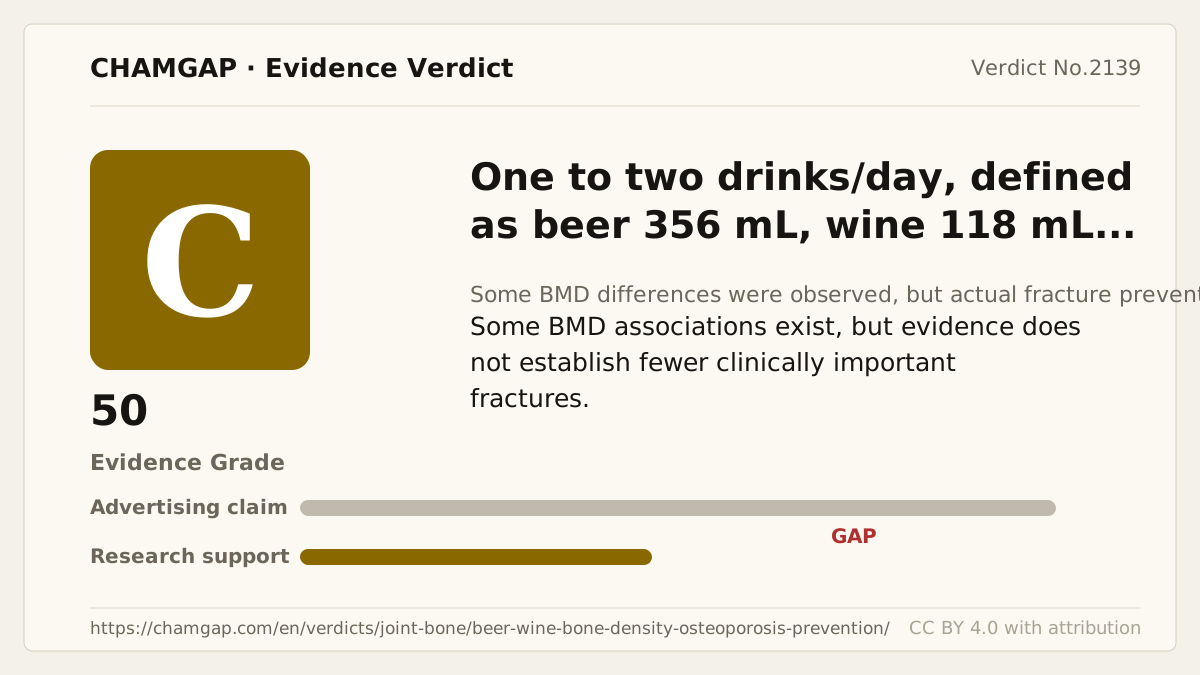
research showsThe grade is C. Men drinking one to two drinks/day had total-hip BMD 1.068 versus 1.033 g/cm², about 3.4% higher. Larger 5.0%-8.3% differences in postmenopausal women occurred mainly above two drinks/day, while premenopausal women had no significant finding. Tucker measured cross-sectional BMD and had no fracture outcome.
ads claimBeer contains silicon and wine contains polyphenols, but these composition facts do not establish fracture prevention. Adjusting for silicon attenuated the beer association. The study did not assign isolated silicon or polyphenols.
Useful facts when choosing a product
- One drink was beer 356 mL, wine 118 mL, or spirits 42 mL, depending on beverage type.
- Men's total-hip BMD was 1.068 versus 1.033 g/cm² at one to two drinks/day.
- Tucker contained cross-sectional BMD but no fracture outcome.
Chamgap Semantic Classification Code
Candidate index · review held
F.one-to-two-drinks-day.food.maintained-bone-density-and-prevention-of-osteoporosis-or-fractures.prevent.UNKFoods and beverages > One to two drinks/day > Food consumption > Maintained bone density and prevention of osteoporosis or fractures > Occurrence-prevention claim > Unknown
An automated migration candidate, not an issued permanent code; exact claim scope remains under review. This machine-generated migration candidate helps retrieval but is not a permanent assignment. The original verdict ID and URL remain authoritative.
What the research actually shows
Framingham Offspring measured BMD once in 1,182 men, 1,289 postmenopausal women, and 248 premenopausal women; it had no fracture outcome. A study drink was defined by beverage-specific volume: beer 356 mL, wine 118 mL, and spirits 42 mL. Men's one-to-two-drink result differs from the mainly above-two-drink result in postmenopausal women, and premenopausal women had no significant finding.
Why this is classified as C (46)
Small surrogate associations with multiplicity and residual confounding, plus no fracture reduction at the target dose, give C with 46 points.
Counterpoint. The BMD signal should not be erased; it remains a surrogate association one step removed from fracture prevention.
Rejudgment record. Cross-check applied — Men's one-to-two-drink BMD association was surrogate, larger postmenopausal differences were mainly above two drinks, premenopausal findings were nonsignificant, and middle-range fracture reduction was absent
| Endpoint | S | Surrogate marker - laboratory or imaging measures |
| Replication | R1 | Single confirmatory trial |
| Independence | I1 | Mixed funding sources |
| Effect size | E~ | Statistically positive but below the threshold |
Stored derived and displayed grades match; this is not a current recalculation or validity check (C).
Sub-claim grades by effect
This ingredient is marketed for several effects. A single overall grade blends strong and weak claims together, so each effect is graded separately here. The overall grade reflects the strongest disconfirming or core claim.
| Effect (sub-claim) | Grade | Basis |
|---|---|---|
| Maintained BMD in some groups | C | This is a small observational surrogate association. |
| Hip-fracture prevention with 1-2 drinks/day | D | The overlapping moderate-dose category had RR 1.00. |
Cross-check — AI research and Codex final gate
Evidence Table
| Study | Design | Sample | Funding | Endpoint | Result | Weight |
|---|---|---|---|---|---|---|
| Tucker KL et al. 2009 Framingham Offspring | Observational cross-sectional BMD analysis | 1,182 men, 1,289 postmenopausal women, and 248 premenopausal women | USDA, NIH, and a foundation linked to the Institute of Brewing and Distilling | Hip and lumbar-spine BMD; no fractures | Men's total hip was 1.068 vs 1.033 g/cm²; larger postmenopausal differences were mainly above two drinks, with no significant premenopausal finding. | Observational surrogate association |
| Zhang X et al. 2015 | Meta-analysis of prospective cohorts for hip fracture | Multiple cohorts | Funding disclosed in the article | Hip fracture | RR 0.88 (0.83-0.89) at 0.01-12.5 g/day, 1.00 (0.85-1.14) at 12.6-49.9, and 1.71 (1.41-2.01) at 50 or more. | Prioritized patient-important event |
Receipt — 2 References
All 2 cited sources were verified for existence at the original page (as of 2026-08-04).
Final verification and publication gate: Codex · Evidence date: 2026-08-04 · Corrections: none
Cite this verdict
[Chamgap] Beer or wine 1-2 drinks/day x bone density and osteoporosis prevention — Evidence Grade C·46. 2 cited sources checked. Source: https://chamgap.com/en/verdicts/joint-bone/beer-wine-bone-density-osteoporosis-prevention/ · CC BY 4.0CC BY 4.0 — free to use with attribution; do not distort grades, numbers, or verdict meaning.
What this document does and does not do
Chamgap is an information source. It reports what research has and has not confirmed; it does not tell readers what to take or buy. That decision belongs to readers and, when needed, medical or legal professionals. This verdict reflects literature available up to the search date and may change as new research appears. Nothing here is medical advice.