
Bed rest,
does it really help with Improved pain, function, and overall recovery?
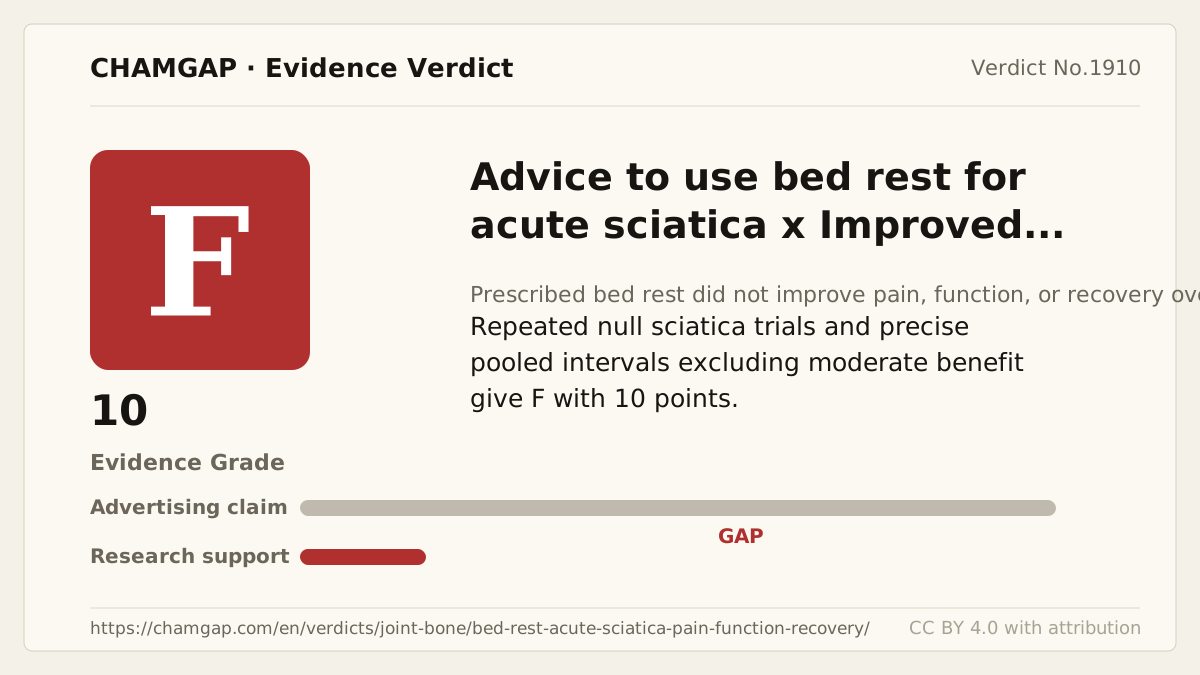
research showsThe grade is F. In Vroomen, 183 randomized participants had two-week global improvement of 64/92 (70%) versus 59/91 (65%), adjusted OR 1.2 (95% CI 0.6 to 2.3), and Hofstee also found no bed-rest benefit. Pooled results from two trials and 348 participants excluded a conventional moderate effect, giving F with 10 points.
ads claimClaims that patients must remain in bed so the nerve can recover are inconsistent with randomized evidence. Brief position changes and prescribed bed rest are different interventions.
Useful facts when choosing a product
- The pivotal intervention required remaining in bed for two weeks except for bathroom use and bathing.
- The Cochrane synthesis found little or no pain or functional difference between bed rest and staying active in sciatica.
- No existing verdict for the same bed-rest and sciatica combination was identified.
Chamgap Semantic Classification Code
Candidate index · review held
UNK.advice-to-use-bed-rest.UNK.pain-function-and-overall-recovery.improve.UNKUnknown > Advice to use bed rest > Unknown > pain, function, and overall recovery > Improvement claim > Unknown
An automated migration candidate, not an issued permanent code; exact claim scope remains under review. This machine-generated migration candidate helps retrieval but is not a permanent assignment. The original verdict ID and URL remain authoritative.
What the research actually shows
Vroomen 1999 randomized and analyzed all 183 participants, 92 to two weeks of bed rest and 91 to watchful waiting. Participant masking was impossible, but outcome assessors and analysts were masked. Hofstee 2002 randomized 250 participants among bed rest, physiotherapy, and continuation of daily activities; 167 were assigned to the bed-rest versus daily-activity comparison. At six months, the odds ratio was 1.6 (95% CI 0.8 to 3.5) for treatment failure and 1.5 (0.7 to 3.6) for surgery, showing no benefit.
Why this is classified as F (10)
Two trials were repeatedly null in the same indication, and pooled intervals from 348 participants excluded a conventional moderate effect, giving F with 10 points.
Counterpoint. F does not mean a person must never rest briefly during severe pain; it refutes planned bed rest as an efficacy strategy.
Rejudgment record. Cross-check applied — Two randomized trials were repeatedly null in acute sciatica, and pooled pain and function intervals excluded a conventional moderate effect
| Endpoint | P | Symptom or function itself is the target - including patient reports and performance tests |
| Replication | RX | Repeatedly refuted in the same indication |
| Independence | I2 | Decisive evidence is publicly or non-profit funded |
| Effect size | E0 | Null |
| Precision | C1 | The confidence interval excludes meaningful benefit |
Stored derived and displayed grades match; this is not a current recalculation or validity check (F).
Sub-claim grades by effect
This ingredient is marketed for several effects. A single overall grade blends strong and weak claims together, so each effect is graded separately here. The overall grade reflects the strongest disconfirming or core claim.
| Effect (sub-claim) | Grade | Basis |
|---|---|---|
| Faster overall recovery | F | The two-week difference was not significant and both groups were 87% at 12 weeks. |
| Pain relief | F | The pooled SMD was -0.03, 95% CI -0.24 to 0.18. |
| Functional improvement | F | The pooled SMD was 0.19, 95% CI -0.02 to 0.41, excluding a 0.5-SD benefit. |
Cross-check — AI research and Codex final gate
Evidence Table
| Study | Design | Sample | Funding | Endpoint | Result | Weight |
|---|---|---|---|---|---|---|
| Vroomen et al. 1999 | Randomized assessor-blinded watchful-waiting-controlled trial | 183 randomized and analyzed, 92 versus 91 | Dutch public-academic investigators; no manufacturer sponsorship reported | Patient and investigator global improvement at two and 12 weeks, primary measures | Two-week patient improvement 64/92 (70%) versus 59/91 (65%), adjusted OR 1.2, 95% CI 0.6 to 2.3; both 87% at 12 weeks. Pain and function also did not differ. | Pivotal all-randomized null trial |
| Hofstee et al. 2002 Westeinde Sciatica Trial | Randomized three-arm trial of bed rest, physiotherapy, and continuation of daily activities | 250 randomized; 167 assigned to the bed-rest versus daily-activity comparison | Nonmanufacturer clinical trial | Treatment failure and surgery at six months | Bed rest versus daily activities: treatment-failure OR 1.6 (95% CI 0.8 to 3.5), surgery OR 1.5 (0.7 to 3.6). | Second null trial in the same indication |
| Dahm et al. Cochrane sciatica synthesis | Meta-analysis of low-risk randomized trials | Two sciatica trials with 348 participants | Independent Cochrane synthesis of nonmanufacturer trials | Pain relief and functional status | Pain SMD -0.03, 95% CI -0.24 to 0.18; function SMD 0.19, 95% CI -0.02 to 0.41. | Pooled evidence excluding a meaningful moderate effect |
Receipt — 4 References
All 4 cited sources were verified for existence at the original page (as of 2026-08-01).
Final verification and publication gate: Codex · Evidence date: 2026-08-01 · Corrections: none
Cite this verdict
[Chamgap] Bed rest x acute sciatica pain, function, and recovery — Evidence Grade F·10. 4 cited sources checked. Source: https://chamgap.com/en/verdicts/joint-bone/bed-rest-acute-sciatica-pain-function-recovery/ · CC BY 4.0CC BY 4.0 — free to use with attribution; do not distort grades, numbers, or verdict meaning.
What this document does and does not do
Chamgap is an information source. It reports what research has and has not confirmed; it does not tell readers what to take or buy. That decision belongs to readers and, when needed, medical or legal professionals. This verdict reflects literature available up to the search date and may change as new research appears. Nothing here is medical advice.