
Bed-exit alarms,
does it really help with Reduced inpatient falls and injurious falls?
research showsThe grade is D. In a cluster-randomized trial of 16 nursing units and 27,672 patients, alarm use was about 36-fold higher but remained only 64.41 versus 1.79 alarm-days per 1,000 patient-days. There were 315 falls over 59,011 patient-days in intervention units and 408 over 83,604 patient-days in control units; the adjusted rate ratio was 1.09 (95% CI 0.85 to 1.53). The Sahota team's 1,839-person trial was also null, but neither trial excluded clinically important benefit, giving D with 34 points.
ads claimThe result cannot be presented as the effect of an alarm sound alone. The trial tested a bundle of training and technical support that expanded alarm use, and that full bundle did not reduce falls.
Useful facts when choosing a product
- The Shorr study was a cluster-randomized trial of 16 units and 27,672 patients.
- Alarm use was 64.41 versus 1.79 alarm-days per 1,000 patient-days.
- The Sahota trial individually randomized 1,839 patients to a pressure-sensor alarm or no sensor.
Chamgap Semantic Classification Code
Candidate index · review held
UNK.expanded-use-of-hospital-bed-and-chair-exit-alarms.UNK.inpatient-falls-and-injurious-falls.reduce.UNKUnknown > Expanded use of hospital bed and chair exit alarms > Unknown > inpatient falls and injurious falls > Reduction claim > Unknown
An automated migration candidate, not an issued permanent code; exact claim scope remains under review. This machine-generated migration candidate helps retrieval but is not a permanent assignment. The original verdict ID and URL remain authoritative.
What the research actually shows
The Shorr trial paired units by baseline fall rate, randomized 16 units, and used a negative-binomial model accounting for unit clustering and baseline falls. The intervention was a bundle to increase use of existing bed and chair pressure alarms: nurse education, use training, and technical support. Control units retained access to alarms but did not receive systematic promotion, training, or technical support. Blinding patients and frontline staff was infeasible, while outcome adjudicators were masked. Falls nevertheless depended on staff reporting, leaving an avoidable possibility that unit assignment influenced ascertainment.
Why this is classified as D (34)
Separate publicly funded large trials repeatedly failed to show fewer falls, but their intervals did not exclude clinically important benefit, giving D with 34 points.
Counterpoint. Failure to reduce a hospital-wide fall rate does not prove that alarms have no operational use for any selected patient. Supporting observation or notification is a different question from preventing falls across a hospital population.
Rejudgment record. Cross-check applied — Cluster adjustment, delivered alarm use, absolute falls and injurious falls, and an independent repeat trial were checked separately
| Endpoint | H | Hard endpoint - actual events such as death |
| Replication | RX | Repeatedly refuted in the same indication |
| Independence | I2 | Decisive evidence is publicly or non-profit funded |
| Effect size | E0 | Null |
| Precision | C0 | The confidence interval leaves room for benefit |
Stored derived and displayed grades match; this is not a current recalculation or validity check (D).
Sub-claim grades by effect
This ingredient is marketed for several effects. A single overall grade blends strong and weak claims together, so each effect is graded separately here. The overall grade reflects the strongest disconfirming or core claim.
| Effect (sub-claim) | Grade | Basis |
|---|---|---|
| Reduced all inpatient falls | D | Two separate large randomized trials were null, but clinically important benefit was not excluded. |
| Reduced injurious falls | D | The Shorr trial found 77 of 315 versus 111 of 408, with an imprecise adjusted estimate. |
Cross-check — AI research and Codex final gate
Evidence Table
| Study | Design | Sample | Funding | Endpoint | Result | Weight |
|---|---|---|---|---|---|---|
| Shorr et al. 2012 | Cluster-randomized trial across 16 nursing units | 27,672 patients; 142,615 patient-days | Public funding from the US National Institute on Aging | Hospital fall rate and injurious falls | 315 falls over 59,011 patient-days versus 408 over 83,604; adjusted RR 1.09 (0.85 to 1.53). Injurious falls 77 of 315 versus 111 of 408; adjusted RR 1.42 (0.77 to 3.34) | Decisive cluster trial |
| Sahota et al. 2014 | Individually randomized pressure-sensor trial | 1,839 participants, 918 versus 921 | Public funding from the UK National Institute for Health Research | Falls per 1,000 bed-days and injurious falls | 85 falls at 8.71 versus 83 at 9.84 per 1,000 bed-days, adjusted IRR 0.90 (0.66 to 1.22); minor injury 24 versus 16, major injury or fracture 2 versus 3 | Independent repeat null trial |
Receipt — 2 References
All 2 cited sources were verified for existence at the original page (as of 2026-08-05).
Final verification and publication gate: Codex · Evidence date: 2026-08-05 · Corrections: none
Cite this verdict
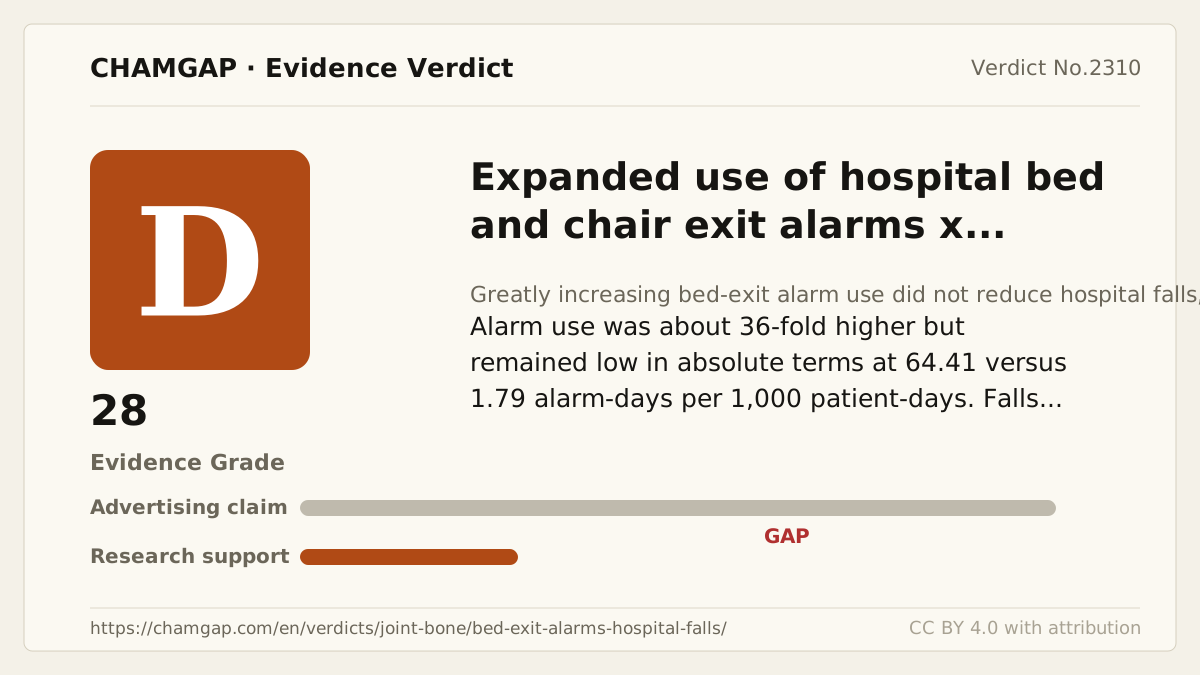
[Chamgap] Bed-exit alarms x hospital falls — Evidence Grade D·34. 2 cited sources checked. Source: https://chamgap.com/en/verdicts/joint-bone/bed-exit-alarms-hospital-falls/ · CC BY 4.0CC BY 4.0 — free to use with attribution; do not distort grades, numbers, or verdict meaning.
What this document does and does not do
Chamgap is an information source. It reports what research has and has not confirmed; it does not tell readers what to take or buy. That decision belongs to readers and, when needed, medical or legal professionals. This verdict reflects literature available up to the search date and may change as new research appears. Nothing here is medical advice.