
Balance and functional exercise,
does it really help with Prevention of fall-related fractures in community-dwelling older adults?
research showsCommunity exercise programs are rated C because they may reduce fall-related fractures. The 2019 Cochrane review estimated RR 0.73 (95% CI 0.56 to 0.95) across 10 trials and 4,047 participants, but GRADE certainty was low. In the same review, reductions in fall rate and number of fallers had high certainty, and balance and functional exercise reduced fall rate by 24%. The stronger falls evidence is not reassigned to fracture prevention, so low certainty for the fracture endpoint imposes a C ceiling.
ads claimHigh-certainty evidence for fewer falls can be expanded into equally certain fracture, hospitalization, and mortality claims. This verdict concerns the fracture endpoint of balance and functional exercise, not vitamin D, hip protectors, or cataract surgery.
Useful facts when choosing a product
- Balance and functional exercise trains postural control through standing, weight shifting, walking, turning, and repeated daily-life movements.
- Programs in the Cochrane review differed in frequency, intensity, supervision, and duration and were not one standardized product.
- Reported adverse events were mainly nonserious musculoskeletal symptoms; one trial reported one pelvic stress fracture and one inguinal-hernia operation.
- Fracture evidence must be kept separate from evidence for vitamin D, hip protectors, and vision-correction interventions.
Chamgap Semantic Classification Code
Candidate index · review held
X.balance-and-functional-exercise.behavioral.fall-related-fractures.prevent.UNKBehaviors, exposures and policies > Balance and functional exercise > Behavioral delivery > fall-related fractures > Occurrence-prevention claim > Unknown
An automated migration candidate, not an issued permanent code; exact claim scope remains under review. This machine-generated migration candidate helps retrieval but is not a permanent assignment. The original verdict ID and URL remain authoritative.
What the research actually shows
The Cochrane review included 108 randomized trials and 23,407 community-dwelling adults aged at least 60 years. All exercise reduced fall rate by 23%, rate ratio 0.77 (95% CI 0.71 to 0.83; high certainty). Balance and functional exercise reduced fall rate by 24%, rate ratio 0.76 (0.70 to 0.81; 39 studies, 7,920 participants; high certainty). Fall-related fracture RR was 0.73 (0.56 to 0.95; 10 studies, 4,047 participants; low certainty). Fall-related hospital admission was unclear, RR 0.78 (0.51 to 1.18; very low certainty).
Why this is classified as C (55)
The fall-related fracture RR of 0.73 (95% CI 0.56 to 0.95) across 10 trials and 4,047 participants was positive, but Cochrane GRADE certainty was low. High-certainty fall-rate evidence is not transferred to fracture prevention, giving C with 55 points.
Counterpoint. Large, long trials designed with fracture as a primary endpoint could improve precision.
Rejudgment record. New verdict — Accepted the positive pooled fracture RR of 0.73 but applied the C ceiling because it came from 10 trials and 4,047 participants with low GRADE certainty
Sub-claim grades by effect
This ingredient is marketed for several effects. A single overall grade blends strong and weak claims together, so each effect is graded separately here. The overall grade reflects the strongest disconfirming or core claim.
| Effect (sub-claim) | Grade | Basis |
|---|---|---|
| Prevention of fall-related fractures | C | RR 0.73 was positive, but evidence came from 10 trials and 4,047 participants with low GRADE certainty. |
| Reduced rate of falls | C | As a separate endpoint, balance and functional exercise had a rate ratio of 0.76 with high certainty, distinct from this fracture-focused verdict. |
| Reduced fall-related hospitalization or death | C | Hospitalization is unclear with very-low-certainty evidence, and mortality evidence is insufficient. |
Cross-check — AI research and Codex final gate
Evidence Table
| Study | Design | Sample | Funding | Endpoint | Result | Weight |
|---|---|---|---|---|---|---|
| Sherrington C et al. 2019 | Cochrane systematic review and meta-analysis of randomized trials | 108 randomized trials and 23,407 participants; 10 fracture trials and 4,047 participants | National Institute for Health Research and related public support | Fall rate, fallers, fall-related fractures, admissions, and adverse events | Fracture RR was 0.73 (0.56 to 0.95), low certainty; all-exercise fall-rate ratio was 0.77 (0.71 to 0.83), high certainty. | Key GRADE synthesis |
| Sherrington C et al. 2017 | Updated systematic review and meta-analysis | Included 61 community trials and 69 comparisons | Academic and public research support | Rate of falls | Exercise produced a fall-rate ratio of 0.79 (0.73 to 0.85) in community-dwelling older adults. | Supportive falls evidence, not direct fracture evidence |
Receipt — 2 References
All 2 cited sources were verified for existence at the original page (as of 2026-07-23).
Final verification and publication gate: Codex · Evidence date: 2026-07-23 · Corrections: none
Cite this verdict
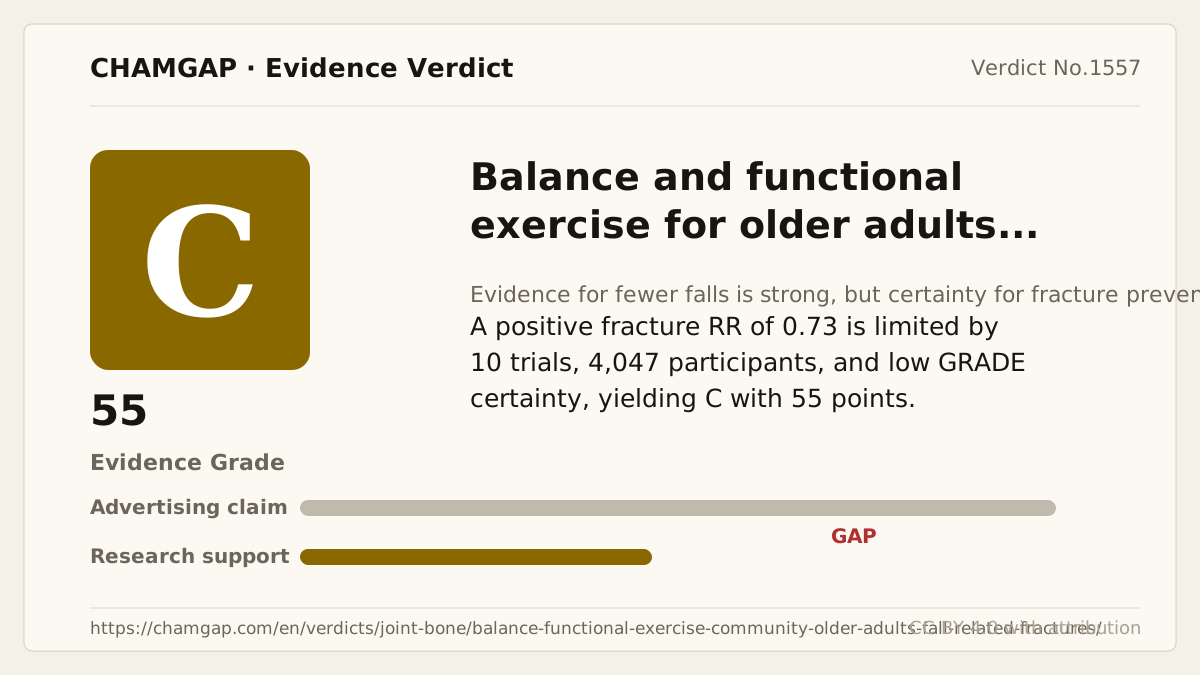
[Chamgap] Balance and functional exercise x prevention of fall-related fractures in community-dwelling older adults — Evidence Grade C·55. 2 cited sources checked. Source: https://chamgap.com/en/verdicts/joint-bone/balance-functional-exercise-community-older-adults-fall-related-fractures/ · CC BY 4.0CC BY 4.0 — free to use with attribution; do not distort grades, numbers, or verdict meaning.
What this document does and does not do
Chamgap is an information source. It reports what research has and has not confirmed; it does not tell readers what to take or buy. That decision belongs to readers and, when needed, medical or legal professionals. This verdict reflects literature available up to the search date and may change as new research appears. Nothing here is medical advice.