
Autologous intra-articular PRP,
does it really help with Reduced pain and slowed cartilage loss in knee osteoarthritis?
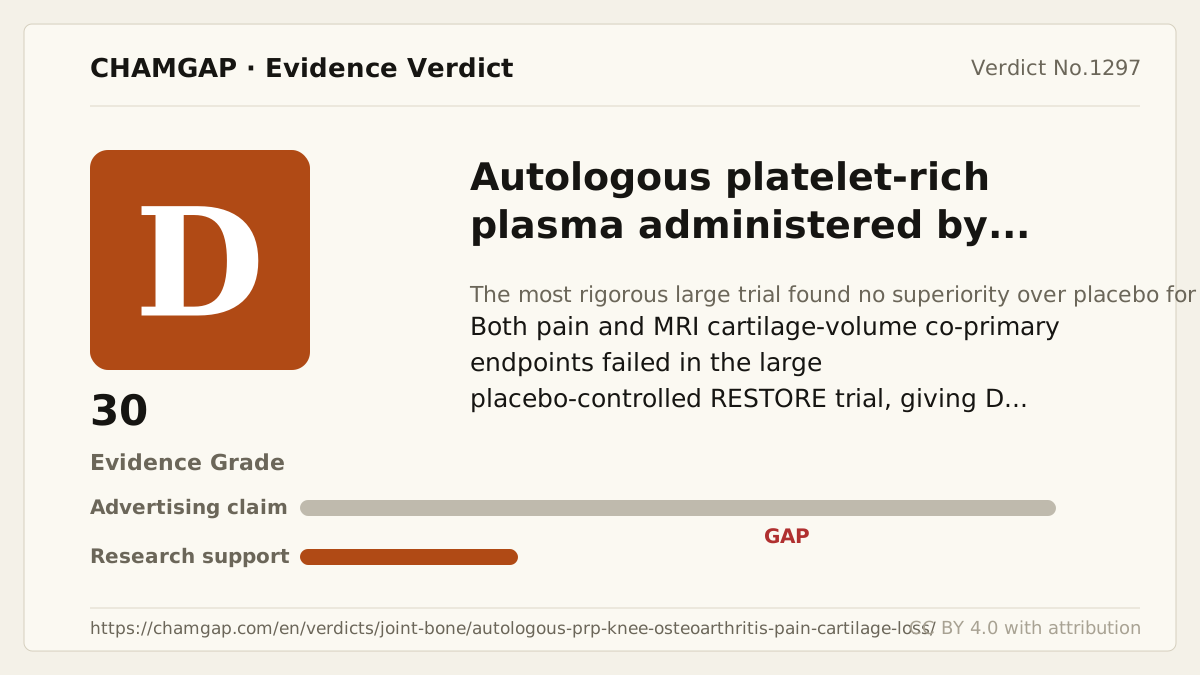
research showsAutologous intra-articular knee PRP is rated D. The most rigorous independent placebo-controlled study, RESTORE, randomized 288 participants to three PRP or three saline injections, but both co-primary endpoints failed at 12 months: the pain difference was -0.4 points (95% CI -0.9 to 0.2; P=.17) and the medial tibial cartilage-volume difference was -0.2% (95% CI -1.9% to 1.5%; P=.81). Twenty-nine of 31 prespecified secondary outcomes also showed no between-group difference. Positive results exist in smaller trials and reviews combining diverse preparations and comparators, but the direct large placebo-controlled primary-endpoint failure takes priority and gives D with 30 points.
ads claimMarketing describes an injection made from the patient's own blood as regenerative, anti-inflammatory, or cartilage-restoring. Autologous origin may reduce some immunologic concerns, but it does not guarantee efficacy, and RESTORE confirmed neither pain superiority nor slower cartilage loss.
Useful facts when choosing a product
- PRP is produced by centrifuging a patient's blood and injecting a platelet-enriched fraction into the knee joint, but blood volume, platelet concentration, leukocyte content, activation, and injection schedules vary by clinic.
- RESTORE used three injections one week apart, so its findings are not perfectly identical to every preparation or single-injection protocol, but they directly constrain class-wide efficacy claims.
- Temporary injection-site pain, swelling, and bruising can occur, while bleeding and joint infection are uncommon but important risks that require sterile technique and review of anticoagulants and active infection.
- Exercise therapy, weight management, appropriate analgesic treatment, and surgical assessment remain separate standards of care, and PRP should not be presented as a proven cartilage-regeneration substitute.
Chamgap Semantic Classification Code
Candidate index · review held
UNK.autologous-platelet-rich-plasma-administered-by-intra-articular-knee-injection.intraarticular.pain-and-slowed-cartilage-loss-in-knee-osteoarthritis.reduce.placeboUnknown > Autologous platelet-rich plasma administered by intra-articular knee injection > Intra-articular > pain and slowed cartilage loss in knee osteoarthritis > Reduction claim > Placebo
An automated migration candidate, not an issued permanent code; exact claim scope remains under review. This machine-generated migration candidate helps retrieval but is not a permanent assignment. The original verdict ID and URL remain authoritative.
What the research actually shows
RESTORE randomized 288 adults aged 50 years or older with symptomatic mild-to-moderate medial knee osteoarthritis to PRP or saline and administered three weekly injections. The 12-month co-primary endpoints were average knee pain over the preceding week and MRI medial tibial cartilage-volume change. Neither endpoint differed between groups, and most secondary symptom and MRI outcomes were also null. The Aiyer 2021 review found mixed results across 37 studies and suggested a possible niche in younger patients with early disease, while downgrading confidence for bias, inconsistency, and imprecision. Together, the evidence means that PRP is not proven as a class to reduce pain or preserve cartilage, rather than proving that every formulation is always ineffective.
Why this is classified as D (30)
In RESTORE, 288 participants had null 12-month differences in pain, -0.4 points with P=.17, and cartilage volume, -0.2% with P=.81, while 29 of 31 secondary outcomes were also nonsignificant. Smaller positive evidence uses heterogeneous preparations and comparators, so the large direct placebo-controlled primary-endpoint failure gives D with 30 points.
Counterpoint. A patient with early disease and inadequate relief from standard care may still choose an adjunctive procedure after understanding the cost and uncertainty. Counseling should state that pain relief is not assured and cartilage preservation is unproven.
Rejudgment record. New verdict — Acknowledged smaller heterogeneous positive studies, but applied D because the independent large placebo-controlled RESTORE trial failed both 12-month co-primary endpoints for pain and MRI cartilage volume and most secondary endpoints were also null
Sub-claim grades by effect
This ingredient is marketed for several effects. A single overall grade blends strong and weak claims together, so each effect is graded separately here. The overall grade reflects the strongest disconfirming or core claim.
| Effect (sub-claim) | Grade | Basis |
|---|---|---|
| Reduction of knee osteoarthritis pain | D | The 12-month between-group difference of -0.4 points in RESTORE was statistically nonsignificant and clinically small. |
| Slowing of knee cartilage loss | D | The MRI medial tibial cartilage-volume difference of -0.2% was null at P=.81, so structural preservation was not demonstrated. |
| Improvement in knee function | D | Most prespecified secondary symptom and function outcomes in RESTORE did not differ significantly from placebo. |
Cross-check — AI research and Codex final gate
Evidence Table
| Study | Design | Sample | Funding | Endpoint | Result | Weight |
|---|---|---|---|---|---|---|
| Bennell KL et al. 2021 RESTORE | Multicenter randomized double-blind saline-placebo-controlled trial | 288 patients with knee osteoarthritis; 144 assigned to PRP and 144 to placebo | Public research support including the Australian National Health and Medical Research Council | Co-primary 12-month outcomes of knee pain on a 0-to-10 scale and MRI medial tibial cartilage volume | Both outcomes were null, with a pain difference of -0.4 points (P=.17) and cartilage-volume difference of -0.2% (P=.81); 29 of 31 secondary outcomes were also nonsignificant. | Key large direct null evidence |
| Aiyer R et al. 2021 | Systematic review of clinical PRP studies in knee osteoarthritis | Thirty-seven studies and 48 comparisons | Not reported in the public abstract | Knee pain and function | Thirty comparisons favored PRP and 16 were null, with confidence limited by bias, inconsistency, and imprecision. | Context for prior positive but heterogeneous evidence |
Receipt — 2 References
All 2 cited sources were verified for existence at the original page (as of 2026-07-24).
Final verification and publication gate: Codex · Evidence date: 2026-07-24 · Corrections: none
Cite this verdict
[Chamgap] Autologous intra-articular PRP x reduced pain and slowed cartilage loss in knee osteoarthritis — Evidence Grade D·30. 2 cited sources checked. Source: https://chamgap.com/en/verdicts/joint-bone/autologous-prp-knee-osteoarthritis-pain-cartilage-loss/ · CC BY 4.0CC BY 4.0 — free to use with attribution; do not distort grades, numbers, or verdict meaning.
What this document does and does not do
Chamgap is an information source. It reports what research has and has not confirmed; it does not tell readers what to take or buy. That decision belongs to readers and, when needed, medical or legal professionals. This verdict reflects literature available up to the search date and may change as new research appears. Nothing here is medical advice.