
Arthroscopic subacromial decompression,
does it really help with Improved shoulder pain and disability attributed to impingement syndrome?
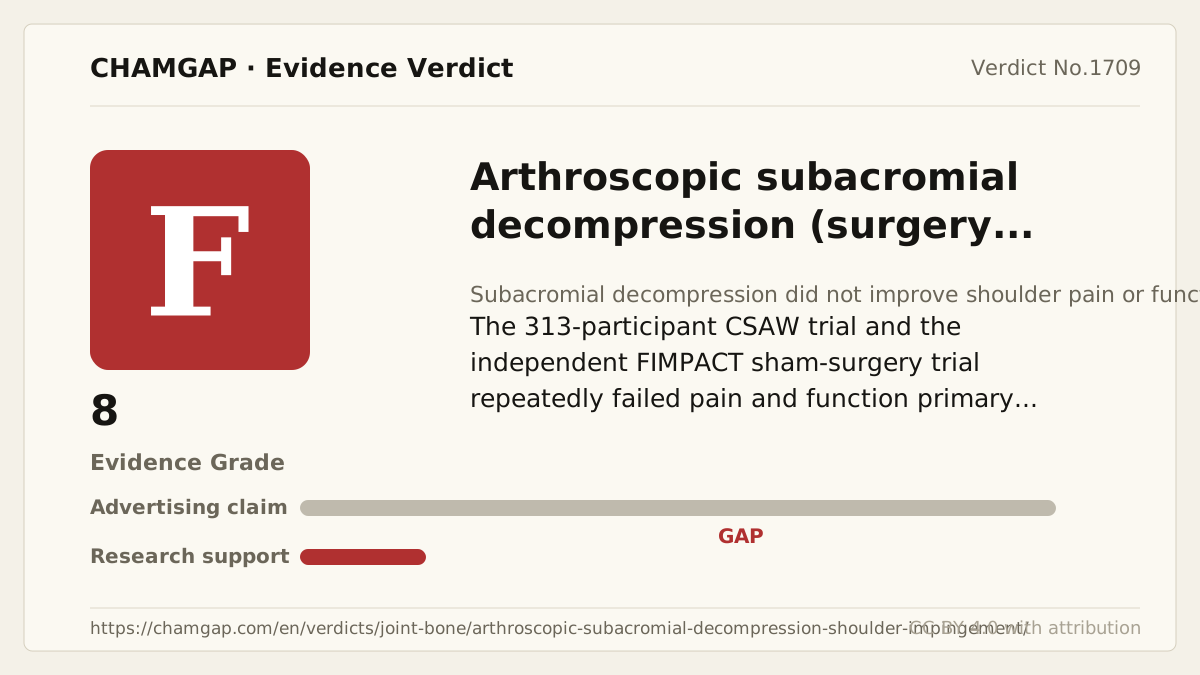
research showsArthroscopic subacromial decompression is rated F for the claim that surgery improves shoulder pain and disability attributed to impingement syndrome. The United Kingdom CSAW trial randomized 313 participants to decompression, diagnostic-arthroscopy sham, or no treatment. The actual observed primary-endpoint sample at six months was 274, with 90, 94, and 90 participants respectively. The Oxford Shoulder Score primary endpoint failed: 32.7 after decompression versus 34.2 after sham, mean difference -1.3 points (95% CI -3.9 to 1.3), P=.3141. The independent Finnish FIMPACT trial also failed both 24-month co-primary endpoints for pain at rest and with activity among 59 decompression and 63 sham participants, missing the 15-point clinical threshold. Cochrane included the two low-bias sham trials with 506 participants and found high-certainty evidence of no benefit for pain, function, or quality of life, while the 2025 FIMPACT ten-year follow-up remained null. Independent sham-surgery trials repeatedly failed in the same indication and excluded a clinically important benefit, so the grade is F with 8 points.
ads claimThe operation is explained as removing an acromial spur, bursa, and soft tissue to enlarge the space and eliminate mechanical impingement. Outcomes were the same after sham arthroscopy that omitted this critical removal step, so the proposed mechanical decompression did not produce a specific clinical benefit.
Useful facts when choosing a product
- Arthroscopic subacromial decompression removes bursal tissue and bone or soft tissue beneath the acromion to enlarge the subacromial space.
- The CSAW and FIMPACT shams included anesthesia, diagnostic arthroscopy, and postoperative rehabilitation but omitted the critical removal of bone and soft tissue.
- This verdict concerns decompression for persistent subacromial pain without a full-thickness rotator cuff tear, not repair of a full-thickness tear or surgery for acute trauma.
- Frozen shoulder, infection, thromboembolism, nerve injury, and anesthetic complications can occur; even a small risk matters when a procedure has no specific efficacy.
Chamgap Semantic Classification Code
Candidate index · review held
P.arthroscopic-subacromial-decompression.procedural.shoulder-pain-and-disability-attributed-to-impingement-syndrome.improve.MULTIProcedures, devices and tests > Arthroscopic subacromial decompression > Procedural > shoulder pain and disability attributed to impingement syndrome > Improvement claim > Multiple: primary unresolved
An automated migration candidate, not an issued permanent code; exact claim scope remains under review. This machine-generated migration candidate helps retrieval but is not a permanent assignment. The original verdict ID and URL remain authoritative.
What the research actually shows
CSAW randomized 313 participants, with observed six-month Oxford Shoulder Score data for 274. Decompression versus sham failed by -1.3 points (95% CI -3.9 to 1.3), P=.3141. FIMPACT's 15/100 threshold was not a validated MCID from one study. Because no directly validated value then existed for shoulder impingement syndrome, investigators prespecified it in the protocol and sample-size calculation after reviewing literature across several musculoskeletal disorders. Cochrane pooled two trials with 506 participants: pain was -0.26 (95% CI -0.84 to 0.33) and function was +2.8 (95% CI -1.4 to 6.9). The pain MCID of 1.5/10 came from Tashjian 2009 and Hao 2019, while the Constant function MCID of 8.3/100 came from the MID systematic review by Hao and colleagues.
Why this is classified as F (8)
CSAW randomized 313 participants and observed 274 at six months; the Oxford Shoulder Score difference was -1.3 points, P=.3141. Independent FIMPACT missed its prespecified 15/100 protocol and sample-size threshold, which was literature-derived rather than a validated single-study MCID. Cochrane evidence from two trials and 506 participants excluded clinically important benefit, supporting F with 8 points.
Counterpoint. Full-thickness rotator cuff tears, acute trauma, infection, instability, and other structural disease require separate diagnosis and treatment. For subacromial pain without a full-thickness tear, education, progressive exercise and rehabilitation, activity adjustment, and appropriate analgesia can be discussed first.
Rejudgment record. Cross-check applied — Confirmed failure of the Oxford Shoulder Score primary endpoint in the 313-randomized CSAW trial with 274 observed six-month outcomes and failure of both 24-month co-primary pain endpoints in independent FIMPACT; applied F because high-certainty synthesis of two same-indication sham-surgery trials with 506 participants excluded pain and function minimally important differences and the null result persisted to ten years
Sub-claim grades by effect
This ingredient is marketed for several effects. A single overall grade blends strong and weak claims together, so each effect is graded separately here. The overall grade reflects the strongest disconfirming or core claim.
| Effect (sub-claim) | Grade | Basis |
|---|---|---|
| Reduction in shoulder pain | F | Two independent sham trials and Cochrane found a one-year pain difference of -0.26 on a 10-point scale, with the confidence interval excluding the 1.5-point minimally important difference. |
| Improvement in shoulder function | F | The CSAW Oxford Shoulder Score primary endpoint failed, and the pooled 2.8-point function difference on a 100-point scale was below the 8.3-point minimally important difference. |
| Improvement in health-related quality of life | F | Cochrane found high-certainty null evidence for quality of life versus placebo surgery, with a difference of -0.03 points (95% CI -0.11 to 0.06). |
Cross-check — AI research and Codex final gate
Evidence Table
| Study | Design | Sample | Funding | Endpoint | Result | Weight |
|---|---|---|---|---|---|---|
| Beard DJ et al. 2018 (CSAW) | Multicenter randomized participant-blinded sham-surgery and no-treatment controlled trial at 32 hospitals | 313 randomized; 274 with observed six-month primary-endpoint data (90 decompression, 94 sham, and 90 no treatment), with multiple imputation also used in the principal intention-to-treat analysis | Arthritis Research UK Clinical Studies Grant 19707, NIHR Oxford Biomedical Research Centre, and Royal College of Surgeons of England; non-industry funding | Primary endpoint: Oxford Shoulder Score six months after randomization | Primary endpoint failed: 32.7 with decompression versus 34.2 with sham, mean difference -1.3 points (95% CI -3.9 to 1.3), P=.3141. Small differences versus no treatment were not clinically important. | Pivotal large sham-surgery trial |
| Paavola M et al. 2018 (FIMPACT) | Finnish multicenter double-blind sham-surgery and exercise-therapy controlled trial | 210 in the first randomization; after surgical eligibility confirmation, 59 were randomized to decompression and 63 to diagnostic-arthroscopy sham, with 122 in the 24-month primary full-analysis comparison | Sigrid Juselius Foundation and Finnish state research funding for Tampere and Helsinki University Hospitals; later long-term analyses also received Academy of Finland and Jane and Aatos Erkko Foundation support, all non-industry | Co-primary endpoints: pain at rest and with arm activity at 24 months; a 15/100 threshold prespecified in the protocol and sample-size calculation from a literature review | Both co-primary endpoints failed: decompression versus sham differences were 4.6 points for pain at rest and an adjusted 9.0 points for pain with activity, both below the 15-point threshold and statistically nonsuperior. | Independent sham replication trial |
| Karjalainen TV et al. 2019 Cochrane review | Cochrane systematic review of randomized and quasi-randomized trials | Eight trials and 1,062 participants; two pivotal placebo-surgery trials with 506 participants | Internal Monash University support plus Finnish Medical Foundation and FICEBO, United States NIAMS, Australian NHMRC, and Cochrane Musculoskeletal support; no manufacturer funding | One-year pain, shoulder function, quality of life, and global success | High-certainty null evidence: pain -0.26 on a 10-point scale (95% CI -0.84 to 0.33; minimally important difference 1.5) and function +2.8 on a 100-point scale (95% CI -1.4 to 6.9; minimally important difference 8.3), excluding clinically important benefit. | Key synthesis establishing repeated failure and exclusion of minimally important benefit |
Receipt — 5 References
All 5 cited sources were verified for existence at the original page (as of 2026-07-24).
Final verification and publication gate: Codex · Evidence date: 2026-07-24 · Corrections: none
Cite this verdict
[Chamgap] Arthroscopic subacromial decompression x improved shoulder pain and disability attributed to impingement syndrome — Evidence Grade F·8. 5 cited sources checked. Source: https://chamgap.com/en/verdicts/joint-bone/arthroscopic-subacromial-decompression-shoulder-impingement/ · CC BY 4.0CC BY 4.0 — free to use with attribution; do not distort grades, numbers, or verdict meaning.
What this document does and does not do
Chamgap is an information source. It reports what research has and has not confirmed; it does not tell readers what to take or buy. That decision belongs to readers and, when needed, medical or legal professionals. This verdict reflects literature available up to the search date and may change as new research appears. Nothing here is medical advice.