
Arthroscopic partial meniscectomy,
does it really help with Improved pain, locking, and knee function in middle-aged adults with degenerative meniscal tears?
research showsArthroscopic partial meniscectomy for a middle-aged degenerative meniscal tear is rated F. In FIDELITY, pain, Lysholm, and WOMET outcomes at 12 months were no better than sham surgery; at five years the same blinded comparison still showed no symptomatic or functional benefit and more mechanical symptoms after real surgery. METEOR found no significant functional advantage over physical therapy, and the BMJ Rapid Recommendation strongly recommends against arthroscopy in nearly all degenerative knee disease. Convergent sham, neutral active-comparator, and guideline evidence yields 8 points.
ads claimThe intuitive claim that removing a torn fragment removes the source of catching and pain conflicts with sham-surgery evidence. Degenerative MRI tears are also common in asymptomatic middle-aged adults, so an image alone does not prove the pain generator.
Useful facts when choosing a product
- This verdict concerns partial resection for nontraumatic degenerative tears in middle age, not repair of an acute traumatic tear.
- The operation involves arthroscopic incisions, anesthesia, recovery, and rehabilitation.
- Risks include infection, venous thromboembolism, anesthesia complications, neurovascular injury, persistent pain, and further surgery.
- Exercise-based therapy, weight management, analgesic strategies, and time are initial options; a truly locked knee or acute trauma needs separate orthopedic assessment.
Chamgap Semantic Classification Code
Candidate index · review held
P.arthroscopic-partial-meniscectomy.procedural.pain-locking-and-knee-function-with-degenerative-meniscal-tears.improve.MULTIProcedures, devices and tests > Arthroscopic partial meniscectomy > Procedural > pain, locking, and knee function with degenerative meniscal tears > Improvement claim > Multiple: primary unresolved
An automated migration candidate, not an issued permanent code; exact claim scope remains under review. This machine-generated migration candidate helps retrieval but is not a permanent assignment. The original verdict ID and URL remain authoritative.
What the research actually shows
FIDELITY randomized 146 adults aged 35 to 65 with a degenerative medial meniscal tear to partial meniscectomy or diagnostic-arthroscopy sham surgery. None of three primary outcomes differed at 12 months. At five years there was no WOMET, Lysholm, or exercise-pain benefit; the absolute difference in Kellgren-Lawrence progression was 13%, and mechanical symptoms were 18 percentage points more frequent after real surgery. METEOR randomized 351 adults aged 45 or older and found a six-month WOMAC functional difference of 2.4 points (95% CI -1.8 to 6.5), with similar results at 12 months.
Why this is classified as F (8)
FIDELITY showed no pain or functional advantage over sham at 12 months or five years and no improvement in mechanical symptoms. Neutral active-comparator evidence and a strong BMJ recommendation against arthroscopy converge, so rule ③ yields F with 8 points.
Counterpoint. Objective inability to extend the knee from an acute displaced tear differs from the studied population. Ordinary clicking or intermittent catching should not be relabeled as a true locked knee to evade this finding.
Rejudgment record. New verdict — Applied boundary rule ③ because FIDELITY showed no pain, function, or mechanical-symptom benefit over sham at 12 months and five years, active-comparator trials such as METEOR were neutral, and the BMJ Rapid Recommendation strongly opposed arthroscopy
Sub-claim grades by effect
This ingredient is marketed for several effects. A single overall grade blends strong and weak claims together, so each effect is graded separately here. The overall grade reflects the strongest disconfirming or core claim.
| Effect (sub-claim) | Grade | Basis |
|---|---|---|
| Improved knee pain | F | No clinically relevant added pain relief was found versus sham at 12 months or five years. |
| Improved locking, catching, or other mechanical symptoms | F | Mechanical symptoms were more frequent after real surgery in the five-year sham comparison. |
| Improved knee function | F | No significant functional advantage was shown over sham surgery or physical therapy. |
Cross-check — AI research and Codex final gate
Evidence Table
| Study | Design | Sample | Funding | Endpoint | Result | Weight |
|---|---|---|---|---|---|---|
| Sihvonen R et al. 2013 FIDELITY | Multicenter randomized double-blind sham-surgery-controlled trial | 146 adults aged 35 to 65 years | Noncommercial public and foundation grants including the Sigrid Juselius Foundation | Twelve-month Lysholm, WOMET, and knee pain after exercise | None of the three primary outcomes differed significantly between partial meniscectomy and sham surgery. | Key direct sham-surgery evidence |
| Sihvonen R et al. 2020 FIDELITY five-year follow-up | Blinded five-year follow-up of a sham-surgery-controlled randomized trial | 146 originally randomized participants | Finnish public and foundation noncommercial funding | WOMET, Lysholm, exercise pain, mechanical symptoms, and radiographic osteoarthritis | There was no patient-relevant benefit; mechanical symptoms were 18 percentage points more frequent and osteoarthritis progression was slightly greater after surgery. | Long-term sham-controlled null result with harm signal |
| Katz JN et al. 2013 METEOR | Multicenter randomized trial of surgery plus physical therapy versus physical therapy | 351 adults aged 45 years or older | Public funding from the U.S. NIAMS | WOMAC physical function at six and 12 months | In intention-to-treat analysis, functional improvement was not significantly better with surgery than physical therapy. | Supporting neutral active-comparator evidence |
| Siemieniuk RAC et al. 2017 BMJ Rapid Recommendation | Clinical practice guideline based on linked systematic reviews | Body of randomized evidence for degenerative knee disease | BMJ Rapid Recommendations international panel | Pain, function, quality of life, harms, and patient burden | Issued a strong recommendation against arthroscopy in nearly all patients with degenerative knee disease. | Major guideline opposition |
Receipt — 4 References
All 4 cited sources were verified for existence at the original page (as of 2026-07-23).
Final verification and publication gate: Codex · Evidence date: 2026-07-23 · Corrections: none
Cite this verdict
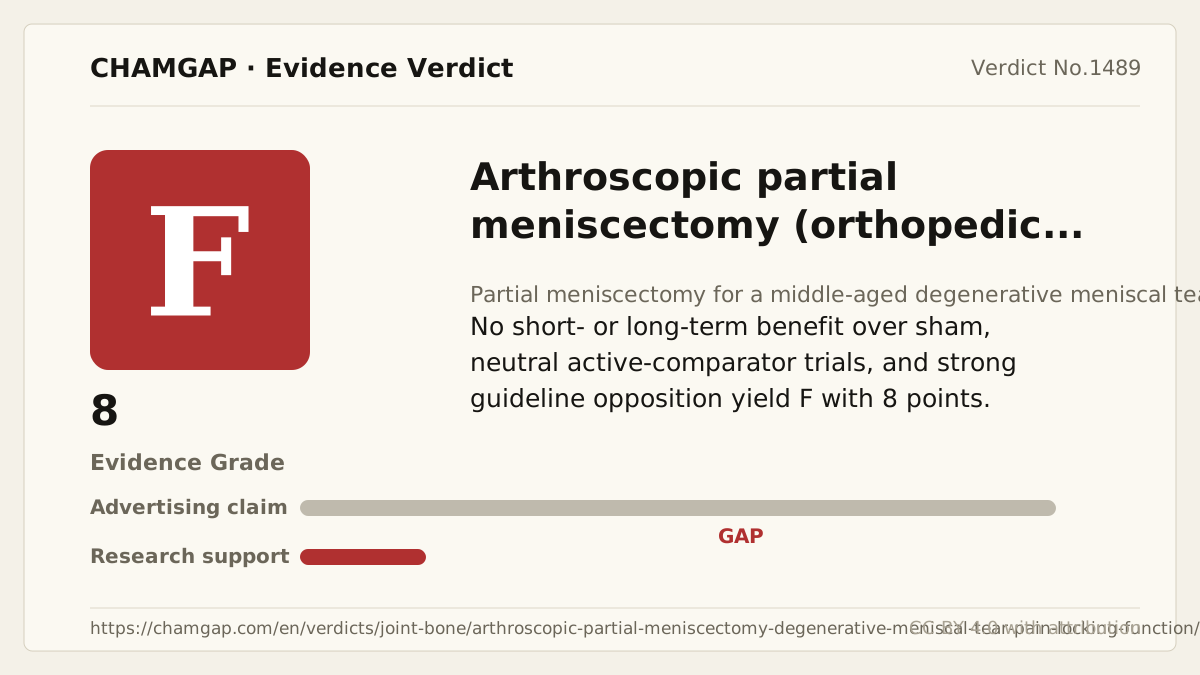
[Chamgap] Arthroscopic partial meniscectomy x pain, locking, and function in degenerative tears — Evidence Grade F·8. 4 cited sources checked. Source: https://chamgap.com/en/verdicts/joint-bone/arthroscopic-partial-meniscectomy-degenerative-meniscal-tear-pain-locking-function/ · CC BY 4.0CC BY 4.0 — free to use with attribution; do not distort grades, numbers, or verdict meaning.
What this document does and does not do
Chamgap is an information source. It reports what research has and has not confirmed; it does not tell readers what to take or buy. That decision belongs to readers and, when needed, medical or legal professionals. This verdict reflects literature available up to the search date and may change as new research appears. Nothing here is medical advice.