
Aquatic exercise,
does it really help with Improvement of pain and daily function in knee or hip osteoarthritis?
research showsThe grade is C. Bartels and colleagues reported immediate post-treatment pain across 12 trials and 1,076 participants at SMD -0.31 (95% CI -0.47 to -0.15), equivalent to about 5 points on a 0-to-100 pain scale (95% CI 3 to 8). This comparison has no validated between-group minimal important difference, so it was judged by the Cohen d convention: 0.5 is moderate, whereas -0.31 is a smaller effect, giving 58 points.
ads claimFeeling easier movement because of buoyancy must be separated from a claim of large average pain relief. The evidence supports about a 5-of-100 short-term mean improvement after active exercise, not reversal of arthritis or cartilage regeneration.
Useful facts when choosing a product
- The Cochrane intervention was active exercise, typically in water at 32 to 36 degrees Celsius, not passive spa or balneotherapy.
- Mean intervention duration across the 13 trials was 12 weeks, and persistence of benefit was not established well.
- No included trial assessed structural joint change with imaging.
Chamgap Semantic Classification Code
Candidate index · review held
X.therapeutic-aquatic-exercise.behavioral.pain-and-daily-function-in-knee-or-hip-osteoarthritis.improve.usual-careBehaviors, exposures and policies > Therapeutic aquatic exercise > Behavioral delivery > pain and daily function in knee or hip osteoarthritis > Improvement claim > Usual care
An automated migration candidate, not an issued permanent code; exact claim scope remains under review. This machine-generated migration candidate helps retrieval but is not a permanent assignment. The original verdict ID and URL remain authoritative.
What the research actually shows
The Bartels Cochrane review included 13 trials and 1,190 participants. Immediately post-treatment, pain across 12 trials and 1,076 people was SMD -0.31 (95% CI -0.47 to -0.15), equivalent to about 5 points on a 0-to-100 pain scale (95% CI 3 to 8). Four to 24 weeks later, pain in three trials and 381 participants was SMD -0.30 (-0.92 to 0.32), so persistence was not confirmed. Controls were mostly usual care, education, or waiting list, and direct comparison with land exercise found SMD 0.04 (95% CI -0.15 to 0.24).
Why this is classified as C (54)
With no validated between-group minimal important difference, conventional interpretation finds a small immediate effect, while inactive controls and absent persistence limit the grade to C with 54 points.
Counterpoint. Individual response and preference can differ despite a small average effect. Safe pool access and supervision should be considered for people with fall risk or limitations on land.
Rejudgment record. Cross-check applied — After rejecting the unvalidated 0.37-SD cutoff and reassessing by convention, immediate pain improvement is small, with mostly inactive controls and no confirmed persistence
| Endpoint | P | Symptom or function itself is the target - including patient reports and performance tests |
| Replication | R2 | Independently replicated across trials |
| Independence | I2 | Decisive evidence is publicly or non-profit funded |
| Effect size | E~ | Statistically positive but below the threshold |
Stored derived and displayed grades match; this is not a current recalculation or validity check (C).
Sub-claim grades by effect
This ingredient is marketed for several effects. A single overall grade blends strong and weak claims together, so each effect is graded separately here. The overall grade reflects the strongest disconfirming or core claim.
| Effect (sub-claim) | Grade | Basis |
|---|---|---|
| Pain and function improvement immediately after treatment | C | No validated between-group minimal important difference exists; the statistically positive mean difference was about 5 of 100 points. |
| Sustained long-term pain and function improvement | ? | Pain, disability, and quality-of-life effects were not confirmed 4 to 24 weeks after treatment ended. |
Cross-check — AI research and Codex final gate
Evidence Table
| Study | Design | Sample | Funding | Endpoint | Result | Weight |
|---|---|---|---|---|---|---|
| Hinman RS et al. 2007 | Assessor-blinded randomized controlled trial | 71 randomized (36/35) and all 71 analyzed with imputation | Supported by Australia's National Health and Medical Research Council | Primary outcome of pain on movement at six weeks | A 33% reduction from baseline, effect size 0.24, between-group P<0.05 | Pivotal publicly funded original trial, but small |
| Bartels EM et al. 2016 Cochrane review | Systematic review and meta-analysis of randomized trials | 13 trials and 1,190 participants; pain 12 trials/1,076; disability 12 trials/1,059 | Cochrane Musculoskeletal and Danish/Norwegian public academic institutions; included trials involved multiple independent teams | Pain, disability, and quality of life immediately after treatment | Pain SMD -0.31 (95% CI -0.47 to -0.15), function SMD -0.32 (-0.47 to -0.17); each about 5 of 100 points better | Key synthesis for clinical magnitude and duration |
Receipt — 3 References
All 3 cited sources were verified for existence at the original page (as of 2026-08-01).
Final verification and publication gate: Codex · Evidence date: 2026-08-01 · Corrections: none
Cite this verdict
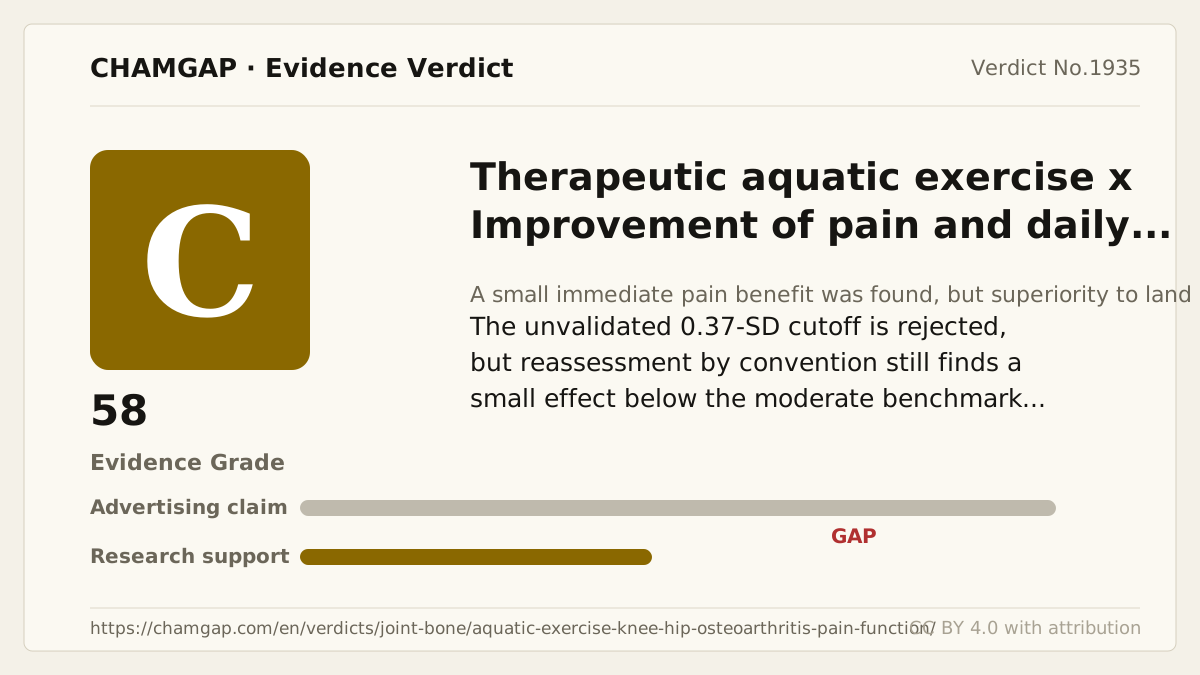
[Chamgap] Aquatic exercise x pain and function in knee or hip osteoarthritis — Evidence Grade C·54. 3 cited sources checked. Source: https://chamgap.com/en/verdicts/joint-bone/aquatic-exercise-knee-hip-osteoarthritis-pain-function/ · CC BY 4.0CC BY 4.0 — free to use with attribution; do not distort grades, numbers, or verdict meaning.
What this document does and does not do
Chamgap is an information source. It reports what research has and has not confirmed; it does not tell readers what to take or buy. That decision belongs to readers and, when needed, medical or legal professionals. This verdict reflects literature available up to the search date and may change as new research appears. Nothing here is medical advice.