
Allopurinol,
does it really help with Maintenance of target serum urate and long-term reduction of gout flares and tophi in recurrent or tophaceous gout?
research showsAllopurinol-centered treat-to-target urate lowering is rated B because it reduces long-term flares and tophi in recurrent or tophaceous gout. In a 517-participant two-year randomized trial, nurse-led treat-to-target care achieved serum urate below 6 mg/dL in 95% versus 30%, reduced two or more flares in year two to 8% versus 24%, and reduced tophi to 3% versus 11%. This was not a blinded allopurinol-versus-placebo drug trial, however; it combined education, follow-up, adherence support, and dose titration, with some use of other urate-lowering drugs. The American College of Rheumatology's strong first-line and treat-to-target recommendations support clinical use but are not counted as efficacy trials, so the direct long-term outcome benefit supports B rather than A, with 76 points.
ads claimNormalizing urate can be misdescribed as immediate analgesia for an acute flare or as a treatment that prevents flares from the first dose without prophylaxis. Long-term benefit requires low-dose initiation, titration to target, and sustained adherence, while flares can temporarily increase during the first months.
Useful facts when choosing a product
- Allopurinol inhibits xanthine oxidase to reduce urate production for long-term control; it is not an immediate analgesic for an acute flare, and established therapy should not be stopped arbitrarily during a flare.
- Treatment generally starts at a low dose with serial serum urate measurements and titration to below 6 mg/dL; kidney impairment calls for an even lower starting dose, while maintenance dosing is adjusted to response and tolerability.
- Flares can temporarily increase during initiation and dose escalation, so appropriate anti-inflammatory prophylaxis with colchicine, an NSAID, or a glucocorticoid is generally considered for three to six months.
- Rash, fever, facial swelling, mucosal lesions, or liver or kidney abnormalities can signal rare but potentially fatal hypersensitivity. Pre-treatment HLA-B*58:01 testing should be considered in higher-risk groups, including people of Korean ancestry.
Chamgap Semantic Classification Code
Candidate index · review held
M.allopurinol.UNK.target-serum-urate-and-long-term-reduction-of-gout-flares-and-tophi-in-recurrent-or-tophaceous-gout.reduce.usual-careMedicinal interventions > Allopurinol > Unknown > target serum urate and long-term reduction of gout flares and tophi in recurrent or tophaceous gout > Reduction claim > Usual care
An automated migration candidate, not an issued permanent code; exact claim scope remains under review. This machine-generated migration candidate helps retrieval but is not a permanent assignment. The original verdict ID and URL remain authoritative.
What the research actually shows
Doherty and colleagues randomized 517 adults with a flare in the previous year to nurse-led education, engagement, and treat-to-target urate lowering or general-practitioner usual care. At two years, serum urate below 6 mg/dL was achieved in 94.88% versus 29.71% (RR 3.18, 95% CI 2.42 to 4.18), at least two annual flares occurred in 8.00% versus 24.29% (RR 0.33, 95% CI 0.19 to 0.57), and tophi were present in 2.85% versus 11.29% (RR 0.21, 95% CI 0.08 to 0.52). At year one, at least two flares were more frequent, 53.99% versus 39.82%, illustrating the early flare increase when urate lowering begins. The 2020 American College of Rheumatology guideline strongly recommended urate-lowering therapy for tophi, radiographic damage, or frequent flares; first-line allopurinol; low-dose initiation and titration to serum urate below 6 mg/dL; and three to six months of anti-inflammatory prophylaxis.
Why this is classified as B (76)
A 517-participant two-year trial improved not only target urate but direct outcomes: at least two annual flares were 8.00% versus 24.29% and tophi 2.85% versus 11.29%, consistent with the American College of Rheumatology guideline. The pivotal evidence was nevertheless an open-label strategy trial combining education, adherence, frequent monitoring, and access to alternative urate-lowering drugs rather than an allopurinol-only placebo comparison. A guideline does not substitute for an efficacy trial, yielding B with 76 points.
Counterpoint. To reduce long-term flares and tophi, patients should not abandon urate lowering because of transient early flares; prophylaxis, low-dose initiation, titration to target, and adherence need to be managed together.
Rejudgment record. New verdict — Credited direct two-year effects in a 517-participant randomized trial, including serum urate target achievement of 94.88% versus 29.71%, at least two annual flares of 8.00% versus 24.29%, and tophi of 2.85% versus 11.29%, but applied B because the open-label intervention bundled education, adherence, frequent follow-up, and several urate-lowering options and because a guideline recommendation is not itself an efficacy trial
Sub-claim grades by effect
This ingredient is marketed for several effects. A single overall grade blends strong and weak claims together, so each effect is graded separately here. The overall grade reflects the strongest disconfirming or core claim.
| Effect (sub-claim) | Grade | Basis |
|---|---|---|
| Long-term reduction of gout flares in recurrent or tophaceous gout | B | At least two flares in year two fell to 8.00% versus 24.29% in the treat-to-target trial, although early flares were more frequent during year one. |
| Reduction of tophi in recurrent or tophaceous gout | B | At two years, tophi were present in 2.85% with treat-to-target care versus 11.29% with usual care, with improvements in number and size. |
| Achievement and maintenance of serum urate below 6 mg/dL | B | Two-year target achievement was 94.88% versus 29.71%, although serum urate is a titration surrogate linked to clinical outcomes. |
Cross-check — AI research and Codex final gate
Evidence Table
| Study | Design | Sample | Funding | Endpoint | Result | Weight |
|---|---|---|---|---|---|---|
| Doherty M et al. 2018 | Two-year randomized open-label strategy trial of nurse-led treat-to-target care versus general-practitioner usual care | 517 adults with a gout flare in the previous year; 255 versus 262 | Arthritis Research UK | Two-year serum urate below 6 mg/dL, annual flare frequency, tophi, and quality of life | Target urate was achieved in 94.88% versus 29.71%, at least two flares in year two occurred in 8.00% versus 24.29%, and tophi were present in 2.85% versus 11.29%, all favoring treat-to-target care. | Pivotal long-term randomized evidence on direct clinical outcomes; attribution to one drug is limited by the bundled strategy |
| FitzGerald JD et al. 2020 American College of Rheumatology guideline | GRADE-based systematic review, network meta-analysis, patient input, and clinical guideline | Fifty-seven PICO questions, 42 recommendations, and 16 strong recommendations | American College of Rheumatology | Indications for urate lowering, first-line therapy, starting dose, treat-to-target care, and flare prophylaxis | Strongly recommended first-line allopurinol, low-dose initiation, titration to serum urate below 6 mg/dL, and three to six months of anti-inflammatory prophylaxis. | Clinical-use and safety context; the guideline is not itself an efficacy trial |
| Ramasamy SN et al. 2013 | Systematic review of published allopurinol-hypersensitivity cases from 1950 through 2012 | 802 people with hypersensitivity; 167 tested for HLA-B*58:01 | Academic research; funding and conflicts as reported in the article | Clinical features, mortality, risk factors, and HLA-B*58:01 in hypersensitivity | HLA-B*58:01 was present in 166 of 167 tested cases (99%), all-cause mortality was 14%, and most reactions began within 60 days of initiation. | Severe-hypersensitivity safety evidence; separate from efficacy grading |
Receipt — 3 References
All 3 cited sources were verified for existence at the original page (as of 2026-07-22).
Final verification and publication gate: Codex · Evidence date: 2026-07-22 · Corrections: none
Cite this verdict
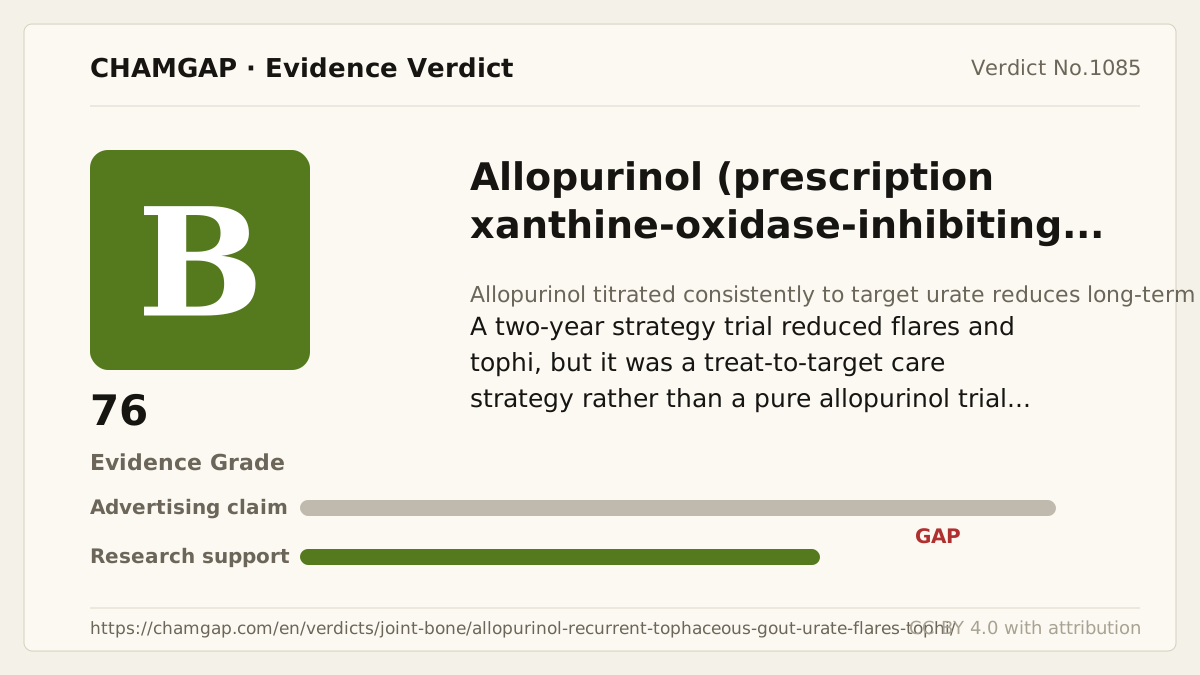
[Chamgap] Allopurinol x target urate maintenance and long-term reduction of flares and tophi in recurrent or tophaceous gout — Evidence Grade B·76. 3 cited sources checked. Source: https://chamgap.com/en/verdicts/joint-bone/allopurinol-recurrent-tophaceous-gout-urate-flares-tophi/ · CC BY 4.0CC BY 4.0 — free to use with attribution; do not distort grades, numbers, or verdict meaning.
What this document does and does not do
Chamgap is an information source. It reports what research has and has not confirmed; it does not tell readers what to take or buy. That decision belongs to readers and, when needed, medical or legal professionals. This verdict reflects literature available up to the search date and may change as new research appears. Nothing here is medical advice.