
Stopping versus continuing alendronate after five years,
does it really help with Fracture prevention over the next five years?
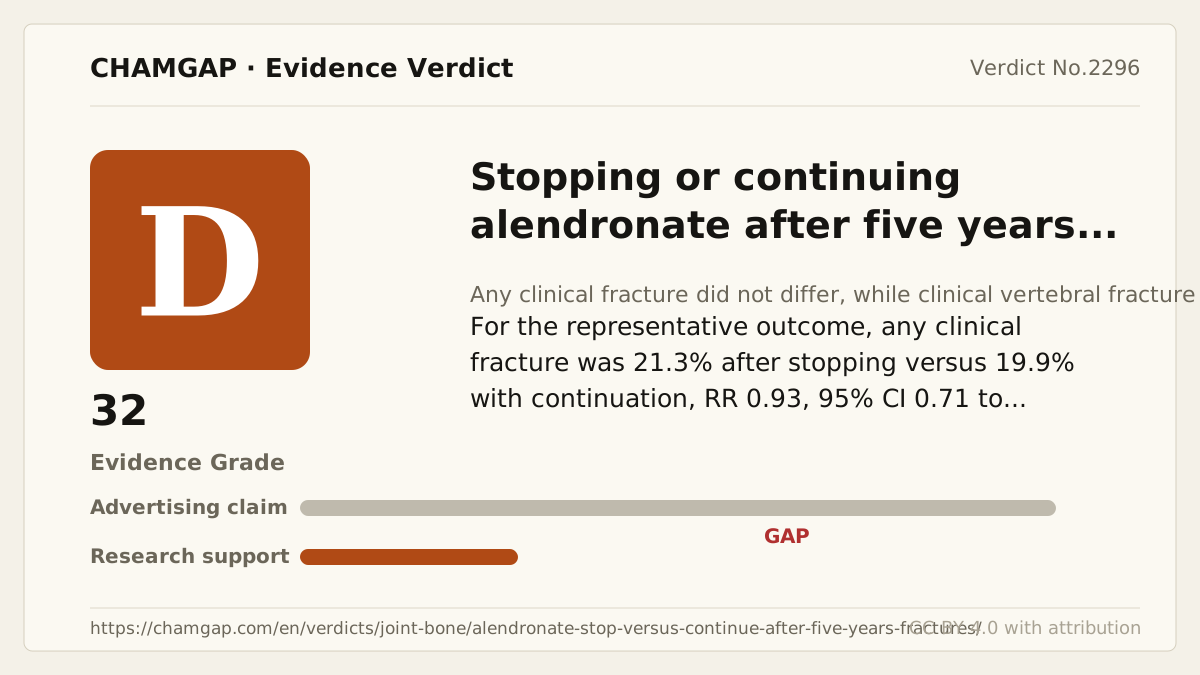
research showsThe grade is D with 30 points. In FLEX, any clinical fracture occurred in 21.3% after stopping versus 19.9% with continuation, RR 0.93, 95% CI 0.71 to 1.21, with no significant difference. Nonspine fractures were 19.0% versus 18.9%, and radiographic vertebral fractures were 11.3% versus 9.8%. Clinical vertebral fracture alone was significantly lower with continuation, at 5.3% versus 2.4%. Fractures are clinical events, but the prespecified primary endpoint was total-hip bone mineral density and fracture was exploratory.
ads claimVerdict 632 is B with 79 points for alendronate itself preventing repeat fractures in postmenopausal osteoporosis with a prior fragility fracture. This verdict asks a different question: stopping after about five years versus continuing for another five years.
Useful facts when choosing a product
- The comparison was placebo discontinuation after about five years versus five additional years of alendronate.
- The prespecified primary endpoint was total-hip bone mineral density; fractures were exploratory.
- Women with total-hip bone mineral density below 0.515 g/cm² were excluded from rerandomization.
- Follow-up was five years and 1,099 women were randomized.
Chamgap Semantic Classification Code
Candidate index · review held
UNK.stopping-or-continuing-alendronate-after-of-use.UNK.fracture-prevention-over-the-next.prevent.placeboUnknown > Stopping or continuing alendronate after of use > Unknown > Fracture prevention over the next > Occurrence-prevention claim > Placebo
An automated migration candidate, not an issued permanent code; exact claim scope remains under review. This machine-generated migration candidate helps retrieval but is not a permanent assignment. The original verdict ID and URL remain authoritative.
What the research actually shows
Any clinical fracture occurred in 93/437 (21.3%) after stopping versus 132/662 (19.9%) with continuation, RR 0.93, 95% CI 0.71 to 1.21. Nonspine fracture was 83/437 (19.0%) versus 125/662 (18.9%), radiographic vertebral fracture was 11.3% versus 9.8%, and clinical vertebral fracture was 23/437 (5.3%) versus 16/662 (2.4%); only clinical vertebral fracture was significant. Black and colleagues randomized 1,099 postmenopausal women after about five years of alendronate and followed them double-blind for five years. The prespecified primary endpoint was total-hip bone mineral density and fracture was exploratory. The paper states: “The study was supported by contracts with Merck & Co and was designed jointly by the non-Merck investigators and Merck employees. Study drug was manufactured and packaged by Merck.”
Why this is classified as D (30)
Any clinical fracture was null with an interval allowing benefit and harm, and the evidence came from a nonconfirmatory fracture analysis in one manufacturer-supported trial, giving D with 30 points.
Counterpoint. Clinical vertebral fractures were 23/437 (5.3%) after stopping and 16/662 (2.4%) with continuation. Nonspine fractures were 83/437 (19.0%) versus 125/662 (18.9%), and radiographic vertebral fractures were 11.3% versus 9.8%, both null.
Rejudgment record. Cross-check applied — Any clinical fracture at 21.3% versus 19.9%, RR 0.93, 95% CI 0.71 to 1.21; fracture-specific absolute rates; the prespecified total-hip bone-density primary endpoint and exploratory fracture analysis; 1,099 participants and five-year follow-up; and Merck contract support and joint design were applied
| Endpoint | H | Hard endpoint - actual events such as death |
| Replication | R1 | Single confirmatory trial |
| Independence | I0 | Evidence comes only from manufacturer studies |
| Effect size | E0 | Null |
| Precision | C0 | The confidence interval leaves room for benefit |
Stored derived and displayed grades match; this is not a current recalculation or validity check (D).
Sub-claim grades by effect
This ingredient is marketed for several effects. A single overall grade blends strong and weak claims together, so each effect is graded separately here. The overall grade reflects the strongest disconfirming or core claim.
| Effect (sub-claim) | Grade | Basis |
|---|---|---|
| Reduced any clinical fracture | D | Rates were 21.3% versus 19.9%, RR 0.93, 95% CI 0.71 to 1.21, with no significant difference. |
| Reduced nonspine fracture | D | Rates were 19.0% versus 18.9%, with no significant difference. |
| Reduced clinical vertebral fracture | C | Rates were 5.3% versus 2.4%, significantly lower with continuation. |
| Reduced radiographic vertebral fracture | D | Rates were 11.3% versus 9.8%, with no significant difference. |
Cross-check — AI research and Codex final gate
Evidence Table
| Study | Design | Sample | Funding | Endpoint | Result | Weight |
|---|---|---|---|---|---|---|
| Black DM et al. 2006 FLEX | Double-blind randomized discontinuation-versus-continuation trial after about five years of alendronate | 1,099 women: 437 stopped and 662 continued | The study was supported by contracts with Merck & Co and was designed jointly by the non-Merck investigators and Merck employees. Study drug was manufactured and packaged by Merck. | Primary total-hip bone mineral density; exploratory nonspine, clinical vertebral, and radiographic vertebral fractures | Any clinical fracture 21.3% versus 19.9%, RR 0.93 (95% CI 0.71 to 1.21); nonspine 19.0% versus 18.9%; radiographic vertebral 11.3% versus 9.8%; clinical vertebral 5.3% versus 2.4%, RR 0.45 (0.24 to 0.85), the only significant fracture result | Decisive single large randomized trial |
Receipt — 1 References
All 1 cited sources were verified for existence at the original page (as of 2026-08-05).
Final verification and publication gate: Codex · Evidence date: 2026-08-05 · Corrections: none
Cite this verdict
[Chamgap] Stopping versus continuing alendronate after five years x fractures — Evidence Grade D·30. 1 cited sources checked. Source: https://chamgap.com/en/verdicts/joint-bone/alendronate-stop-versus-continue-after-five-years-fractures/ · CC BY 4.0CC BY 4.0 — free to use with attribution; do not distort grades, numbers, or verdict meaning.
What this document does and does not do
Chamgap is an information source. It reports what research has and has not confirmed; it does not tell readers what to take or buy. That decision belongs to readers and, when needed, medical or legal professionals. This verdict reflects literature available up to the search date and may change as new research appears. Nothing here is medical advice.